American water is too clean
The European Union spends more on science each year than America’s National Science Foundation, but European scientific output trails the US. What can it do to fix this? To answer this question, Works in Progress is hosting an event in Brussels on 2nd March. Sign up here.
San Francisco has some of the strictest environmental rules on the planet. The city has legally committed itself to sending zero garbage to landfills by 2030 and to using 100 percent clean energy by 2040. It was among the first to ban plastic bags and new gas boilers. It has twice been named the number one city in America for clean energy.
Yet in 2019 the federal Environmental Protection Agency ordered the city to take action to limit its alleged contamination of the Pacific Ocean. In oral arguments before the US Supreme Court, the EPA’s lawyer condemned the city’s ‘decades-long failure’ to update its sanitation systems. This order came on top of an existing mandate requiring San Francisco to spend almost $11 billion, or $13,000 for every man, woman, and child in the city, updating its sewage systems.
San Francisco and other cities in a similar situation are not delinquent on sanitation. Instead, the EPA is setting water mandates that far exceed what even the most progressive cities think is necessary. These mandates drive up the cost of water, stymie housing, and burden city budgets.
Americans open a tap and get water much like their parents and grandparents did, but the price of water and sewer for households has more than doubled since the early 1980s, adjusted for inflation. American households in large cities now spend about $1,300 a year on water and sewer charges, even though per-capita use has actually decreased.
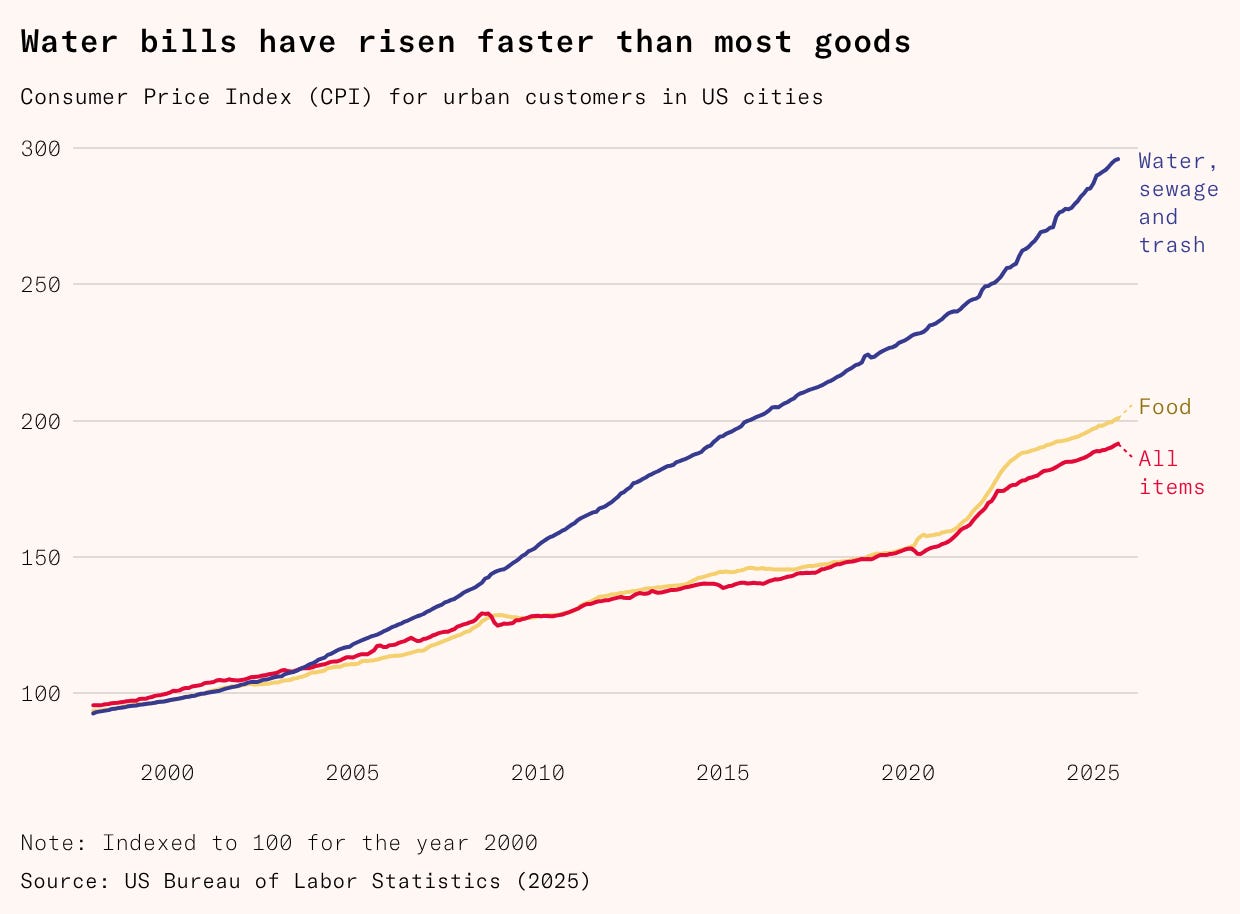
The roots of America’s water problems lie in the 1970s. Since the Clean Water Act of 1972 and the Safe Drinking Water Act of 1974, federal environmental rules have ratcheted up. Although state and local water systems had spent the previous century implementing massive improvements in water quality, national regulators treated these systems, supervised by local voters, as delinquent and needing prodding to reform.
Water policy parallels nuclear power, similarly forcing operators to reduce risks, no matter how trivial, and increasing costs to the point where nuclear is expensive and seldom used. This is another example of ‘safetyism’, the tacit ideology that the government’s main goal
...This excerpt is provided for preview purposes. Full article content is available on the original publication.