MAGA’s Affordability Crisis Will Soon Get Worse
Deep Dives
Explore related topics with these Wikipedia articles, rewritten for enjoyable reading:
-
Affordable Care Act
13 min read
The article's central policy discussion revolves around ACA subsidies expiring and their political consequences. While readers may know Obamacare exists, the legislative history, structure of subsidies, and premium subsidy mechanisms are technical details most readers don't deeply understand.
-
Welfare's effect on poverty
14 min read
Krugman discusses means-tested benefits, voting behavior of recipients, and whether people recognize government aid. This article provides empirical context on how welfare programs affect poverty and public perception, directly relevant to Mettler's research cited in the piece.
Long ago, probably in a long-forgotten hotel room, I watched a 1974 movie called The Internecine Project — now available, as you’ll see if you follow the hyperlink, on YouTube. In truth, it’s a pretty bad movie. But what made it memorable was the unusual nature of the villain, played by James Coburn: An evil, murderous chair of the President’s Council of Economic Advisers. Yes, you read that correctly – an evil, murderous chair of the CEA.
In the opening scene, Coburn is on a talk show, being quizzed about the high rate of inflation. He responds that people shouldn’t be upset about rising prices, because their incomes are rising even faster. Presumably the scriptwriters intended this to show how smarmy and cynical he is.
And that’s why Donald Trump won the 2024 election. No, Democrats didn’t lose because they use big words, or advocate for open borders, or talk too much about trans rights. None of those things actually happened to any significant degree, regardless of what Trump or the self-defeating wing of the Democratic Party says. They lost because Americans were angry about higher prices and not mollified by the fact that most people’s wages had risen more than overall consumer prices. In this coming Sunday’s primer, I’ll talk more about the underlying economics of the affordability issue, and in the following primer I’ll talk about specific strategies for Democrats to adopt to address it.
But what I want to focus on today is the politics of affordability. As current polls show, swing voters are increasingly blaming Trump, rather than Biden, for the cost of living. And the public’s ire is likely to get worse for the Republicans as time goes on.
In the summer of 2024, as Trump was lagging in the polls behind Kamala Harris, he began to repeatedly and explicitly promise not simply to reduce inflation but to deliver large declines in consumer prices: “Starting the day I take the oath of office, I will rapidly drive prices down.” Although economists warned that there was no way he could deliver on those promises, enough voters believed him to swing the election.
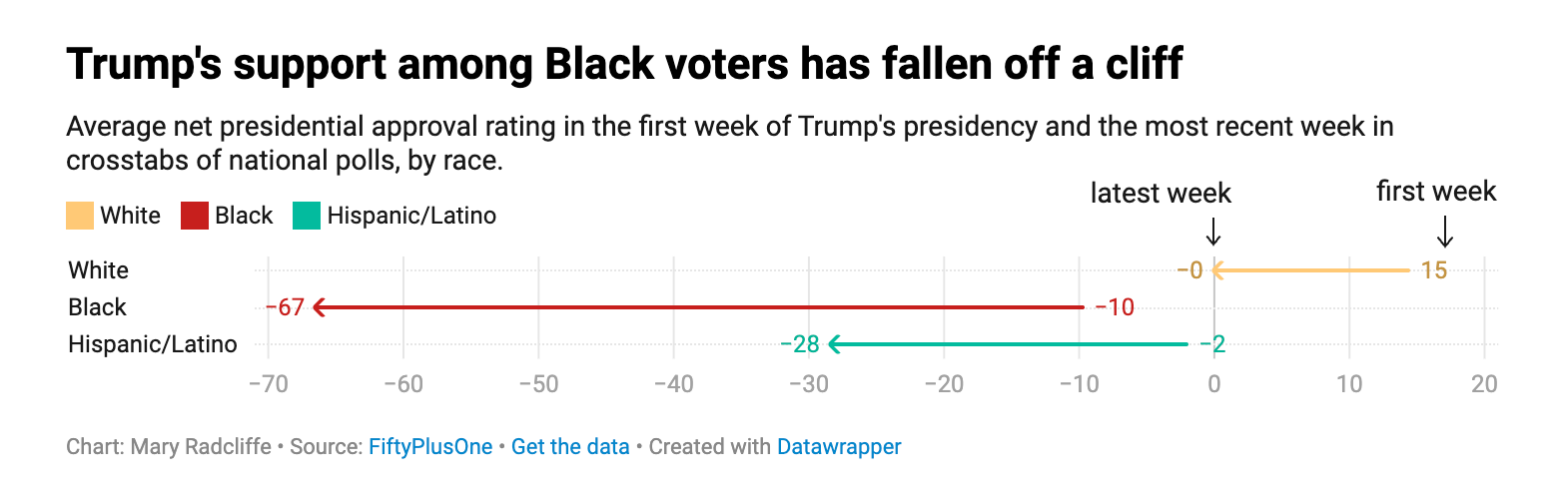
Now that Trump has in fact utterly failed to deliver, those voters — especially those Black and Latino voters who believed him — have swung back to the Democrats with a vengeance:
Trump is handling this reversal with his usual style and grace:
...This excerpt is provided for preview purposes. Full article content is available on the original publication.