The fly can escape when it realises it is the spider
Deep Dives
Explore related topics with these Wikipedia articles, rewritten for enjoyable reading:
-
Clifford Geertz
13 min read
Linked in the article (18 min read)
-
Moloch
14 min read
The article extensively references Moloch as a metaphor for destructive competitive logic, including a creative dialogue with Moloch as a therapy patient. Understanding the ancient deity and its modern philosophical usage (especially via Scott Alexander's 'Meditations on Moloch') would enrich the reader's grasp of this central metaphor.
-
Iatrogenesis
11 min read
The article explicitly uses 'iatrogenic' to describe the old lady's death, noting that 'the solution is often the problem.' This medical concept about harm caused by treatment is used metaphorically throughout the piece and understanding its full scope would deepen appreciation of the article's thesis.
We are the web, the spider spinning it, and the fly that gets caught there. The fly can only escape when it realises it is the spider. The spider can only escape when it realises it is the fly. The web abides.
There was an old lady who swallowed a fly. We don’t know why, but it seems likely that it was an accident. The spider, however, was a choice. Following a subsequent series of questionable decisions, the lady ate a horse. She’s dead, of course.1
The coroner’s report was tactful, simply stating that the cause of death was iatrogenic.2 The solution is often the problem. He noted that further research is required on the relationship between flies and spiders.
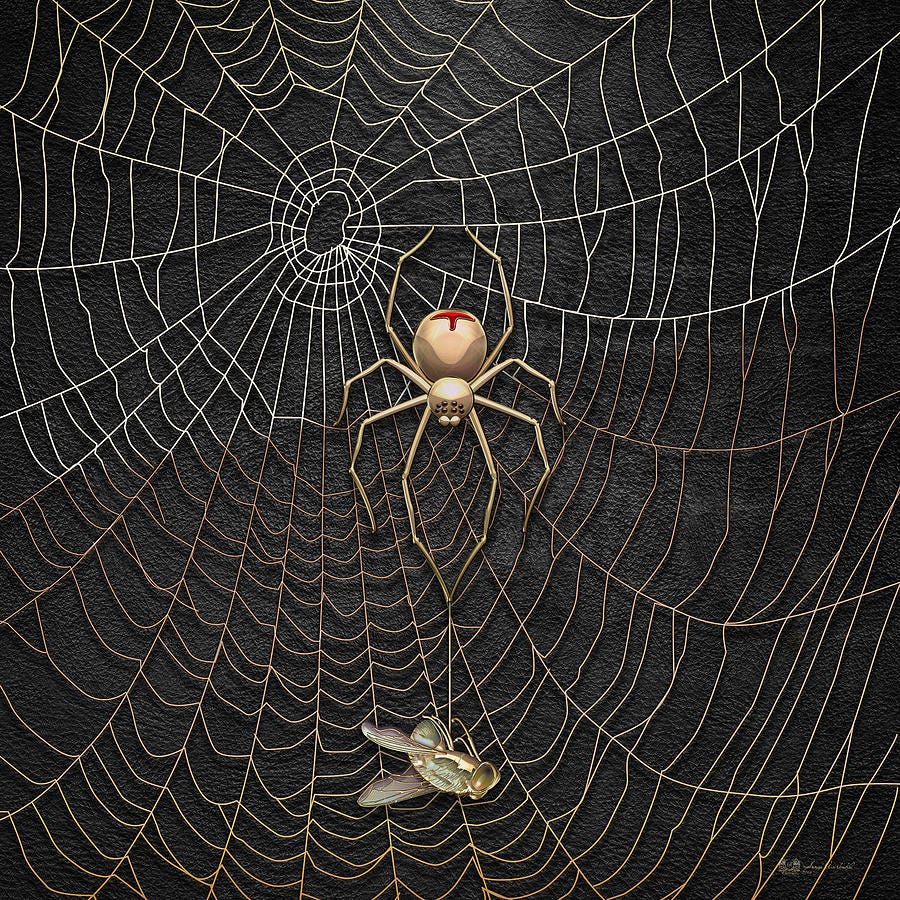
The cultural anthropologist Clifford Geertz once said “Man is an animal suspended in webs of significance that he himself have spun”. He’s giving a nod to biology, but talking of culture, and he makes us all sound like spiders and flies. Figuratively speaking, maybe we are.3
When we are the fly with the gift of flight, rendered trapped and helpless, the spider may appear to be an ominous object outside of us (perhaps capitalism, the state, or our mortality), but in a deeper sense, we are co-constituted and bring the spider into being.
As the spider, the fly is our livelihood, our sustenance, not quite our raison d’être, but it will become part of us; yet we don’t tend to identify with the fly, despite consisting of digested flies.4
If the web were to speak, it might say something like: “I take no sides. I come from the spider, but I serve nature by holding the fly.”
The fly may not feel so dispassionate.
Yet what is actually present is a spider-web-fly, and all that gave rise to them and all that situates them. Ecologically speaking, and spiritually too, thou art all of that.
We can meet with other flies on the web - other individuals in culture - and collectively lament the spider, but we are more likely to free ourselves if we start by asking: what exactly is this web, and how did we become part of it? If this is not my DNA, is it at least my amino acids? Did I consent to this?
We appear to live as subjects in a world of objects, and sometimes we feel agentic
...This excerpt is provided for preview purposes. Full article content is available on the original publication.