Why GenAI is Good for Google
For the last year, one of the most persistent narratives in tech has been that generative AI will make Google Search obsolete.
After all, if an AI can answer your question directly, why click on a link? And if nobody clicks, Google’s ad business collapses. Right?
But Google’s earnings tell a different story. Revenue is up. Search is up. GenAI features are additive to usage and revenue.
So what’s really going on?
Google’s Core Business
To answer that, it helps to step back and look at what Google actually is. The company can be thought of as operating three distinct business:
Information (Search and other apps, monetized primarily through advertising)
Entertainment (YouTube, also ad‑driven but with subscriptions too)
Cloud Computing
A fourth is emerging too:
Transportation (Waymo, a bet on the future)
Let’s focus on the information business, and specifically on search — Google’s oldest and most profitable segment, and the one most often assumed to be in existential danger from GenAI.
JTBD
The job-to-be-done is simple: answer my question.
The user asks a question, Google delivers the best answer, and advertisers pay to appear alongside those answers.
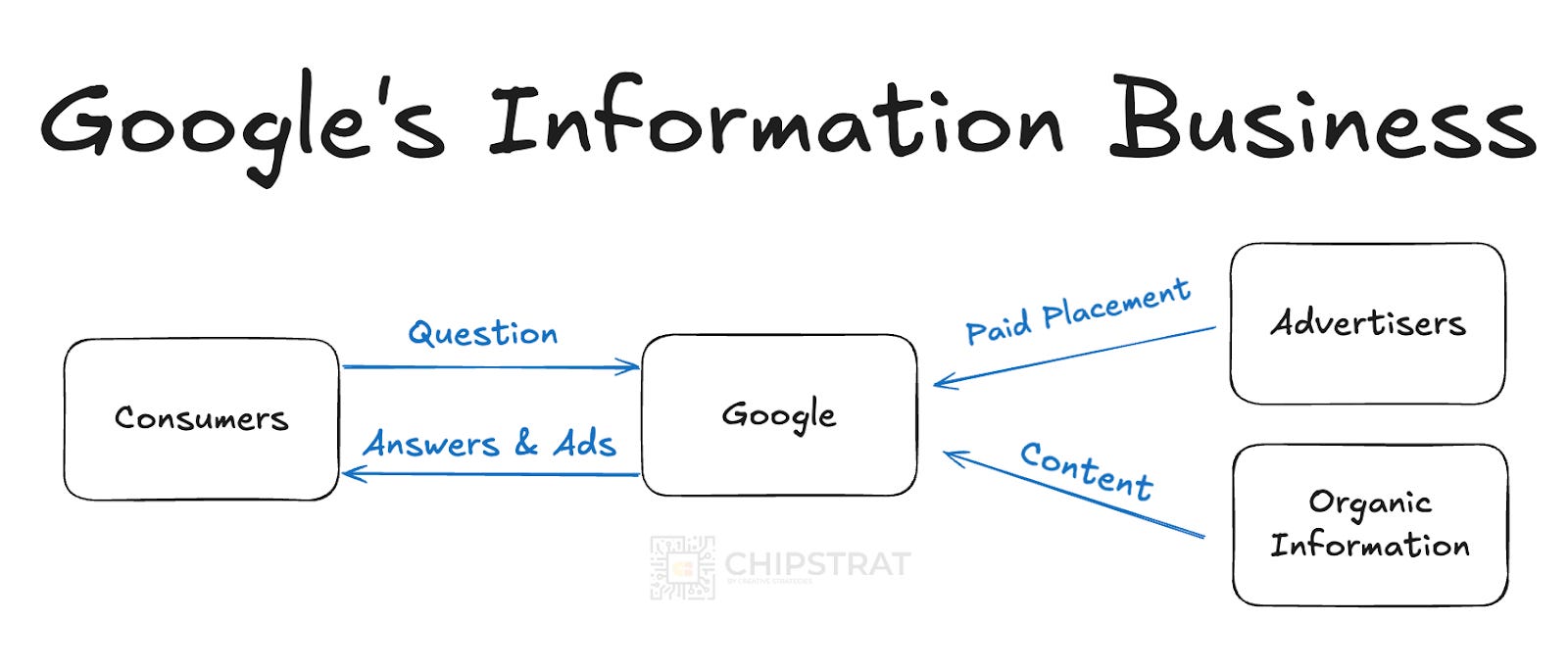
Historically, this answer took the form of “10 blue links”, with ads sold for the most prominent spots.
The “GenAI ends Search” narrative assumes that generative answers replace the 10 blue links with a static box of text — something like a ChatGPT answer that eliminates the ads and often all links.
But that assumption jumps straight to a solution without first discussing the problem. What problem is Search solving for its stakeholders, and how can GenAI help solve it better? Are we sure that ChatGPT answers are the best UX for all stakeholders?
Let’s start with Google’s pre-Generative AI solution first. This search experience has friction for users, advertisers, and Google itself.
GenAI makes the experience much better, all around.
Friction Within Google’s Current UX
For users, the pain often starts with intent. Does Google understand what you are asking for?
Paradoxically, the longer and more detailed the search prompt, the worse the results often get because more keywords match more content. That is the opposite of what you would expect! More context should help Google better understand your intent, right?
Search operators were introduced to bridge this gap, but they are a clunky workaround from computer
...This excerpt is provided for preview purposes. Full article content is available on the original publication.