Ukraine’s Conventional Long-Range Strike Forces at the end of 2025
Deep Dives
Explore related topics with these Wikipedia articles, rewritten for enjoyable reading:
-
Tomahawk missile
12 min read
The article discusses cruise missile technology extensively, including TERCOM guidance and land-attack capabilities. The Tomahawk is the archetypal modern cruise missile that established many design principles referenced in the article, providing essential context for understanding Ukraine's indigenous missile development efforts.
-
TERCOM
14 min read
The article specifically mentions TERCOM as a key guidance technology for cruise missiles operating in GPS-denied environments. This Cold War-era navigation innovation remains crucial for modern cruise missile survivability and accuracy.
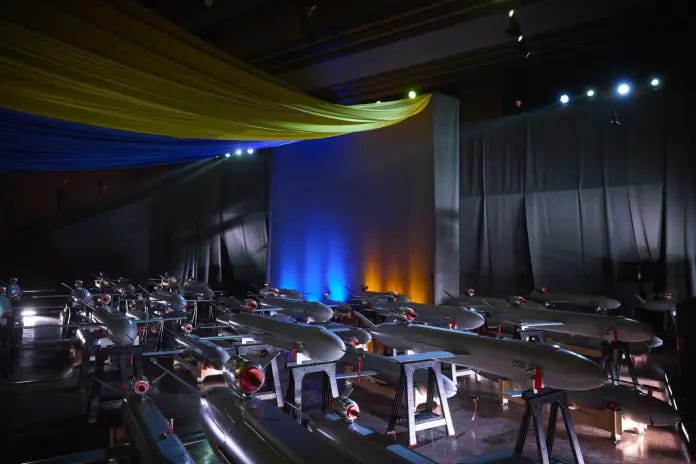
Picture: Office of the President of Ukraine
Around this time last year, I reviewed Ukraine’s newest additions to its conventional long-range strike arsenal. One year later, Ukraine’s missile and long-range drone capabilities have expanded and diversified further. In addition, more reliable information is now available on the capability profiles of Ukraine’s conventional long-range strike weapons employed throughout the war.
This post offers an updated 2025 overview of Ukraine’s conventional long-range strike arsenal, including all confirmed missile and long-range drone systems with ranges of 150 kilometers or more. Programs based on speculation or lacking sufficient public data are excluded.
Missile categorization
I group Ukraine’s conventional long-range strike weapons into three categories: heavy, medium, and light one-way effectors.
Heavy effectors deliver large payloads, defined here as 200 kilograms or more, enabling them to credibly threaten a wide range of targets in single strikes. Their main drawback is that these systems are often more expensive and complex to manufacture than lighter alternatives.
Medium effectors carry smaller but still substantial payloads, defined here as 100 to 200 kilograms. They deliver significant destructive power, but are generally less lethal than their heavier counterparts, especially against structurally hardened targets. Several systems in this category are sometimes described as “missile drones”, though that term is misleading. Based on their specifications, “mini-cruise missile” is more accurate, since they share most characteristics with traditional cruise missiles but are generally smaller than many pre-war designs.
Light effectors have a payload capacity below 100 kilograms. This greatly reduces their lethality against hardened targets, and the small lethal radius often makes it difficult to compensate for terminal inaccuracies. That said, these systems are relatively easy to produce and affordable.
Key trends at the end of 2025
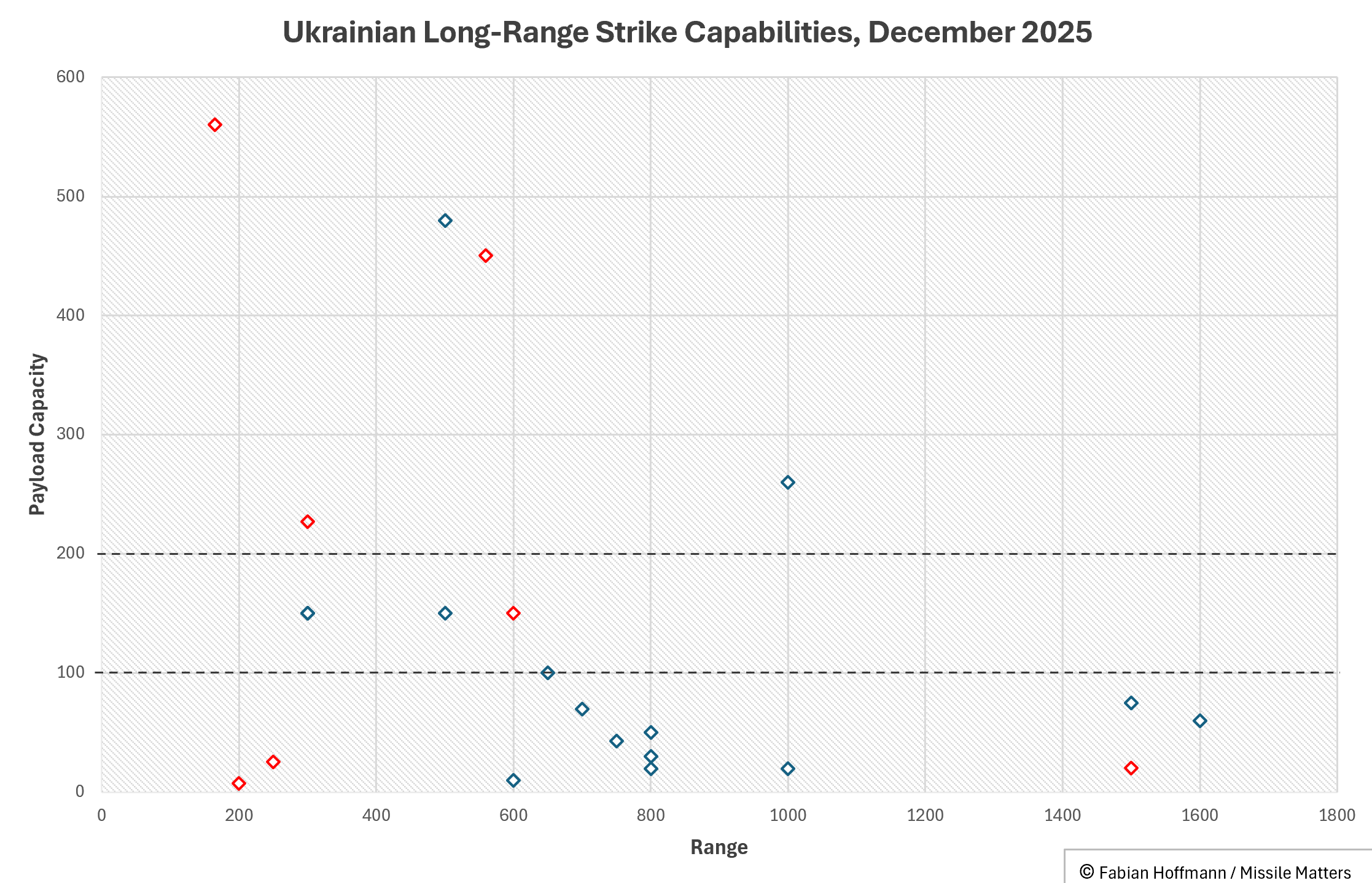
The image above provides an overview of Ukraine’s conventional long-range strike arsenal at the end of 2025 by plotting individual missile and long-range drone systems according to their range and payload capacity. Imported systems are indicated in red; indigenously produced ones in blue. For readability, the graph omits the FP-5 “Flamingo”, which is an outlier due to its outsized payload and range (1,150 kilograms and 3,000 kilometers), but it is discussed below.
Note that these two variables alone reveal little about survivability or accuracy. They do, however, offer basic insight into the types of targets these systems can reach and destroy.
At the end of 2025, the vast majority of Ukraine’s conventional long-range strike weapons will
...This excerpt is provided for preview purposes. Full article content is available on the original publication.