When Broadcom’s Customers Start Buying Chip Startups
Deep Dives
Explore related topics with these Wikipedia articles, rewritten for enjoyable reading:
-
Application-specific integrated circuit
12 min read
The article centers on XPUs (custom AI accelerators), which are ASICs designed for specific workloads. Understanding the ASIC design process, economics, and trade-offs versus general-purpose chips provides essential context for why hyperscalers are investing billions in custom silicon rather than buying off-the-shelf GPUs.
-
Fabless manufacturing
12 min read
Broadcom operates as a fabless semiconductor company, designing chips but outsourcing manufacturing. This business model is central to understanding how Broadcom can partner with multiple hyperscalers simultaneously and why acquiring startups like Rivos or SambaNova gives customers design talent but not fabrication capability.
-
Vertical integration
15 min read
The article's core question is whether hyperscalers acquiring chip startups will disintermediate Broadcom—a classic vertical integration decision. Understanding the economic theory, historical examples, and trade-offs of bringing suppliers in-house illuminates why companies like Meta and Oracle are considering this strategic shift.
While we’ve recently discussed Marvell XPUs, Broadcom is the undisputed XPU darling of the semiconductor industry.
After all, remember when Hock Tan dropped this bombshell last December in the Q4 24 earnings call?
Hock Tan: As you know, we currently have 3 hyperscale customers, who have developed their own multi-generational AI XPU road map to be deployed at varying rates over the next 3 years.
In 2027, we believe each of them plans to deploy 1 million XPU clusters across a single fabric.
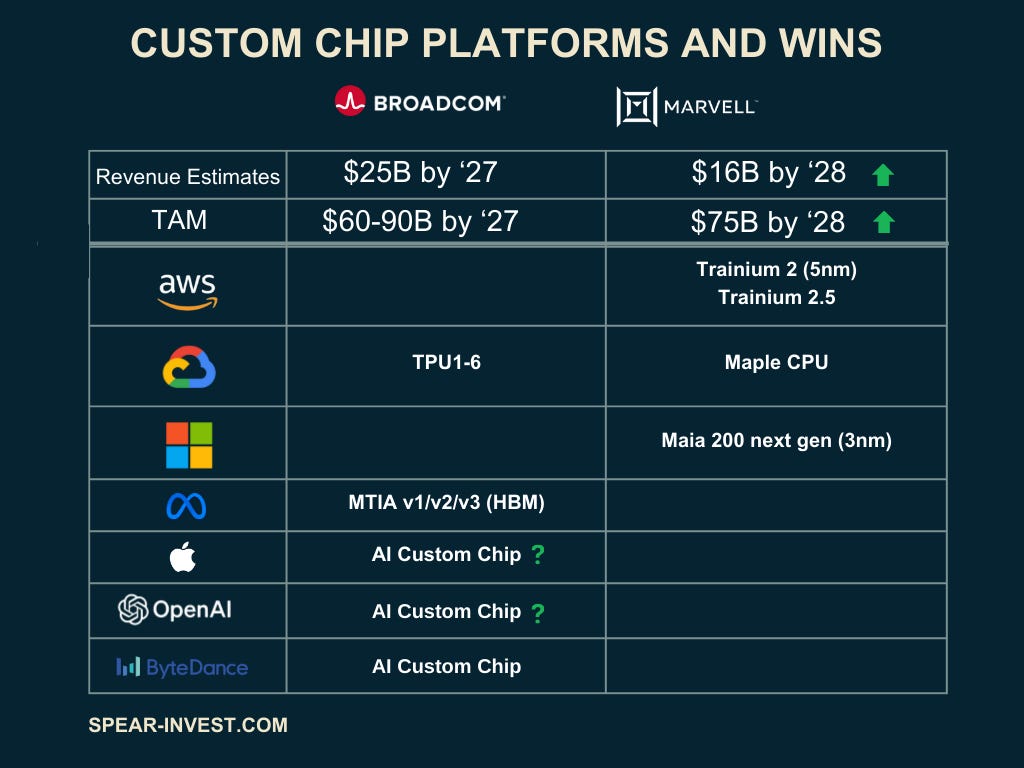
We expect this to represent an AI revenue serviceable addressable market, or SAM, for XPUs and network in the range of $60 billion to $90 billion in fiscal 2027 alone.
Wall Street loved it.

And just a quarter later, Q1 25 earnings call in March,
Hock Tan: Beyond these 3 customers, we had also mentioned previously that we are deeply engaged with 2 other hyperscalers in enabling them to create their own customized AI accelerator. We are on track to take out their XPUs this year.
In the process of working with the hyperscalers, it has become very clear that while they are excellent in the software, Broadcom is the best in hardware. Working together is what optimizes via large language models.
It is, therefore, no surprise to us.
I love Hock’s confidence. He continued,
Hock Tan: Since our last earnings call that 2 additional hyperscalers have selected Broadcom to develop custom accelerators to train their next-generation frontier models. So even as we have 3 hyperscale customers, we are shipping XPUs in volume today, there are now 4 more who are deeply engaged with us to create their own accelerators. And to be clear, of course, these 4 are not included in our estimated SAM of $60 billion to $90 billion in 2027.

Who are these customers? Rumor has it they are Google, Meta, and ByteDance.
And back in September there was rumor OpenAI would become an official customer, from CNBC:
...While Broadcom doesn’t name its large web-scale customers, analysts have said dating back to last year that its first three clients were Google, Meta, and TikTok parent ByteDance.
“During the call, the company surprised us by noting that it had secured a $10B order from a fourth XPU customer (we believe this is OpenAI), adding significant upside to the company’s three current XPU customers (Google, Meta, and ByteDance),”
This excerpt is provided for preview purposes. Full article content is available on the original publication.