Roundup #77: The Fix-Everything Button
Welcome to another roundup of interesting news and events from around the econosphere, from my traditional, 100% handcrafted human-written blog.
First, here’s an episode of Econ 102 for you! As regular readers know, Econ 102’s regular run has ended due to my co-host getting extremely busy with his new job. But we will still come out with an episode every now and then. This episode is about how cameras can improve public safety — and whether they should:
Anyway, on to this week’s list of interesting things.
1. Fixing public spaces is actually pretty easy
The Bay Area Rapid Transit system (BART) is in a parlous state. Ridership has plummeted in recent years; it did not even come close to fully bouncing back after the pandemic.
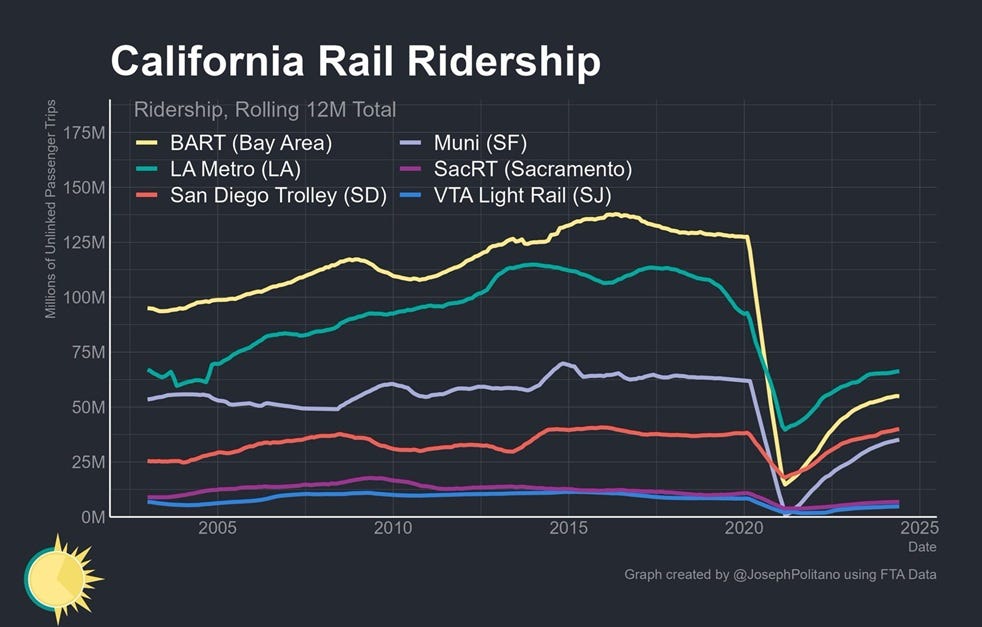
If BART doesn’t get bailed out with higher taxes, it will have to close stations, reduce service, and lay off workers.
Why did so many people stop riding BART? It’s possible that the pandemic permanently shifted people’s tastes; maybe people just got used to taking Uber or driving instead of using the train. But it’s also possible that the general increase in public disorder in the Bay Area just made BART unacceptable as a mode of transportation. It seemed like every train had its share of shady characters, drug users, vagrants, and the mentally ill.
For a long time, everyone talked about this, but no one had the hard evidence to prove it. Well, now we do. After BART installed fare gates last year at many of its stations, crime on the trains plummeted by 54% in a single year.1 What’s more, the amount of time that BART employees have to spend on “patron related Corrective Maintenance” — i.e., fixing or cleaning up things that riders break or defile — went from huge amounts to almost nothing:
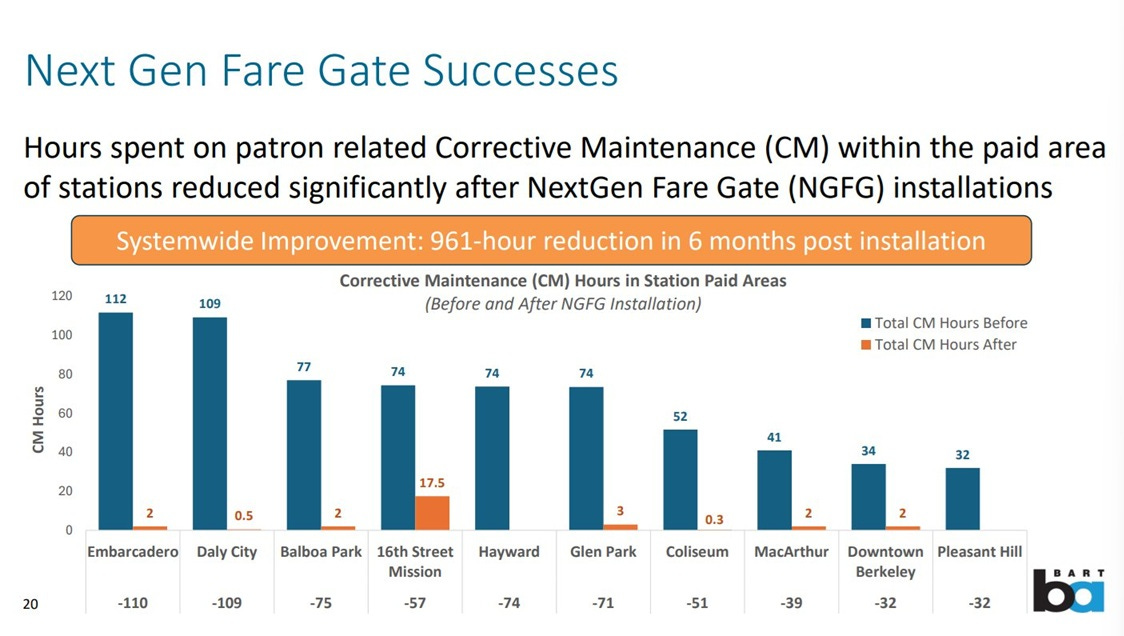
It turns out that just a few riders were causing most of the disorder on the BART — and those riders were mostly not paying their fares, since the fare gates were effective in stopping them.
This demonstrates a general principle: You only have to restrain a very small number of people in order to maintain public order.
Progressives often argue against measures like fare gates, labeling them “carceral” and “racist”. This demonstrates a principle that I call anarchyfare — the idea that eliminating society’s rules serves
...This excerpt is provided for preview purposes. Full article content is available on the original publication.