The Yukon’s Most Important Piece of Infrastructure Is a Plastic Blue Jug
Deep Dives
Explore related topics with these Wikipedia articles, rewritten for enjoyable reading:
-
Whitehorse
4 min read
Related to "The Yukon’s Most Important Piece of Infrastructure Is a Plastic Blue Jug" (25 min read)
-
Cabin Boy
5 min read
Related to "The Yukon’s Most Important Piece of Infrastructure Is a Plastic Blue Jug" (6 min read)
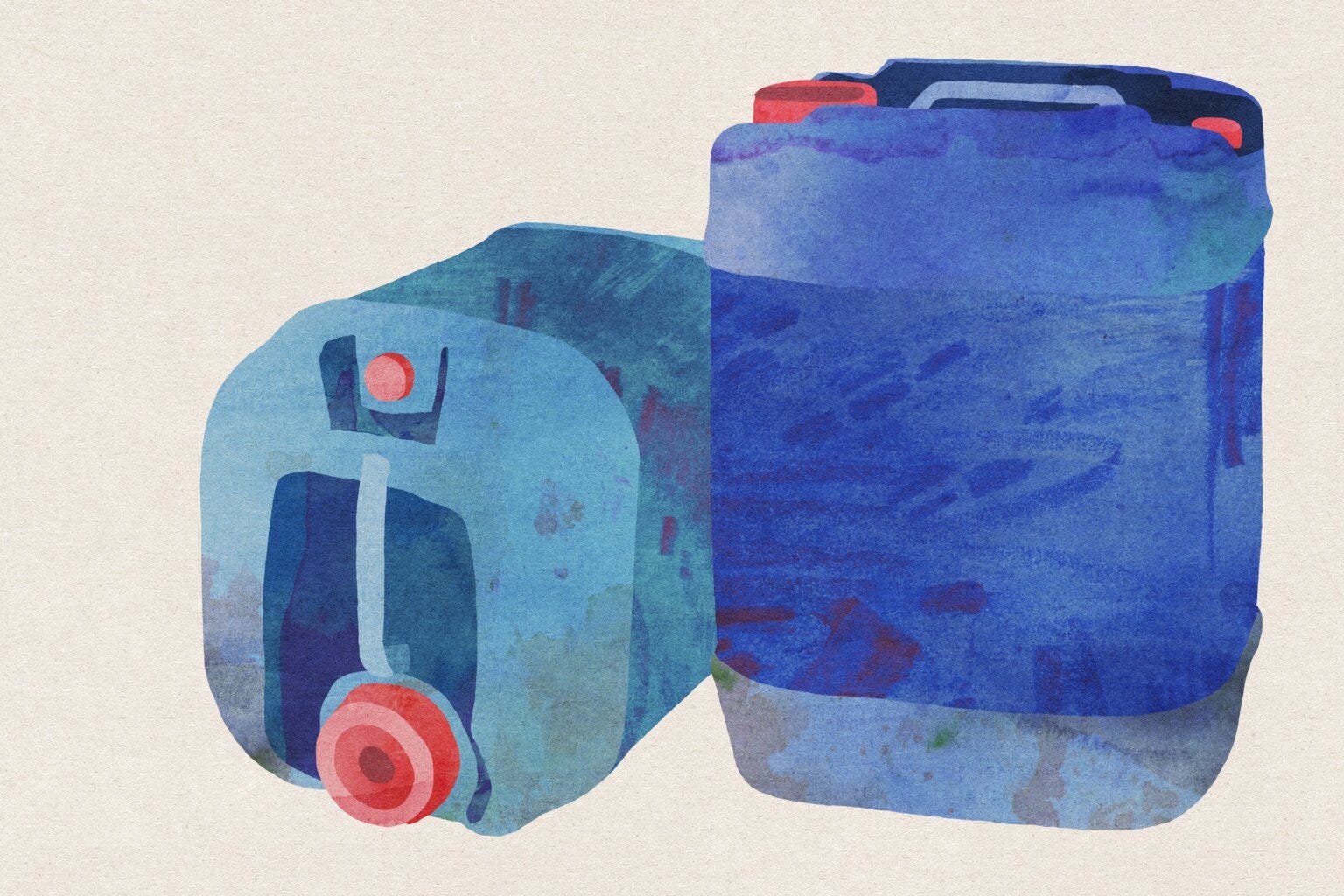
Illustration by Julieta Caballero
This story was originally published on thewalrus.ca
By Trina Moyles
I open the faucet and water gushes out, frothing as it fills a bright blue twenty-litre plastic jug, its faded sticker declaring BUILT TOUGH. You’ve probably seen one in the outdoors aisle at Canadian Tire: a cubic jug with a red or white screw-top faucet and a built-in handle for convenience. Most Canadians would associate the blue jug with camping trips.
I’m lugging six twenty-litre blue jugs in the back of my truck to my permanent residence outside of Whitehorse, a dwelling without running water known as a “dry cabin.” These 120 litres will last myself and my partner—and our three dogs—just over a week. On average, individual Canadians use 223 litres of water a day. For us, it rounds down to just under nine.
Yukoners call us “blue juggers,” or that we’re “blue-jugging it”; the lifestyle is both a noun and a verb. We use an outhouse, even at minus forty, and shower opportunistically at my in-laws’, the cross-country ski club, or a corner gas station.
In the Yukon, a territory of 47,170 people, we belong to a fringe demographic for whom the blue jug isn’t recreational but an essential vessel. It’s difficult to say how many of us exist. Some dry cabins have formal rental agreements. Many, ourselves included, don’t count on paper but, instead, rely on handshake deals.
While modern life is built for convenience, and artificial intelligence works to erode away human labour, the blue jug stands in stark opposition. A tool of utilitarian labour, of measuring out a vital resource and valuing every last drop, the blue jug means something to Yukoners. It’s described with love and resentment, it shows up in art, it’s stitched onto wedding quilts.
I’ve learned to keep empty blue jugs in the back of my truck, always ready for the inevitable invitation to fill them. When friends invite us over for dinner, they offer a hot shower or a load of laundry. Several of them know the ritual well: they’ve lived the blue-jug rite of passage themselves before finding a way onto the grid. Sometimes I feel acutely self-aware, a forty-year-old woman filling blue jugs in a friend’s bathtub. But in the Yukon, there’s nothing strange or taboo about it. If anything, it’s a measure of intimacy, a yardstick for the depth of friendship.
The humble
...This excerpt is provided for preview purposes. Full article content is available on the original publication.