Flamingo Cruise Missile Sees First Combat Use - What Does it Say About the Missile's Effectiveness?
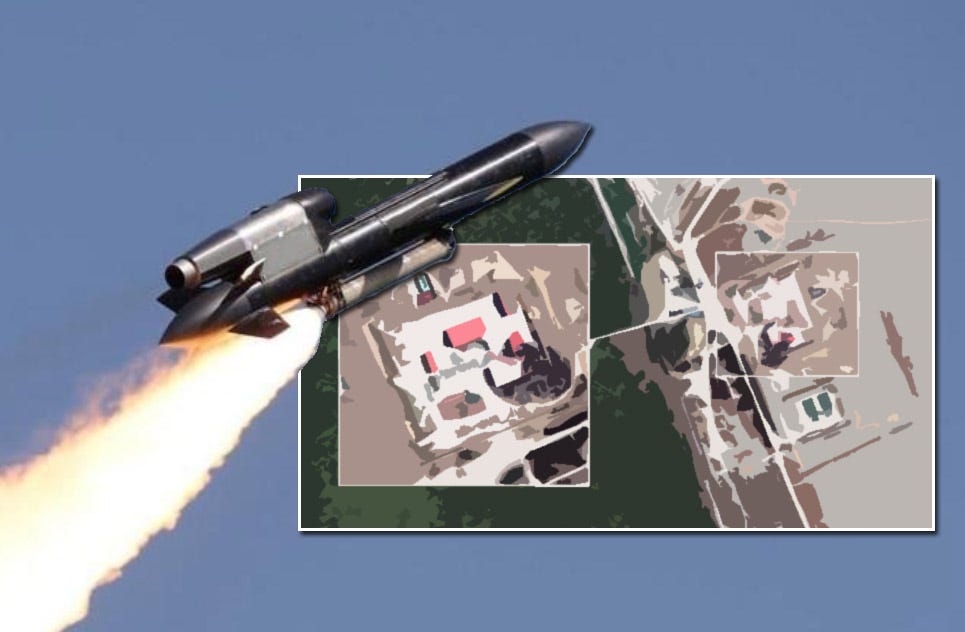
Picture: Fire Point and Hartpunkt
Yesterday evening, high-resolution imagery of the first reported strike by Ukraine’s FP-5 Flamingo cruise missile was released. This post provides an initial battle damage assessment and considers whether the Flamingo lived up to its hype.
Battle Damage Assessment
According to official information, three Flamingo cruise missiles were used in the attack. This aligns with earlier video footage showing three launches unmistakably identified as Flamingo cruise missiles by their characteristic S-curved launch pattern, use of a large solid-fuel booster, and visible top-mounted engine.
The target of the missile strike was an FSB outpost in Armyansk, Northern Crimea, about 100 kilometers southeast of Kherson.
High-resolution satellite imagery shared on social media shows two impacts inside and near the outpost. One missile struck the main building complex, causing significant damage to at least one structure.
The second impact occurred about 200 meters west of the main building complex along the shoreline. The warhead appears to have detonated in the water, cratering the shoreline and burning the surrounding area. No visible damage to nearby infrastructure is evident. However, given the substantial blast radius of a 1,150-kilogram payload, it is not implausible that the strike inflicted light to medium damage on hovercraft and small vessels that were located 80 to 100 meters away at the time of the attack.
In both cases, the warhead detonations created craters with a diameter of 13 to 15 meters, demonstrating the significant punch delivered by the Flamingo.
The fate of the third missile remains unknown. It may have been intercepted midair, either kinetically by Russian missile defenses or non-kinetically through GPS jamming that caused it to veer off course. Another possibility is a systemic failure within the missile itself, preventing it from reaching the target area without outside interference.
It is also unclear why the outpost was chosen as the target, though its location suggests that Ukraine’s armed forces may have been primarily interested in testing the missile’s capabilities. Because the missiles did not need to penetrate deep into Russian-controlled territory, Ukrainian staff were likely able to observe performance parameters under relatively favorable conditions.
In this sense, the strike may have served as a proof of concept for the system, allowing an initial assessment of the missile’s capabilities and suitability.
Observed accuracy and performance of the Flamingo cruise missile
The strike also provides some insight into the missile system’s accuracy. This being said, estimating
...This excerpt is provided for preview purposes. Full article content is available on the original publication.