States with Clean Energy Mandates Have Higher Rate Increases
Deep Dives
Explore related topics with these Wikipedia articles, rewritten for enjoyable reading:
-
Renewable portfolio standard
9 min read
The article discusses clean energy and renewable energy mandates extensively but doesn't explain the policy mechanism itself. Understanding how RPSs work—their structure, compliance mechanisms, and renewable energy certificates—would give readers deeper insight into why these mandates affect utility costs.
-
Electricity pricing
10 min read
The article focuses on rate increases and electricity prices but assumes readers understand how electricity pricing works. This Wikipedia article explains the complex factors that determine electricity costs, including generation, transmission, distribution, and regulatory structures.
As an interesting follow-up to last week’s post on rate increases filed by regulated utility companies, we discovered something that further supports the fact that clean energy mandates lead to higher electricity rates.
Specifically, states with clean energy and renewable energy mandates have sought 32 percent higher rate increase requests since 2020 than states without mandates—and mandate states have higher electricity prices as a result, which are growing at almost double the rate as no mandate states.
For simplicity, we will refer to the different states as “mandate states” and “non-mandate states.”
Here’s a look at what we found.
Background on Mandate vs. No Mandate States
According to S&P Global data, companies in 46 states have filed electric rate increase requests from 2020 through 2025, with 23 filed in states with clean energy or renewable energy mandates, or both, and 23 filed in states without. For our analysis, we considered states with voluntary goals and those that have reached their targets as non-mandate states.1
As of August 2025, 28 states and Washington, D.C., had renewable energy mandates, which are frequently carve-outs for wind and solar generators, and 16 states had layered on an additional 100 percent carbon-free electricity mandate, which often includes nuclear power, large hydroelectric providers, geothermal, and carbon capture and sequestration as part of a larger suite of low or zero-carbon technologies.
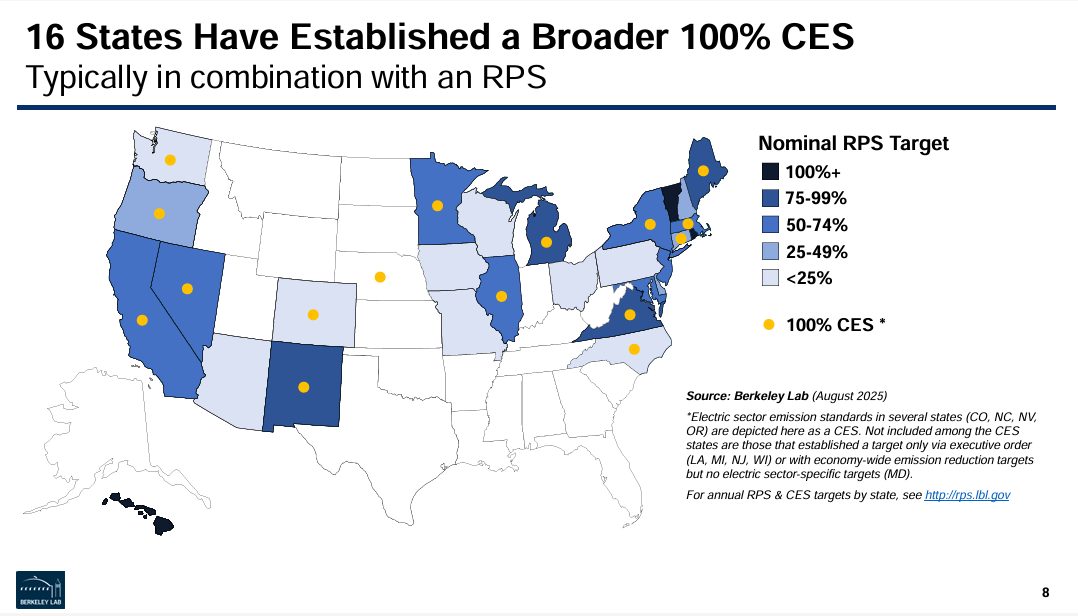
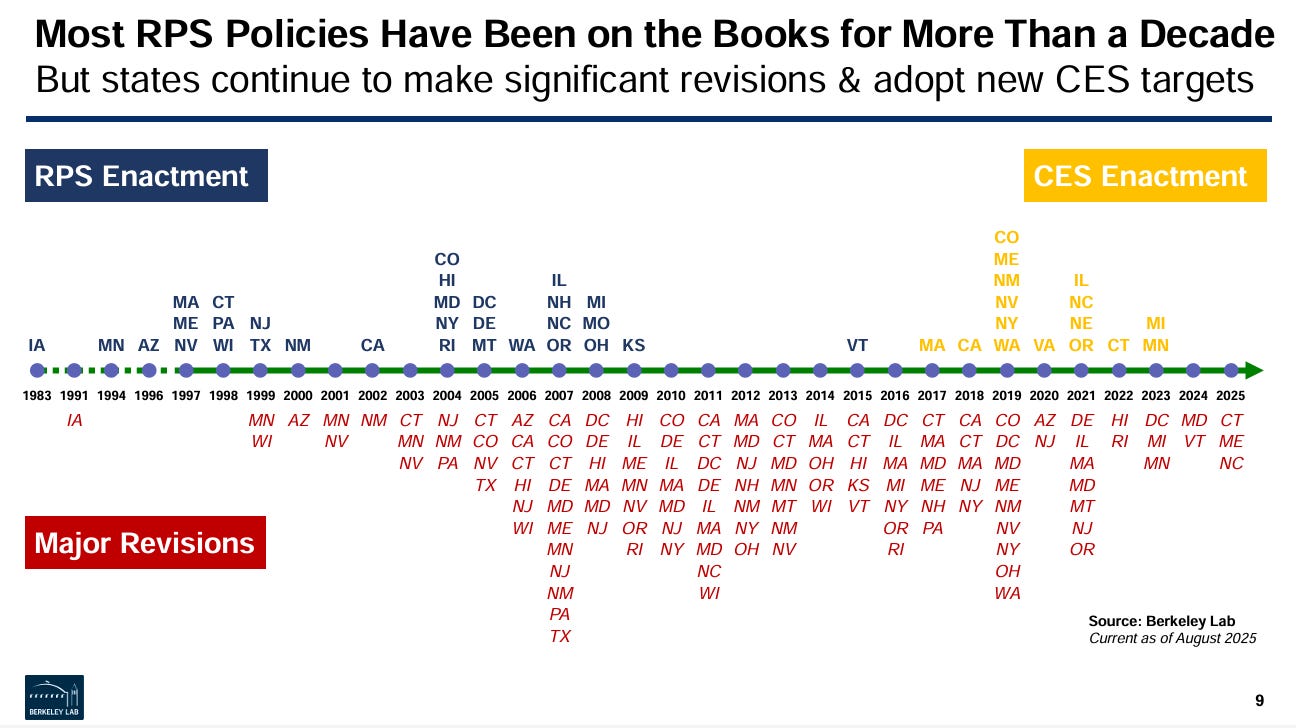
According to LNBL, Massachusetts was the first state to enact a 100 percent carbon-free electricity mandate in 2017, followed by California in 2018, and 14 other states followed suit in the subsequent years, as you can see in the graph below.
Notably, there is a strong correlation between states with 100 percent carbon-free or renewable electricity mandates and political partisanship: 14 of the 19 states—74 percent—are reliably “blue,” having voted for the Democratic candidate in each of the last two presidential elections; 2 are purple, voting for the Democratic candidate in 2020 and Republican in 2024; and 2 are red, voting for the Republican candidate in 2020 and 2024.
The relative recency of these policies means that rate increase requests stemming from building the infrastructure needed to comply with these mandates (or the purchase of required renewable/clean energy certificates) are only just beginning.
Some might be tempted to dismiss the difference in rate requests as a function of population and load growth, but this does not appear to be the case.
Population and Load Growth
...This excerpt is provided for preview purposes. Full article content is available on the original publication.