Why CDC health data are still reliable
Deep Dives
Explore related topics with these Wikipedia articles, rewritten for enjoyable reading:
-
Federalism in the United States
13 min read
The article's central thesis rests on the decentralized, bottom-up structure of U.S. public health data collection. Understanding the constitutional framework of federal-state relations explains why states have authority over their own health data and can choose whether to share with CDC.
-
Wastewater-based epidemiology
11 min read
The article mentions WastewaterSCAN and Biobot as alternative non-federal data sources. This emerging surveillance method represents a significant shift in how disease tracking can occur independently of traditional healthcare reporting systems.
Back in February (a lifetime ago), when data were being edited under Executive Orders and all CDC communications were effectively frozen, I outlined four scenarios that would signal real cause for concern about CDC’s information. Two of them have now unfolded in the past month:
The breach of scientific integrity, for example, the autism and vaccines site along with other less publicized changes.
The injection of political messaging into HHS channels.
Never did I think I would see it, but here we are.
The full extent of the damage is still unclear, and how much more may occur remains unknown. But one question stands out: what is the integrity of the data itself? Public health data—the public information used to estimate disease, hospitalization, and death rates, for example—are a vital resource. Their value lies in their purity, reliability, accuracy, and accessibility.
Despite everything, I remain confident in CDC data. This largely stems from the U.S. public health system’s unconventional, decentralized structure. A pain in the butt fragmented system for epidemiologists, but one that now works to our advantage.
Hannah, the YLE Community Manager, pulled the top six questions you’ve been asking so we can provide answers. Here’s where things stand.
1. Why can we still trust CDC data?
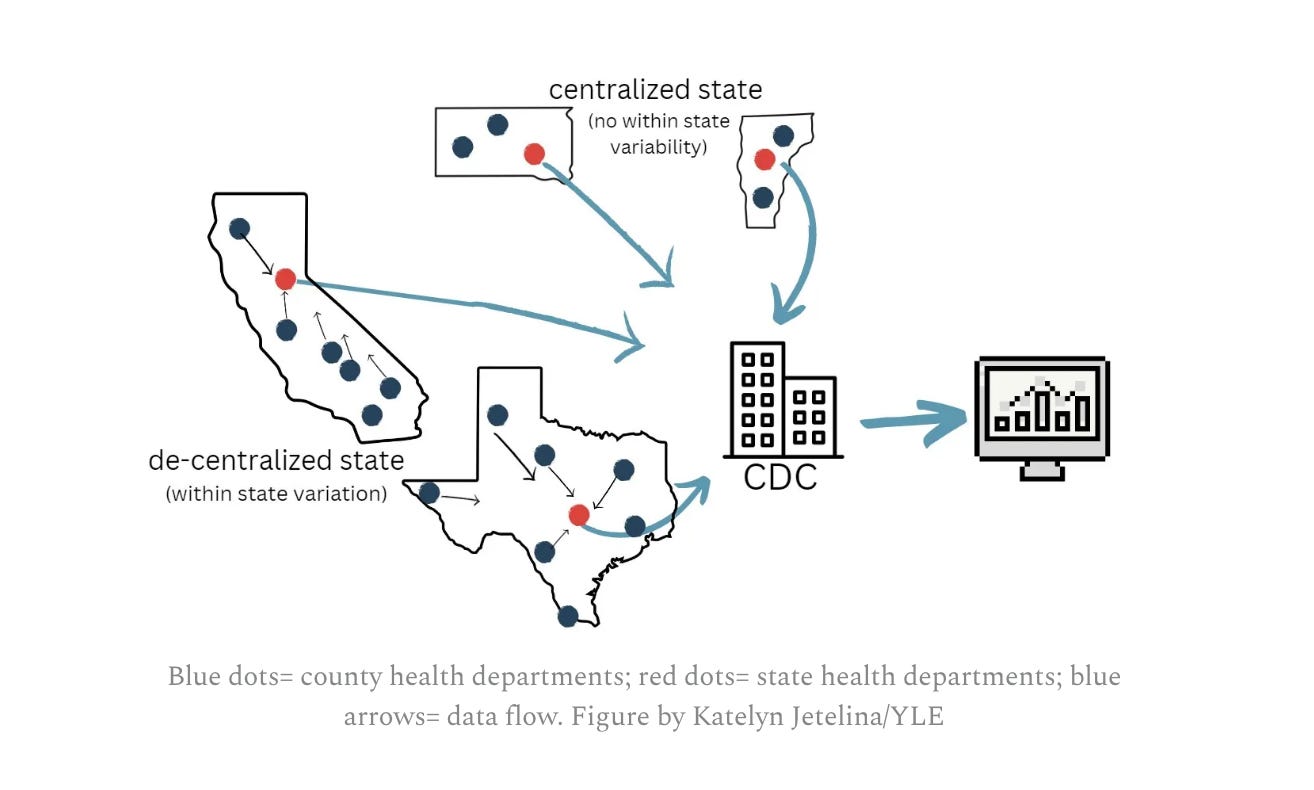
The key is a nuance most people find boring. Public health data in the U.S. do not flow from the top down; data are decentralized and built from the bottom up. Local and state health departments and hospital systems collect, manage, clean, and report data before they ever reach CDC.
Take flu data. When someone is hospitalized, the hospital records the case. That information moves to local or state health departments, where teams verify and clean it. Only then do states upload finalized numbers to CDC through secure systems. CDC then stitches these local puzzle pieces into a coherent national picture.
This role is essential because diseases do not respect state lines. CDC data inform cross-state responses, hospital capacity planning, testing needs, resource allocation, early warning signals, and shared lessons across jurisdictions. Without CDC, we would have 50 separate snapshots instead of a unified national system. Because CDC primarily stitches data rather than collects it, federal interference is much harder.
CDC does run direct data collection for vital statistics and surveys, including collecting information on vaccination uptake, mortality, and health behaviors such as smoking and nutrition. Most of these datasets remain
...This excerpt is provided for preview purposes. Full article content is available on the original publication.