The Penicillin Myth
Deep Dives
Explore related topics with these Wikipedia articles, rewritten for enjoyable reading:
-
Howard Florey
13 min read
The article mentions Florey as the pharmacologist who, alongside Ernst Chain, developed penicillin into a practical drug at Oxford. Understanding his crucial role in transforming Fleming's observation into mass-produced medicine provides essential context for the full penicillin story.
-
Lysozyme
9 min read
The article notes Fleming's earlier discovery of lysozyme as another antibacterial substance with a suspiciously similar 'lucky contamination' story. Understanding this prior discovery helps readers evaluate the plausibility of Fleming's penicillin narrative.
-
Cell wall
11 min read
The article explains that penicillin works by interfering with bacterial cell wall synthesis during active growth, which is central to understanding why scientists couldn't replicate Fleming's results. This biological mechanism is key to the scientific mystery discussed.
“I did not invent penicillin. Nature did that. I only discovered it by accident.”
—Alexander Fleming
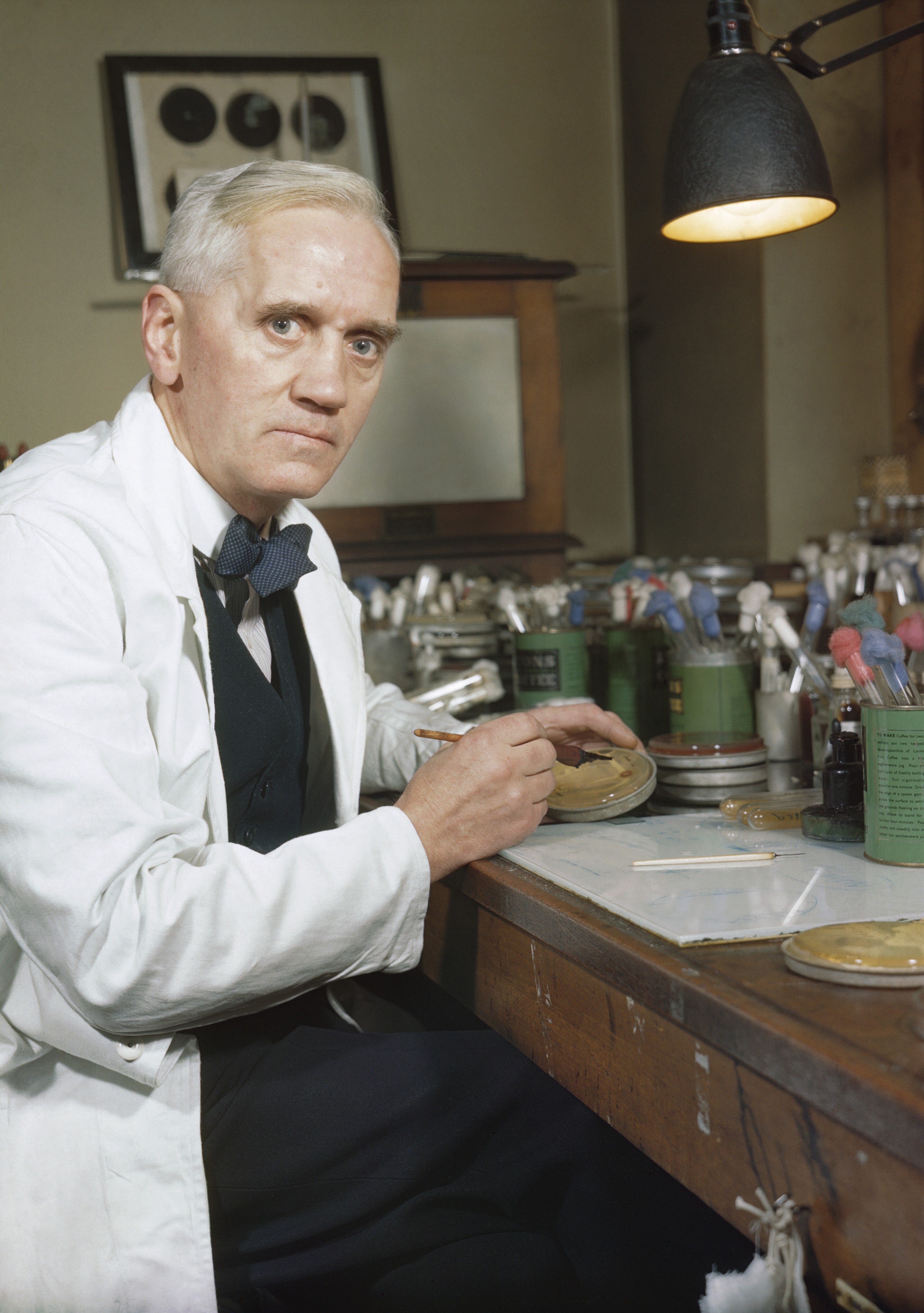
Many know the story of Alexander Fleming’s chance discovery of penicillin. Fleming, a bit of an absent-minded professor (and a bit of a slob), left culture plates streaked with Staphylococcus on his lab bench while he went away on summer holiday. When he returned, he found that “a mould” had contaminated one of his plates, probably having floated in from an open window. Before discarding the plate, he noticed that, within a “ring of death” around the mold, the bacteria had disappeared. Something in the “mould juice” had killed the staphylococci.
Fleming immediately began investigating this strange new substance. He identified the mold as Penicillium rubrum and named the substance penicillin.1 He published his findings in the spring of 1929 in The British Journal of Experimental Pathology.2 But a decade later, pharmacologist Howard Florey and biochemist Ernst Chain at Oxford would pick up where Fleming left off. Alongside a USDA lab in Peoria, Illinois, the pair would develop penicillin into a life-saving drug and usher in the era of antibiotics.
This is the kind of science story everyone likes. One of serendipity and accidental discovery; a chance observation that changed the world. But is it true?
For decades, scientists and historians have puzzled over inconsistencies in Fleming’s story. For starters, the window to Fleming’s lab was rarely (if ever) left open, precisely to prevent the kind of contamination that supposedly led to penicillin’s discovery. Second, the story is strikingly similar to Fleming’s earlier discovery of lysozyme, another antibacterial substance, which also featured lucky contamination from an open window. Third, Fleming claimed to have discovered the historic culture plate on September 3rd, but the first entry in his lab notebook isn’t dated until October 30th, nearly two months later.
Last, and most important: penicillin only works if it’s present before the staphylococci. Fleming did not know it at the time, but penicillin interferes with bacterial cell wall synthesis, which only happens when bacteria are actively growing. Visible colonies, however, are composed mostly of mature or dead cells. By the time a colony can be seen, it is often too late for penicillin to have any effect. In fact, the Penicillium mold typically won’t even grow on a
...This excerpt is provided for preview purposes. Full article content is available on the original publication.