The Week Observed: November 7, 2025
Deep Dives
Explore related topics with these Wikipedia articles, rewritten for enjoyable reading:
-
Inclusionary zoning
15 min read
The article discusses inclusionary zoning policy in depth, including funded vs unfunded approaches and density bonuses. Wikipedia's article provides the policy history, implementation variations across jurisdictions, and empirical research on effectiveness that would give readers deeper context.
-
Land value tax
12 min read
The article mentions that a land value tax would 'obviate many of the practical difficulties' of density bonuses for funding inclusionary zoning. This economic concept, associated with Henry George, is foundational to understanding urban land policy debates but not widely understood by general readers.
-
Columbia River Crossing
12 min read
The article opens with discussion of the Interstate Bridge project being 'basically the same project' as the failed Columbia River Crossing. Wikipedia's article on this specific failed megaproject provides the political and engineering history that contextualizes the current $273 million spending controversy.
What City Observatory Did this Week
The Interstate Bridge: Spending $273 million to design “basically the same project” as the failed Columbia River Crossing. Over the past 20 years, the states of Oregon and Washington have spent nearly half a billion dollars on consultants to design a bridge and freeway expansion across the Columbia River that it increasingly looks like they will never build. The two state DOTs don’t publish spending data, but we obtained it via a public records request. Since restarting the project a little over five years ago, the DOTs have signed $273 million in consulting contracts.
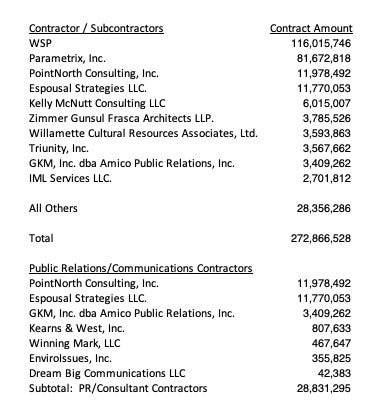
More than 40 percent of that money has gone to a single firm, WSP. And for the past five years, IBR has been run by a former WSP employee, Greg Johnson--who has recently announced he is resigning from the post at the end of this year. In addition, more than ten percent of the total cost of the project has gone to communications and public relations firms, who have raked in almost $29 million to help sell the mega-project.
Must Read
The New York Times weighs in on the ethics of gentrification. Neighborhood change is a fraught topic, and people rightly question whether their personal decisions about where to live might affect others. People moving into a new neighborhood, especially a lower income neighborhood, are often castigated as causing gentrification. A recent letter to the New York Times’ ethicist asked “Is It Bad to Buy Into a Gentrified Neighborhood? Kwame Anthony Appiah, the Times’ ethicist, took a strongly empirical view of the question, writing:
Philosophers have the sometimes-annoying habit of asking what words mean. And “gentrification” is a big one. . . . It’s diagnosis disguised as description. Many economists and demographers have come to question the diagnosis. Rising property values do raise rents and insecurity for tenants; longtime owners gain equity but may struggle with higher taxes. Yet studies in Philadelphia and elsewhere found that low-income residents of appreciating neighborhoods weren’t more likely to move than those elsewhere, and when they did, they didn’t necessarily end up in poorer or more distant areas. Nor do eviction rates seem to be higher. Increasingly, researchers see “gentrification” less as a cause than a symptom of housing scarcity and the lag between wages and housing costs.
It’s often difficult to disentangle the actions of individuals from the larger conditions of a neighborhood
...This excerpt is provided for preview purposes. Full article content is available on the original publication.