The Overlooked Canadian Role in Trump’s Migrant Crackdown
Deep Dives
Explore related topics with these Wikipedia articles, rewritten for enjoyable reading:
-
Private military company
15 min read
The article discusses how private security companies like GardaWorld evolved from military contracting in Afghanistan and Iraq to now managing detention facilities. Understanding the history and business model of PMCs provides essential context for how state functions became privatized.
-
Miccosukee
14 min read
The Miccosukee Tribe is mentioned as challenging the Alligator Alcatraz facility on environmental grounds. Their history as indigenous people of the Everglades and their legal sovereignty adds important context to why they have standing to challenge construction on these wetlands.
-
GardaWorld
14 min read
As one of the main Canadian companies profiting from the detention facility, understanding GardaWorld's history as a major global security firm and its controversial operations worldwide provides crucial context for the article's discussion of corporate accountability gaps.
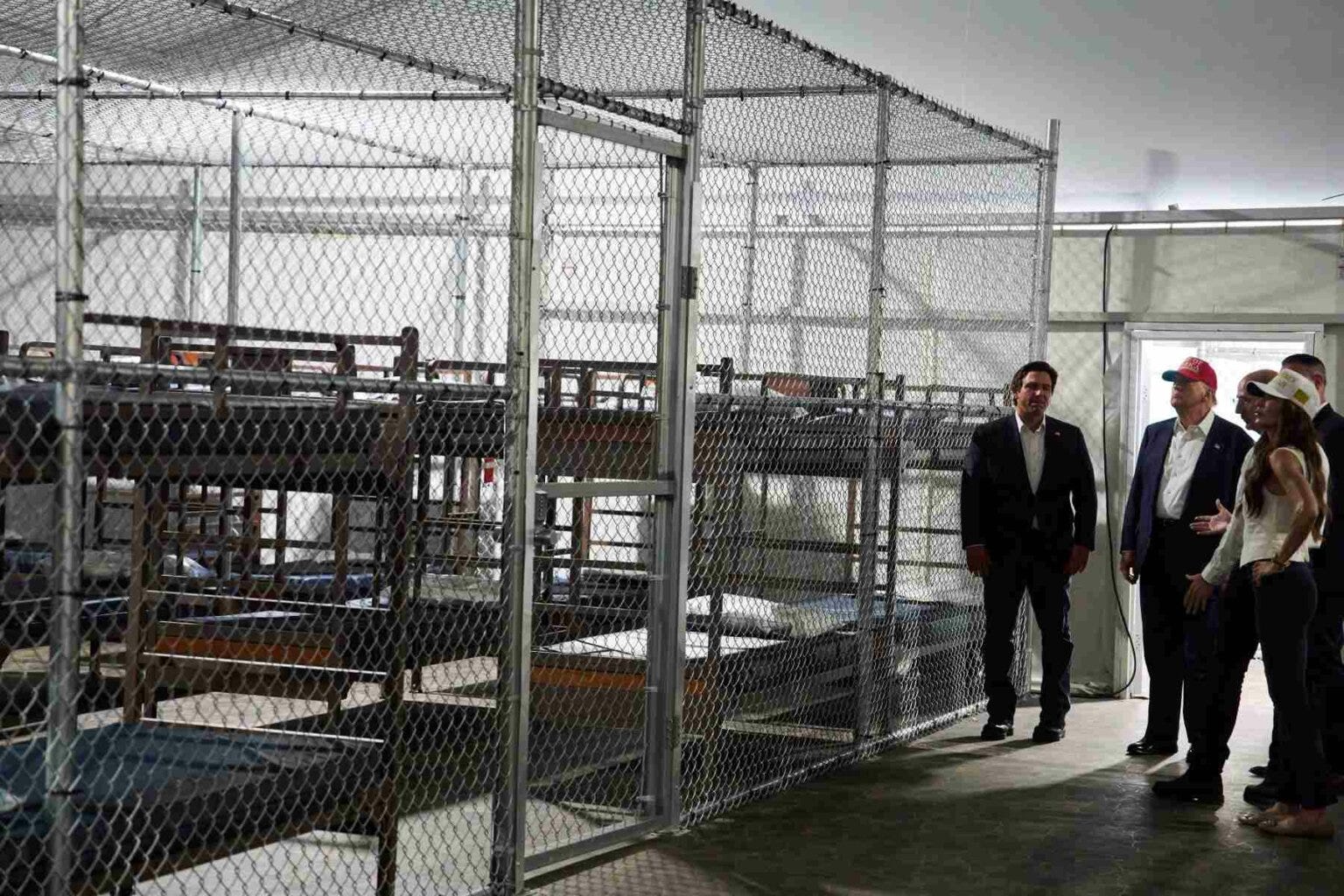
Donald Trump tours Alligator Alcatraz in Ochopee, Florida. (Evan Vucci/AP Photo)
This story was originally published on thewalrus.ca
On August 21, the Federal District Court in Miami ordered the closure of the Florida detention centre known as Alligator Alcatraz. Two weeks later, the United States Court of Appeals for the Eleventh Circuit ruled to pause that lower court decision. Alligator Alcatraz—and all the controversy surrounding it—was resurrected.
Built in just eight days in the Everglades wetlands, the facility was intended to hold up to 5,000 federal immigration detainees. In July, around 1,800 people were confined there in groups of thirty-two inside disaster-relief tents, where conditions reportedly swung between extreme cold and heat, with sewage hauled out and drinking water brought in. Speaking to the Associated Press, migrant detainees and their lawyers described worm-infested food, swarms of mosquitoes, windowless cells, flooded floors with fecal waste, and insufficient showers and toilets.
The centre faced lawsuits from the American Civil Liberties Union and others citing due-process violations. Environmental groups and the Miccosukee Tribe also challenged the site, arguing no environmental review was conducted before it was built. In her late-August ruling on the latter case, US district judge Kathleen M. Williams ruled that detainees must be relocated within sixty days, barred new transfers, and ordered much of the facility dismantled. The state appealed and asked the ruling be paused while their appeal was heard. The stay was granted, and detainees once again began to be transferred to the Everglades facility.
Among the companies contracted to provide services for Alligator Alcatraz are IRG Global Emergency Management—a US offshoot of ARS Global Emergency Management, a Toronto-based company also known as Access Restoration Services Ltd—and a US-based business unit of Quebec-based security operator GardaWorld. IRG Global Emergency Management was incorporated only this past February, yet it has received a total of $25.8 million (US) from the state of Florida so far this year—$6.2 million (US) of that in contracts to provide operational support to Alligator Alcatraz.
Headquartered in Virginia, GardaWorld’s US arm—GardaWorld Federal—has an $8 million (US) contract to provide services for the detention site. (In an email, a GardaWorld spokesperson wrote that the company could not comment on a specific facility or service due to its contractual obligations with the Florida Department of Emergency Management.) In July, it was advertising vacancies for full-time positions based in a remote part of
...This excerpt is provided for preview purposes. Full article content is available on the original publication.