We tell ourselves stories in order to live with ourselves
Deep Dives
Explore related topics with these Wikipedia articles, rewritten for enjoyable reading:
-
Joan Didion
15 min read
The article opens with and repeatedly references Didion's famous quote about storytelling ('We tell ourselves stories in order to live'), critiquing how it has been commodified on tote bags. Understanding Didion's actual work and philosophy of narrative would deepen appreciation of the author's argument.
-
New Order (Indonesia)
12 min read
The article mentions Indonesia's 'ongoing reckoning with the Suharto era' as a key topic at the festival. The New Order was Suharto's authoritarian regime (1966-1998), and understanding this period is essential context for the Indonesian political discussions referenced.
-
Western New Guinea
14 min read
Explicitly mentioned as one of the Indonesian issues emphasized at the festival. The ongoing conflict and human rights situation in West Papua is a significant topic that most Western readers know little about, despite its importance in the region.
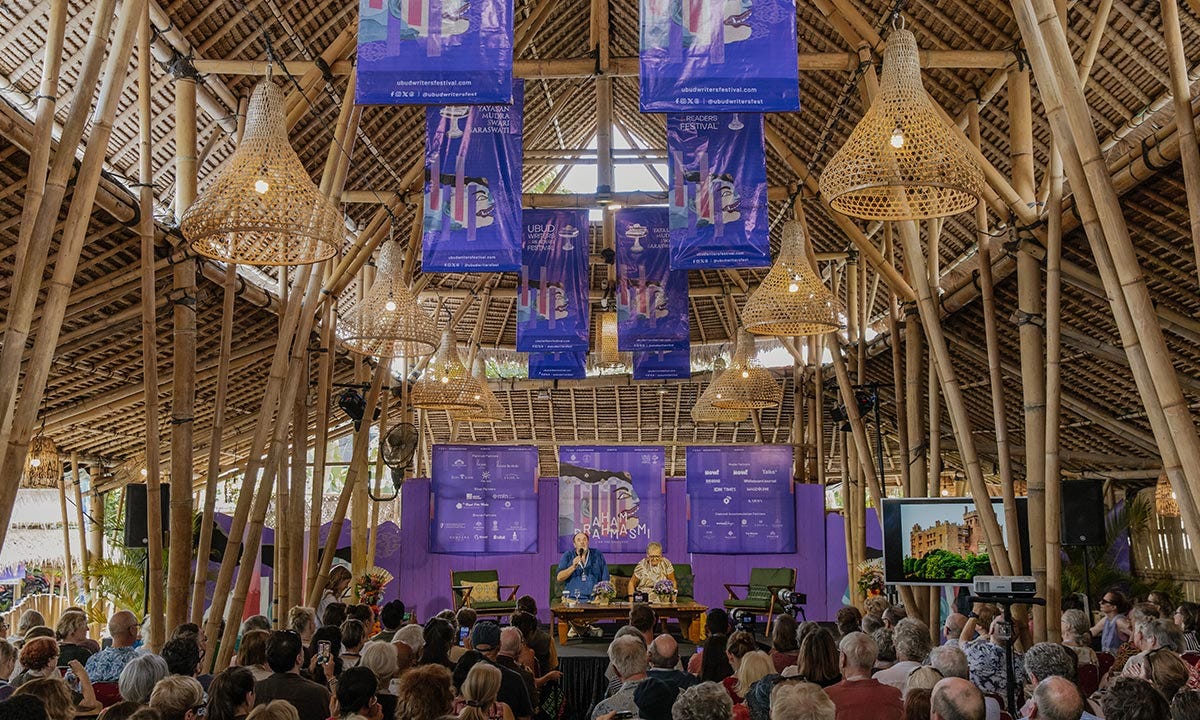
We have become a little bit silly when it comes to our relationship with stories and storytelling. We selectively quote Didion on our tote bags. We claim to be storytelling animals. We invoke stories and storytelling, with their “kitschy magic,” as Amit Chaudhuri has called it, “almost always with an air of glamour and celebration”.
That was certainly the case at the opening night gala of the Ubud Writers & Readers Festival last Wednesday, when festival director Janet DeNeefe told those gathered at the Puri Saren Agung that Ubud is “magical” and that we should “ignite our own magic and share it with each other [because] that’s part of cultures, stories, literature, etcetera.” My hackles went up—at least after I finished laughing at that decidedly unmagical “etcetera”—as they did the next morning when I saw someone walking around with a Byron Writers Festival tote. The sacredness we ascribe to storytelling, which has given rise to the trauma plot, the First-Person Industrial Complex, Ocean Vuong, and other horrors, often smacks too much of the spiritual retreat for me, too much of the scented candle aisle. I was on my guard from the get-go in Ubud against what I considered a certain Ubud type.
Story is not a good in and of itself. Storytelling—“the imposition of a narrative line upon disparate images,” as Didion describes it in a less famous section of her most famous paragraph—is as much a reflex of the right as it is of the left, and stories got us into our current spate of predicaments as much as anything else did. Many of the stories we were told in Ubud, with which we were asked to ignite our magic, were horror ones. They were too-late responses to powerful narratives that our own efforts failed to counter or prevent. Wars and genocides and political campaigns and online advertisements are all stories, too. Tony Abbott recently published a book in which tells a very specific, very skewed story about Australia. Neither the moral weight we ascribe to storytelling nor the role we too often claim for it as an empathy-generating machine is backed up by the evidence of the body count.
It is voice, more than story, that gets me going as a reader. A unique voice is what I look for on the page, and what I hope to put down on it when I
...This excerpt is provided for preview purposes. Full article content is available on the original publication.