A Reality-Based View of Government Funding of Science
This is a back-and-forth between Jeremy M. Berg (University of Pittsburgh School of Medicine, longtime NIH grant applicant, grantee, reviewer, and institute director), and Aishwarya Khanduja + me.
A RESPONSE FROM DR. BERG:
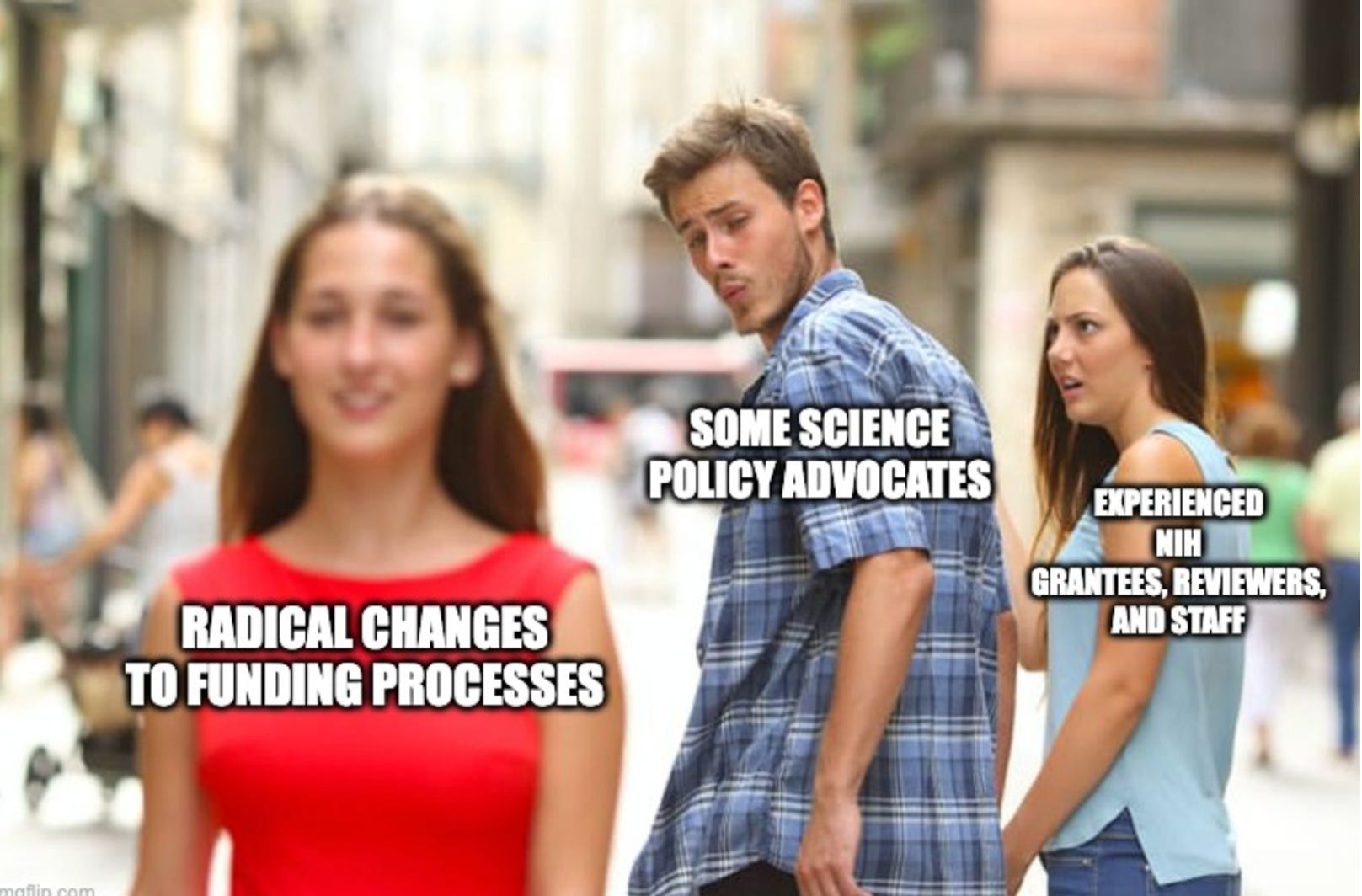
I read with interest “Venture Capital Has Lessons for Government and Philanthropy” by Khanduja and Buck. Discussions and analyses of the benefits and weaknesses of different approaches to providing science funding are important, but these should be based on well-informed perspectives and not on anecdotes and straw man arguments. I will focus of funding by the National Institutes of Health (NIH) as I have decades of experience as an applicant, a grantee, a peer reviewer and study section chair, an NIH institute director (the National Institute of General Medical Sciences, NIGMS, 2003-2011), and a trans-NIH program development leader. I will illustrate my observations with specific examples, all related to discoveries related to DNA and RNA biochemistry and its applications.
There are many misunderstandings and myths in this piece. Perhaps the most fundamental one is captured here.
By the time you get the funding (if at all) and execute the research plan, you might learn that your first idea wasn’t quite right and that an even better approach might work (*Marcia McNutt told one of us that this is what regularly occurred when she was a practicing scientist). But if you try to amend the grant, you will need to navigate the federal bureaucracy once again.
This fundamentally misunderstands that most NIH funding comes in the form of grants, not contracts. My experience and that of essentially every practicing scientist I know is completely aligned with that ascribed to Dr. McNutt. In the course of a executing a research plan, you discover the need for alternative approaches or learn of results, presented or published, that affect your chosen research topic. But you do not have amend anything! You pursue the science and describe whatever changes in approach in your annual progress report. NIH program officers understand that this is the nature of the research and, indeed, often that your are working in a desirably dynamic field.
An often-discussed example of this is represented by the work of Tom Cech when he was a young investigator at the University of Colorado. His proposal was to purify and characterize the protein enzyme responsible for splicing a particular RNA molecule, removing internal portions that were not present in
...This excerpt is provided for preview purposes. Full article content is available on the original publication.