The Flawed V02 Max Craze
In the past couple of weeks I’ve had 2 patients contact me because they were worried: their V02 max was decreasing. Their data were based on smartwatch imputations, which are notoriously imprecise. But the problem is much bigger than that. In this edition of Ground Truths I’m going to get into the difference between cardiorespiratory fitness and V02 max, which are remarkably different for the way they are measured, the datasets that assess them for functional significance and outcomes for healthy adults, and how we got into this craze.
How They Are Measured
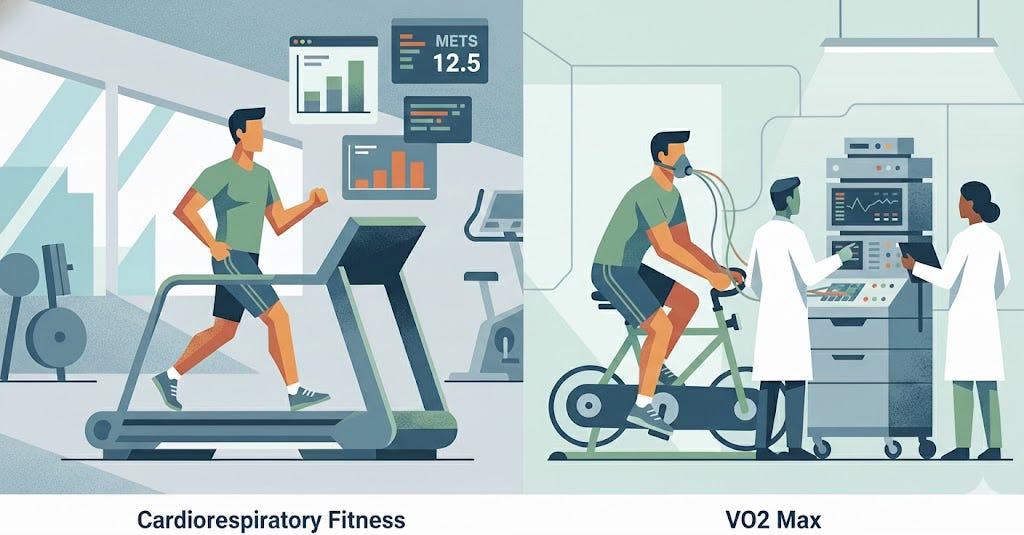
Cardiorespiratory fitness (CRF) is a real world assessment of a person activities, such as walking or on a treadmill, a reflection of a person’s resting metabolic rate, measured in metabolic equivalent of task (MET) units with 3 recognized levels of intensity : Light (<3.0 METs), example slow walking; Moderate (3.0-5.9 METs), example brisk walking, 3-4 miles per hour; and vigorous intensity (>6.0 METs), example jogging. 1 MET is the energy used in sitting or resting; 10 METs requires 10-fold the energy expenditure. CRF integrates cardiovascular, lung and musculoskeletal functional capacity.
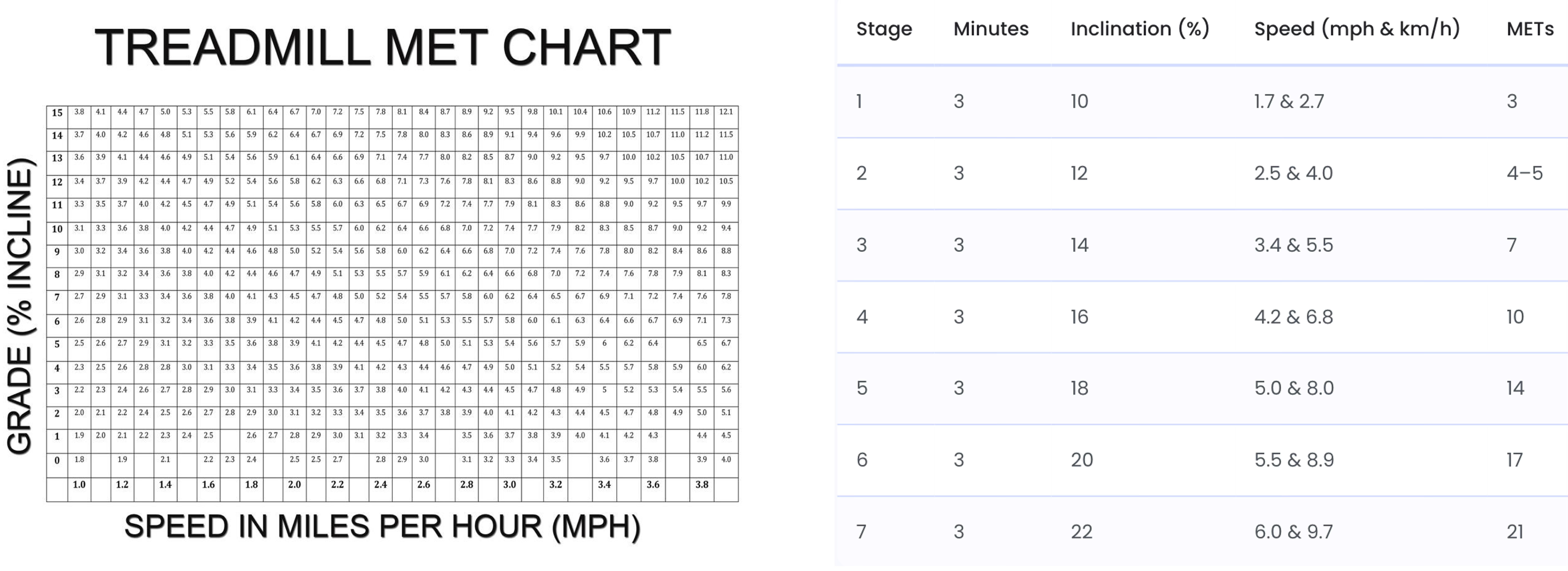
There are multiple methods to calculate your METS, including a standard treadmill MET chart (below left) that plots speed and incline, use a formula if you are doing the Bruce treadmill protocol or the chart below (right), or using heart rate (with any aerobic activity, such as bicycling or jogging) with the formula: METS=0.05 X heart rate+2. So if your HR got to 140 that would be 9 METS. For every increase in heart rate of 10 beats per minute, there’s about a 1 MET increase.
Maximal oxygen uptake (V02 max) is only accurately determined as a performance lab test with a metabolic cart, trained technicians, a specialized tightly fit mask that captures every molecule of inhaled oxygen and exhaled C02 on a ramped treadmill or stationary bike exercise protocol until absolute exhaustion. This is the ceiling of aerobic power achieved via direct gas exchange. A V02 max test costs about $150 for a standard assessment in a university lab.
V02 max by wearables are obviously not measured by gas exchange or directly, but instead through various imputations based upon population-based algorithms of heart rate and movement (GPS/accelerometry). Studies
...This excerpt is provided for preview purposes. Full article content is available on the original publication.