Curtis Yarvin Says We Can't Handle the Truth
Deep Dives
Explore related topics with these Wikipedia articles, rewritten for enjoyable reading:
-
Joseph de Maistre
11 min read
Yarvin directly cites Maistre's interpretation of the French Revolution as divine punishment. Understanding this 18th-century counter-revolutionary philosopher's ideas about monarchy, providence, and opposition to Enlightenment liberalism provides essential context for Yarvin's intellectual lineage.
-
Ancien régime
12 min read
The article directly discusses whether Yarvin wants to return to the pre-revolutionary French system. Understanding the actual structure of the ancien régime—its feudal property relations, guild restrictions, and aristocratic privileges—illuminates why the author argues it's incompatible with the tech capitalism Yarvin champions.
-
Dark Enlightenment
1 min read
Yarvin is a central figure in this neo-reactionary intellectual movement that the article discusses without naming. Understanding the Dark Enlightenment's rejection of democracy, embrace of scientific racism, and influence on figures like Peter Thiel provides crucial context for Yarvin's political philosophy.
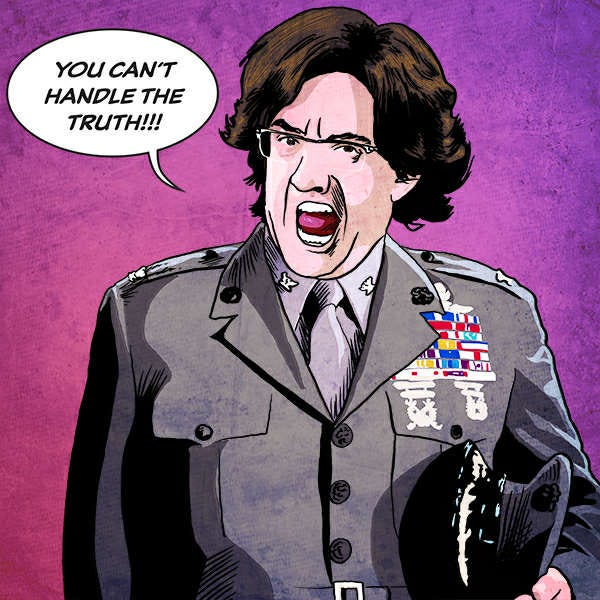
Curtis Yarvin is a right-wing blogger, Peter Thiel protege, and self-described “monarchist.” I wrote about him here and here, and a few years ago I debated him in Chicago.
The current Vice President of the United States has described Yarvin as a friend and an influence. The current President of the United States has done quite a few things to nudge reality closer to Yarvin’s authoritarian fantasies. Somehow, though, none of it seems to be enough to cheer him up.1
In the most recent entry on his Substack (entitled “You Can’t Handle the Truth”), Yarvin writes:
For the past two decades, I’ve been watching the world wake up to the obvious. As Orwell said, nothing is so difficult as noticing the nose in front of your face. A few people, me among them, were seeing that the whole story of reality that we lived in was as false and narcissistic—at least!—as the Soviet Union’s narrative of itself.
Yet none of us could accept the darkest aspect of that truth.
Tonally, this sounds like an extract from a mediocre YA dystopia. Substantively, I’m amazed that someone like Yarvin can cite George Orwell as if they were on the same team without bursting into flames.2
But, see, that’s me expecting the universe to be just.
Yarvin knows better.
We all had the idea that we could stand up and speak the truth and, if it was true enough, it would flash around the world like lightning. Nothing could prevail against the truth. The Father of Lies could not stand against the Lord of Hosts. That this fantasy itself was part of the lie—that truth has no army, that no angels will ride to our rescue—was too much. Perhaps if I had known it, I never would have said anything.. This truth is only available to the most advanced atheists and the most advanced Christians. The advanced atheist has purged himself of all traces of folk religion, and understands the world as it is—an infinitely cold universe of protons and electrons, whose fundamental rules are a few lines of mathematics with no concept of humanity. Our galaxy is not even special, let alone our planet.
So deep.
...To the advanced Christian, God’s will is just as cold and his justice is just as inexorable, and evil is sent to punish evil. Maistre read the French Revolution as God’s punishment of
This excerpt is provided for preview purposes. Full article content is available on the original publication.