Canada Is Building a Surveillance Network in Space
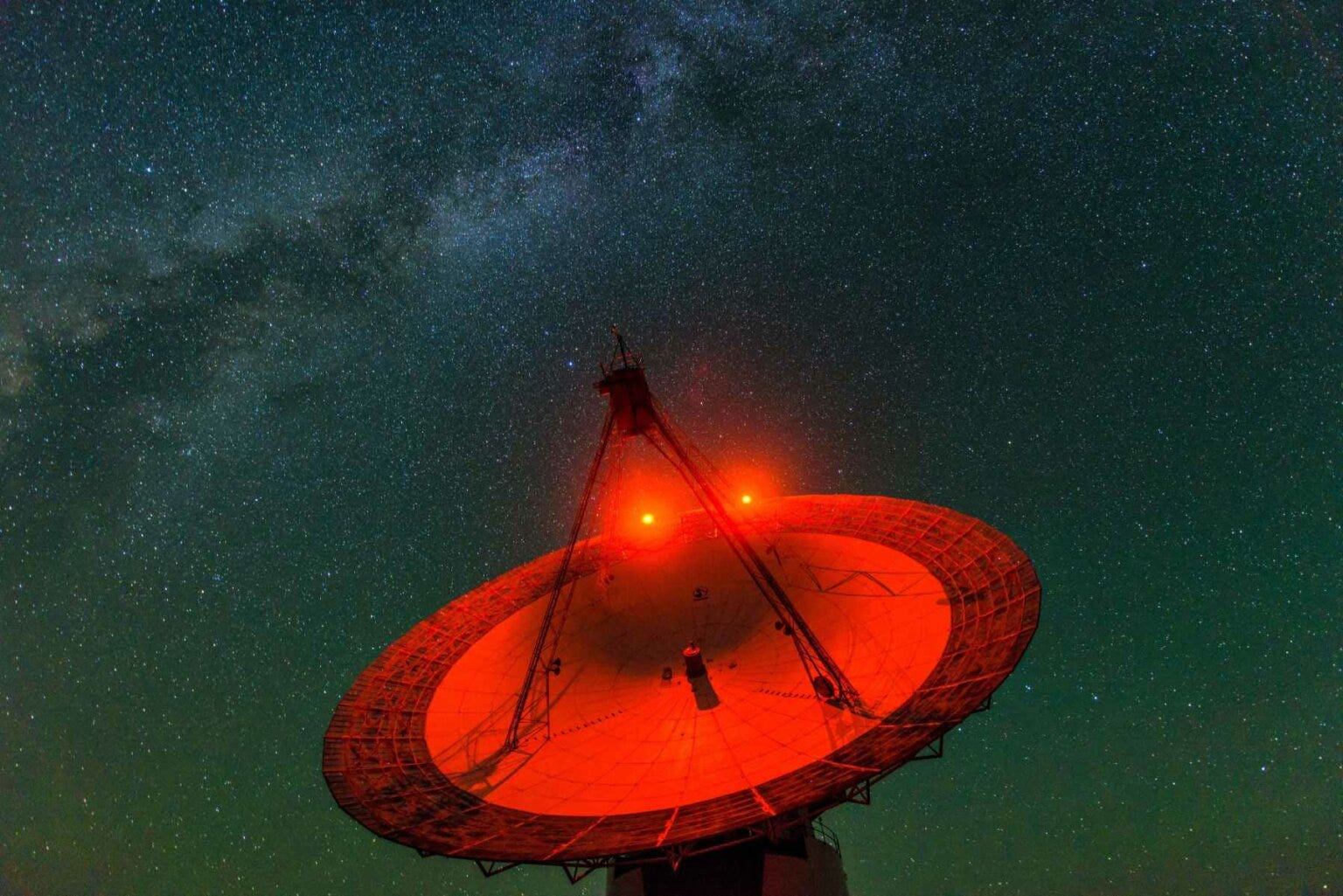
Don Johnston / Alamy
This story was originally published on thewalrus.ca
By Wesley Wark
Deep in the forests of Algonquin Provincial Park, a few hours north of Toronto, sits a metal monster. Like the iron giant of British poet Ted Hughes’s fable, it, too, has come back to life, reassembled. Hughes’s creation saves the planet. What’s this one’s mission?
Our iron giant is a deep space radio telescope, with an antenna dish measuring forty-six metres across, the largest instrument of its kind in Canada. Starting in the 1960s, the Algonquin Radio Observatory performed a number of cutting-edge scientific projects, including joining the search for extraterrestrial intelligence’s early efforts, in the 1970s and 1980s, to find signatures of alien life—spectrum emissions from water molecules, artificial transmitter signals. No luck.
Then the ARO fell on hard times—budget cutbacks, advances in telescope technology, aged and failing equipment. Canada’s iron giant was mothballed by its operator, the National Research Council, in 1987. There it sat, silent, rusting, for two decades.
The radio telescope was leased to a scientist and entrepreneur, Brendan Quine, in 2007. Quine had come to Canada after his PhD at Oxford and helped establish a space engineering program at Toronto’s York University. To pursue more experimental and commercially ambitious projects, he co-founded Thoth Technology in 2001 and later spun off an affiliate, ThothX.
Thoth, Quine reminded me, was an Egyptian deity of wisdom. X? Elon Musk, of course. Musk has built his rocket enterprise, SpaceX, and his social media company, ex-Twitter, now X, into world-leading enterprises. Quine has similar ambitions—what he half-jokingly calls his “world domination plan.”
But first he had to resurrect the iron giant. He fixed the broken windows of the control station, installed new electronics, and secured the perimeter against bears. Then he had to give the instrument a new purpose. What Quine ultimately hit on speaks to our threatened times, severe geopolitical tensions, and our accelerating dependence on space platforms for critical services, including telecommunications and navigation.
Using ARO, ThothX can detect one-metre-long objects in orbit at a distance of 100,000 kilometres—about a quarter of the way to the moon. And it can do it in any weather, day or night, at a fraction of the cost of traditional systems. In military nomenclature, the objective is “space domain awareness.” SDA goes beyond tracking satellites; it’s the work of figuring out what’s out there, what it’s for, and
...This excerpt is provided for preview purposes. Full article content is available on the original publication.