The Climate-Risk Industrial Complex and the Manufactured Insurance Crisis
Deep Dives
Explore related topics with these Wikipedia articles, rewritten for enjoyable reading:
-
Mark Carney
17 min read
Carney is cited as the influential figure who kicked off the climate-risk financial movement with his 2015 speech as Bank of England Governor. Understanding his background, career trajectory from Goldman Sachs to central banking to Canadian politics provides crucial context for evaluating his influence on financial regulation and climate policy.
-
Catastrophe modeling
11 min read
The article critiques how climate risk assessments have changed insurance pricing, specifically mentioning that conventional catastrophe modeling was deemed inadequate. Understanding how insurers actually model disasters—the science, history, and limitations—is essential context for evaluating claims about climate-driven insurance changes.
If you value the deep dives such as this one, which you will find no where else, please consider supporting THB with a paid subscription!
We’ve all seen the headlines — such as the below — loudly proclaiming that due to climate change the insurance industry is in crisis, and even that total economic collapse may soon follow. For instance, since 2019, the New York Times, one of the primary champions of this narrative, has published more than 1,250 articles on climate change and insurance.
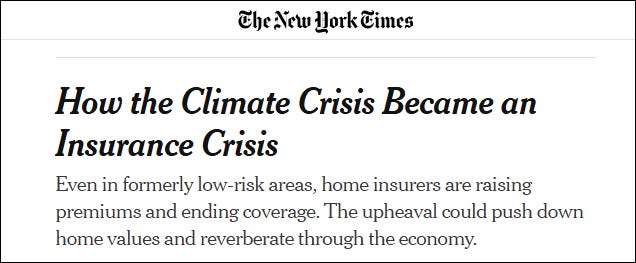
Climate advocates have embraced the idea of a climate-fueled insurance crisis as it neatly ties together the hyping of extreme weather and alleged financial consequences for ordinary people. The oft-cited remedy to the claimed crisis is, of course, to be found in energy policy: “The only long-term solution to preserve an insurable future is to transition from fossil fuels and other greenhouse-gas-emitting industries.”
However, it is not just climate advocates promoting the notion that climate change is fundamentally threatening the insurance industry. A climate-risk industrial complex has emerged in this space and a lot of money is being made by a lot of people. The virtuous veneer of climate advocacy serves to discourage scrutiny and accountability.
In this series, I take a deep dive into the “crisis,” its origins, its politics, and its tenuous relationship with actual climate science.1 Today, I kick things off by sharing three fundamental, and perhaps surprising, facts that go a long way to explaining why insurance prices have increased and who benefits:
Property/casualty insurance is raking in record profits;
Insurance underwriting returns vary year-to-year but show no trend;
“Climate” risk assessments are unreliable and a cause of higher insurance prices.
Grab a cup of coffee, settle in, and let’s go . . .
Property/casualty insurance is raking in record profits
This year is shaping up to be an extremely profitable year for the property/casualty (P/C) insurance industry. In a report covering the first six months of 2025, the National Association of Insurance Commissioners (NAIC) shares the good news (emphasis added):
Despite heavy catastrophe losses, including the costliest wildfires on record, the U.S. Property & Casualty (P&C) industry recorded its best mid-year underwriting gain in nearly 20 years.
In the second half of 2025, returns got even better for the P/C industry. According to a new report from S&P Market Intelligence, as reported by Carrier
...This excerpt is provided for preview purposes. Full article content is available on the original publication.