Embodied AI in Biotech: Why China Might Lead the Next Revolution
Welcome to Decoding Bio: each week our writing collective highlight notable news—from the latest scientific papers to the latest funding rounds—and everything in between. All in one place.
If you’d like to publish your own piece, email us here!
About the author: Cam is a deep tech strategist focused on commercialising technologies at the intersection of biotechnology, materials, AI, and robotics. After leading strategy at two UK–US biotech startups, he recently moved to Shanghai to join XJTLU’s deep tech entrepreneurship campus, where he drives engineering biology innovation and commercialisation initiatives while mentoring and investing in startups through its venture studio incubator.
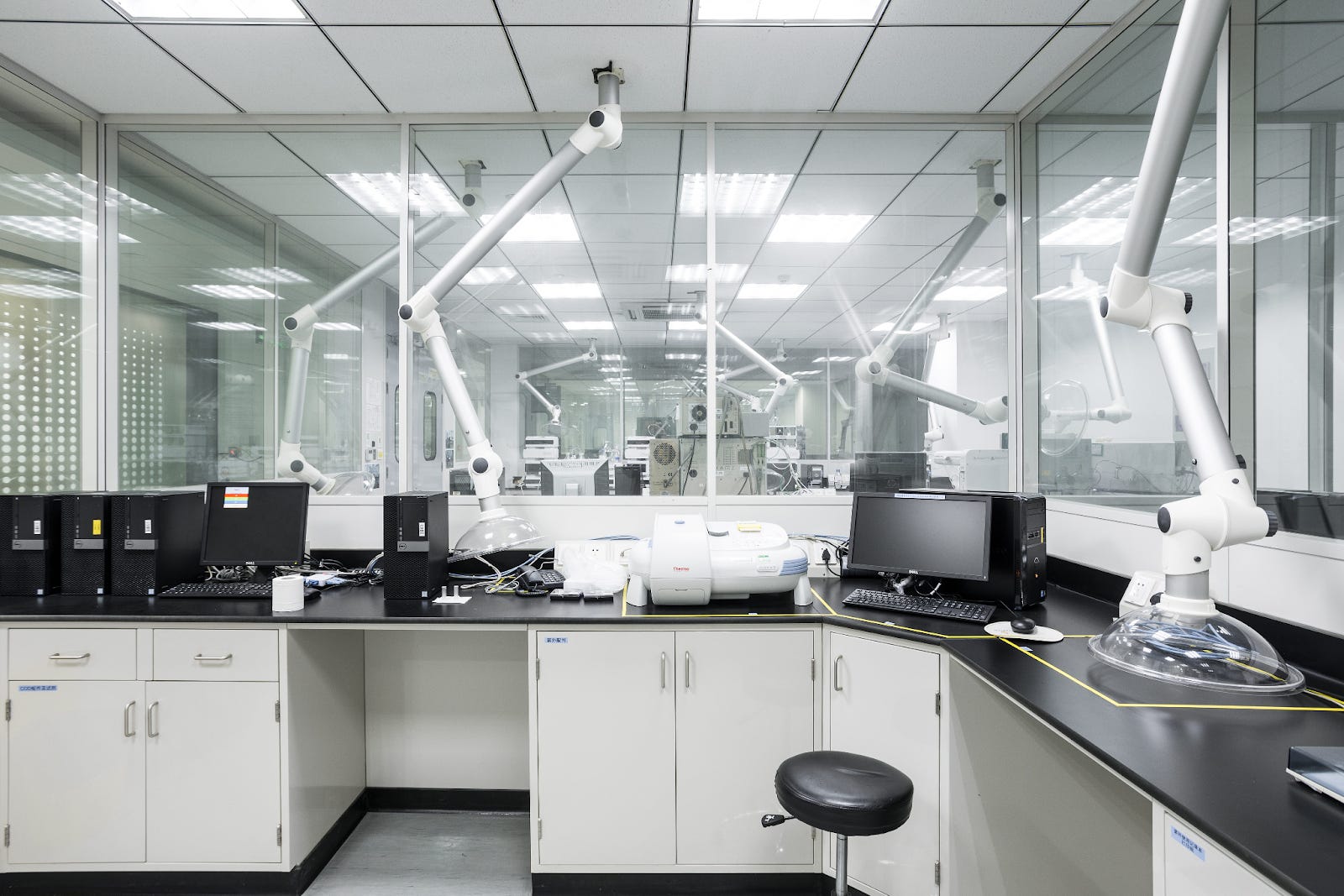
I know I’m not the only lapsed lab scientist that has thrown down their pipettes in frustration at another failed experiment where I’m pretty sure I’m the problem. Biology has always been constrained by its complexity: too many variables, too many unknowns, too slow to experiment. Rapid advances in AI and automation mean we are hopefully converging on the solution to this age old frustration and, from where I am sitting, it seems China might just have the edge.
In a Suzhou lab, a robotic arm gently tilts a culture flask, its movements directed not by a technician but by an AI agent. Nearby, a vision-guided manipulator adjusts microfluidic flows, while a machine-learning model runs in the background, predicting the optimal conditions for cell growth. What makes this scene remarkable is not just the automation, but the loop it creates: AI models generate hypotheses, robotic systems test them in real time and new data flows back to improve the algorithms.
This is the essence of embodied AI in biology; systems where intelligence is fused with physical infrastructure, allowing predictions to be validated in the wet lab rather than just simulated in silico. China, with its state-backed investments, emerging robotics players and rapidly scaling biomanufacturing facilities, may be positioning itself to lead this new paradigm.
Over the past year, I’ve seen a flood of coverage portraying the tech race between China and the West as a zero-sum competition. As a scientist-turned-startup strategist who recently relocated to China to see what all the fuss is about, I wanted to share some of the insights I’m gaining from being on the ground here.
From Software-First to Embodied AI
In the early 2010s, companies like Atomwise helped define the first wave of AI in drug discovery. Their platform, AtomNet, used deep
...This excerpt is provided for preview purposes. Full article content is available on the original publication.