AI Datacenters Drink More Water Than You Think
You can download this post as an epub/pdf for free using the button below. Paid subscribers get every deep-dive in downloadable digital formats. If you’d like to only purchase specific reports, you can see the growing digital asset collection here.
Note: This post is an exploration around a SemiAnalysis article on water use. I discuss tradeoffs I feel are not discussed in the original post. It’s not meant to minimize their work in the semiconductor space. I am a regular reader, and appreciate all the content they put out.
The “water footprint” of AI datacenters has become a hotly debated topic. The most widely cited study on the issue is a paper titled “Making AI less thirsty: uncovering and addressing the secret water footprint of AI models“ by UC Riverside and UT Arlington researchers, set the stage by stating that GPT-3 needs to “drink” a 500 ml bottle of water for roughly 10–50 medium-length responses.
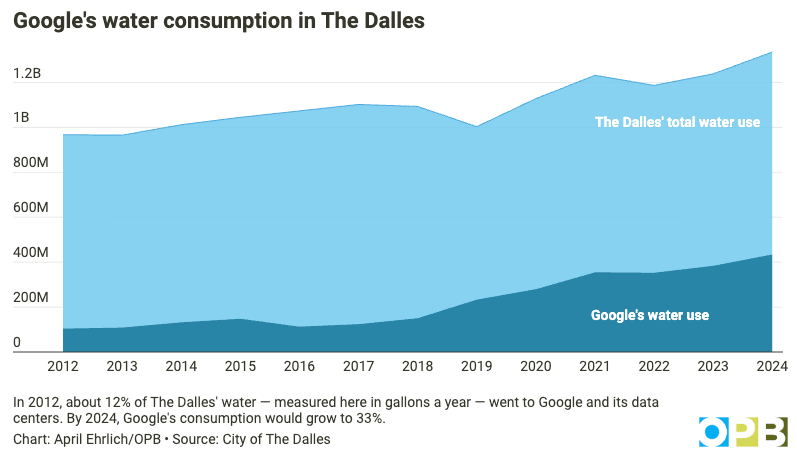
This debate reached a boiling point with the widely-reported controversy surrounding Google’s datacenter in The Dalles, Oregon, where the company initially refused to disclose its water consumption, claiming it was a trade secret. Subsequent legal battles eventually revealed Google was using a quarter of all the water in the entire city. The most striking development is The Dalles’ recent attempt to expand its water reservoir by pulling from the Mount Hood National Forest, an action that drew immediate concern from environmental groups.
In this post, we take a closer look at the SemiAnalysis article that promises I can use “Grok for 668 years, 30 times a day, every single day” for the water footprint of eating a single burger. I know I’ll still take the burger, but there are some important consequences of comparing datacenters to beef that we should talk about. I recommend you read the original article first.
We’ll explore how water use and carbon footprint are finely intertwined, and how datacenter design choices affect both. Not all infrastructure buildouts are reducible to burger metrics.
The Tokens-per-Burger Comparison
A SemiAnalysis post titled “From Tokens to Burgers: A Water Footprint Face-off,” states that a datacenter like xAI’s Colossus 2 consumed the same amount of water as 2.5 In-and-Out burger restaurants, a popular fast food chain in California. David Sacks identified it as a “narrative violation” - a series of tweets he puts out whenever there is something
...This excerpt is provided for preview purposes. Full article content is available on the original publication.