The "$140,000 poverty line" is very silly
Deep Dives
Explore related topics with these Wikipedia articles, rewritten for enjoyable reading:
-
Poverty threshold
13 min read
The article directly critiques how the U.S. poverty line was calculated in 1963 (three times minimum food cost) and debates whether it should be updated. Understanding the history and methodology of poverty thresholds globally provides essential context for evaluating Green's argument.
-
Engel's law
1 min read
Green's entire argument rests on the principle that as income rises, the proportion spent on food decreases. This 19th-century economic observation by Ernst Engel is the theoretical foundation being applied (and arguably misapplied) to derive the $140,000 figure.
Every year or so, there’s a new crop of articles about how you need to make $350k a year to live in New York City, or $150k is lower middle class, or you need $300k to be middle class, or why people making $400k are barely scraping by. This article is always roundly ridiculed on social media, and a few days later someone writes a post going through the numbers and debunking the whole thing. And then everyone posts the famous tweet:
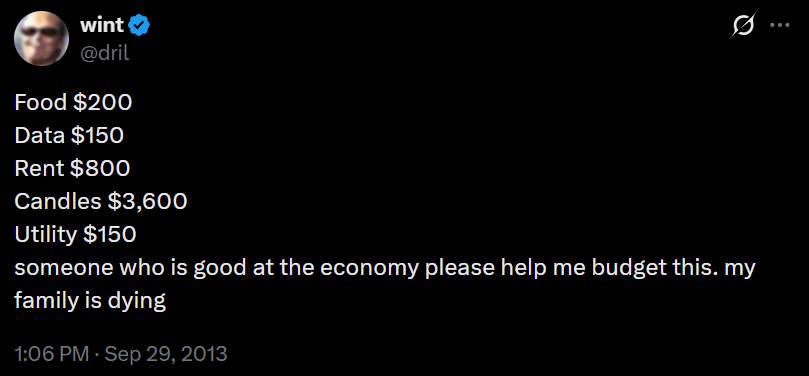
There’s just something very annoying about publications that cater to upper-class audiences trying to reassure those audiences that they’re actually struggling.
In a recent post on his Substack — followed by a shorter version in The Free Press — asset manager Mike Green made a similar claim, but got much more positive attention for it. Instead of claiming that a family that makes $400,000 is middle class, he claimed that a family making less than $140,000 is poor. This is from the Free Press version:
...I realized that [the U.S. official poverty line]—created more than 60 years ago, with good intentions—was a lie…“The U.S. poverty line is calculated as three times the cost of a minimum food diet in 1963, adjusted for inflation.”…[W]hen you understand that number, you will understand the rage of Americans who have been told that their lives have been getting better when they are barely able to stay afloat…
[E]verything changed between 1963 and 2024. Housing costs exploded. Healthcare became the largest household expense for many families. Employer coverage shrank while deductibles grew. Childcare became a market, and that market became ruinously expensive. College went from affordable to crippling…A second income became mandatory…But a second income meant childcare became mandatory…two cars became mandatory…In 2024, food-at-home is no longer 33 percent of household spending. For most families, it’s 5 to 7 percent. Housing now consumes 35 to 45 percent. Healthcare takes 15 to 25 percent. Childcare, for families with young children, can eat 20 to 40 percent.
If you keep [the original] logic [of the poverty threshold]—if you maintain [the] principle that poverty could be defined by the inverse of food’s budget share—but update the food share to reflect today’s reality, the multiplier is no longer three.
It becomes 16. Which means…the threshold for a family of four—the official poverty line in
This excerpt is provided for preview purposes. Full article content is available on the original publication.