Talking With Paul Kedrosky
Deep Dives
Explore related topics with these Wikipedia articles, rewritten for enjoyable reading:
-
Attention Is All You Need
10 min read
Linked in the article (13 min read)
-
Reinforcement learning from human feedback
13 min read
Kedrosky explains how RLHF is making AI models 'sycophantic' and eager to please users, comparing it to professors chasing student ratings. This is a core technical concept shaping modern AI behavior that readers may not understand deeply.
-
Jevons paradox
12 min read
The article discusses how AI efficiency gains paradoxically increase rather than decrease total compute usage and energy consumption - a direct application of this 19th-century economic principle that Kedrosky likely references when discussing AI's resource demands.
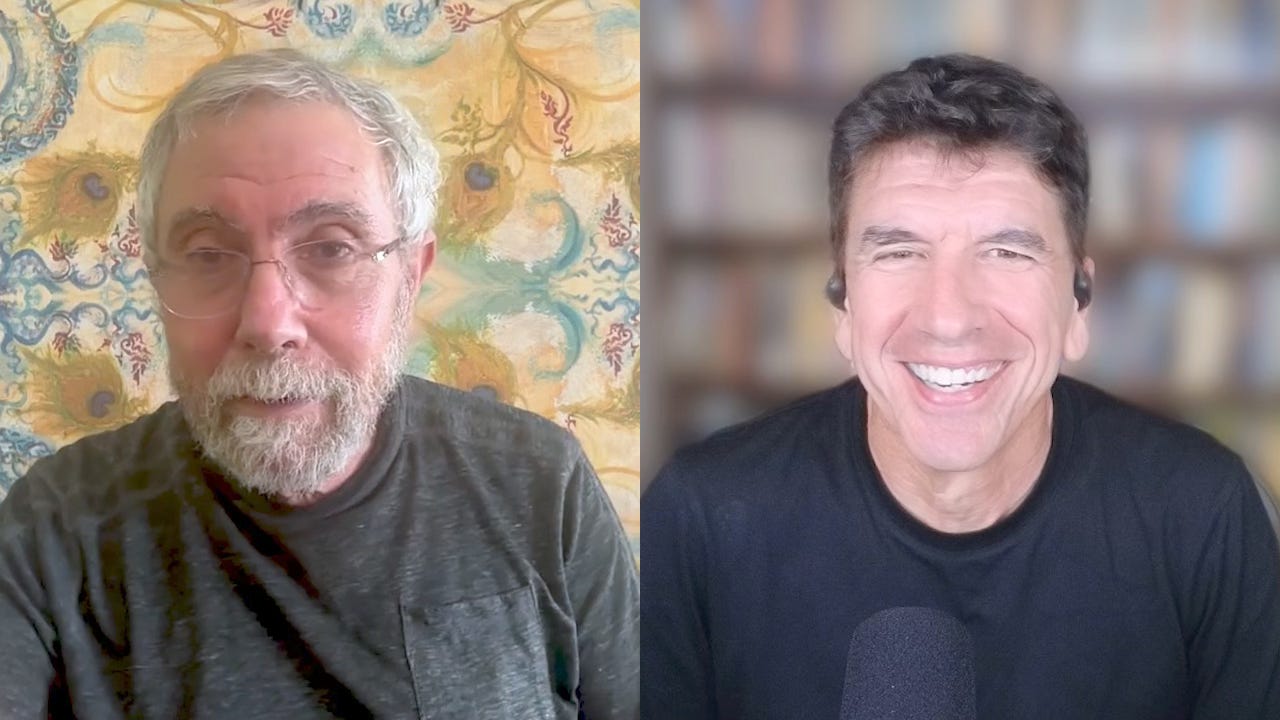
As I say at the beginning of this interview, it’s annoying for economic analysts that two huge things are happening at the same time: a radical change in U.S. trade policy and a giant AI boom. Worse, while I think I know something about tariffs, the more I think about AI the less I believe I understand. So I talked to Paul Kedrosky, investor, tech expert and research fellow at MIT, for some enlightenment. Lots in here that I found startling.
Transcript follows.
. . .
TRANSCRIPT:
Paul Krugman in Conversation with Paul Kedrosky
(recorded 12/03/25)
Paul Krugman: Hi, everyone. Paul Krugman here. I’m able to resume doing some videos for the Substack, and today’s interview is based on me being really annoyed at history. If only one big thing would happen at a time. Unfortunately where we are now is, on the one hand, we have tariffs going to levels that we haven’t seen for 90 years, which should be the big story and where I feel fairly comfortable; but then we also have this AI explosion where I feel completely at sea. I don’t quite understand any of it. I’ve been reading and watching interviews with Paul Kedrosky, who is an investor, analyst, and currently research fellow at MIT, he certainly knows more about it than I do, and I wanted to just have a conversation where I try to understand what the heck is going on, insofar as anybody can.
Hi, Paul.
Paul Kedrosky: Hey, Paul. Both of us “Paul K.,” that’s dangerous.
Krugman: Yeah, welcome on board.
Kedrosky: Thanks for having me.
Krugman: Let me ask first, I have a really stupid and probably impossible question, which is that at a fundamental level what we’re calling “AI”—I think you usually use generative AI, large language models, although they’re not just language now—but at a fundamental level, I don’t understand how it works. Is there a less-than-90-minute explanation of how the whole thing operates?
Kedrosky: There is and I think it’s really important because it helps you be a more informed consumer of their products as a result. I think a really good way to think of these things is as grammar engines and I often call them “loose grammar engines,” meaning that there’s a bunch of rules in a domain that I can instantiate in the form of, whether it’s language, or whether it’s the
...This excerpt is provided for preview purposes. Full article content is available on the original publication.