The Ravenous, Radiant Jim Harrison
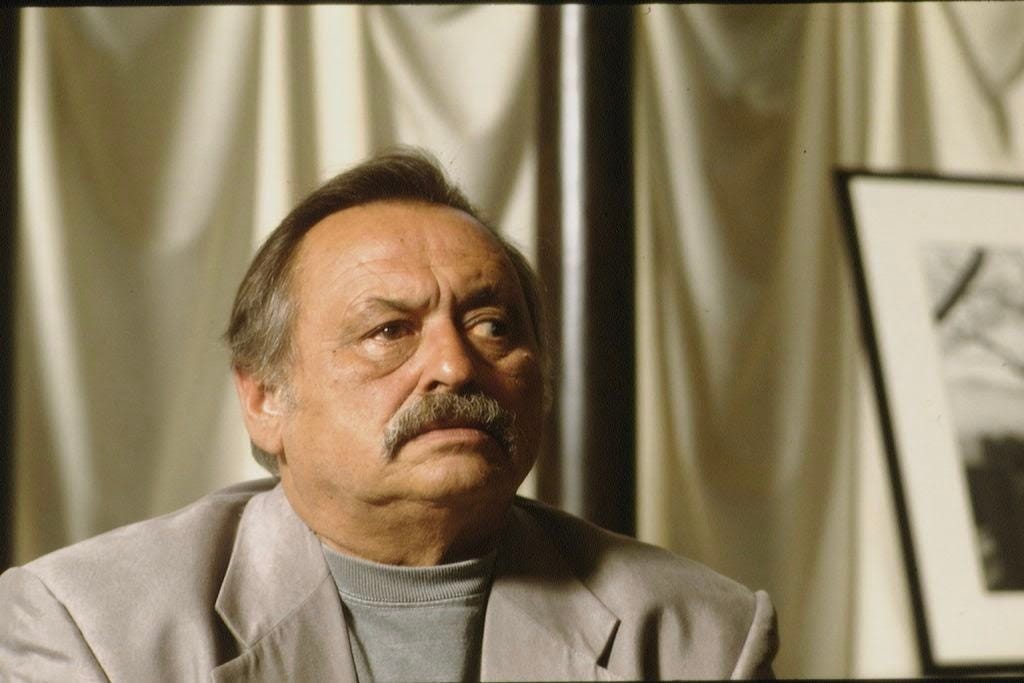
Toward the end of this essay, I’m going to tell you about the time 30 years ago when Jim Harrison — the singular American poet and novelist — stole my date. This happened at a literary festival in Key West when I was 25 years old. Worse, I had flown there from East Lansing, Michigan, with nearly the sole purpose of meeting Harrison, whom I idolized.
Before I get to the story, let me discuss Todd Goddard’s sweeping biography, Devouring Time: Jim Harrison, a Writer’s Life. Harrison wasn’t a household name, but few writers have inspired a readership so passionate. Some of us have even made pilgrimages to the bars he loved — Dick’s Pour House, on Michigan’s Leelanau Peninsula; the Murray Hotel Bar, in Livingston, Montana; or the Night Before Lounge, a strip club in Lincoln, Nebraska. Years ago, I knew a successful New York-based author who discovered Harrison too late, just after his death in 2016, when for a couple of weeks fellow writers celebrated him with fond obituaries and gushing tributes. “I learned that everyone I know had apparently hung out with him at some point,” she wrote to me. “It was like how when David Carr died, I learned that he’d sent every journalist I know an encouraging email, except me.”
The easy way of describing Harrison is to say that he was driven by enormous appetites — for food, sex, booze, literature, and the natural world. The New York Times’ Dwight Garner, an admirer, called him “our poet laureate of lumbering desire.” It’s an apt characterization, though Goddard, an associate professor of literary studies at Utah Valley University, probes more deeply. His book draws from over 100 interviews, Harrison’s vast collection of personal papers, and intimate familiarity with his work. Goddard stresses Harrison’s accomplishments in poetry — the form he most cared about — and while his portrayal is admiring, it does not shirk from his flaws. The Harrison that emerges in Devouring Time is deeply sentimental and disarmingly cerebral, but never didactic. He grappled with metaphysical questions though he resisted abstractions; he found meaning in the dying of elk, winter rivers, and the savor of food.
Harrison was born in the northern Michigan town of Grayling in 1937, which back then was rooted in the timber economy. His Swedish ancestors were hardscrabble farmers, though his
This excerpt is provided for preview purposes. Full article content is available on the original publication.