A unilateral change to childhood vaccines: What it means for you
Deep Dives
Explore related topics with these Wikipedia articles, rewritten for enjoyable reading:
-
Herd immunity
12 min read
Central to understanding the article's argument about population-level vs. individualized vaccination strategies. The shift from universal to high-risk-only recommendations directly impacts herd immunity thresholds, which readers likely understand conceptually but not mechanistically (threshold percentages, indirect protection of vulnerable populations, mathematical models).
-
Advisory Committee on Immunization Practices
12 min read
The article mentions ACIP was bypassed in this decision. Understanding ACIP's role, composition, evidence review process, and historical precedents provides crucial context for why this bypass is significant and unprecedented in vaccine policy.
-
Hepatitis B vaccine
15 min read
The article uses Hepatitis B as a detailed case study comparing U.S. vs. Danish approaches. The Wikipedia article covers the vaccine's development, the science of vertical transmission from mother to infant, the 90% chronic infection rate in infants, and the historical public health impact that led to universal birth-dose recommendations.
Well, he did it. He actually did it.
RFK Jr. unilaterally made sweeping changes to the routine vaccination schedule for children in the United States. This change isn’t based on new data or new evidence, but rather on political and ideological reasons. He bypassed every scientific and clinical process we have, including not taking public comment.
It is one of the most opaque and destabilizing public health decisions I’ve seen—it could blow up a lot of progress in childhood vaccines, which have been one of the most successful public health interventions in history. In its wake there will be confusion among parents, schools, and hospital systems, disruption of clinical workflows, possibility of increased liability, and complications with school vaccine requirements.
The result is painfully predictable: fewer children will be vaccinated, and children will be harmed.
This is overwhelming, but we are far from powerless. So let’s dig into: What the heck just happened? Why is this shift a problem if other countries do it? What does it mean for you? And, what can be done about it?
What the heck just happened?
RFK Jr. directed the CDC Acting Director to formally update the U.S. childhood immunization schedule, effective immediately, to the following:
The CDC will now routinely recommend vaccines for 11 diseases instead of 17.
Several vaccines previously recommended for all children are now:
Limited to high-risk groups.
Left to “shared clinical decision-making.”
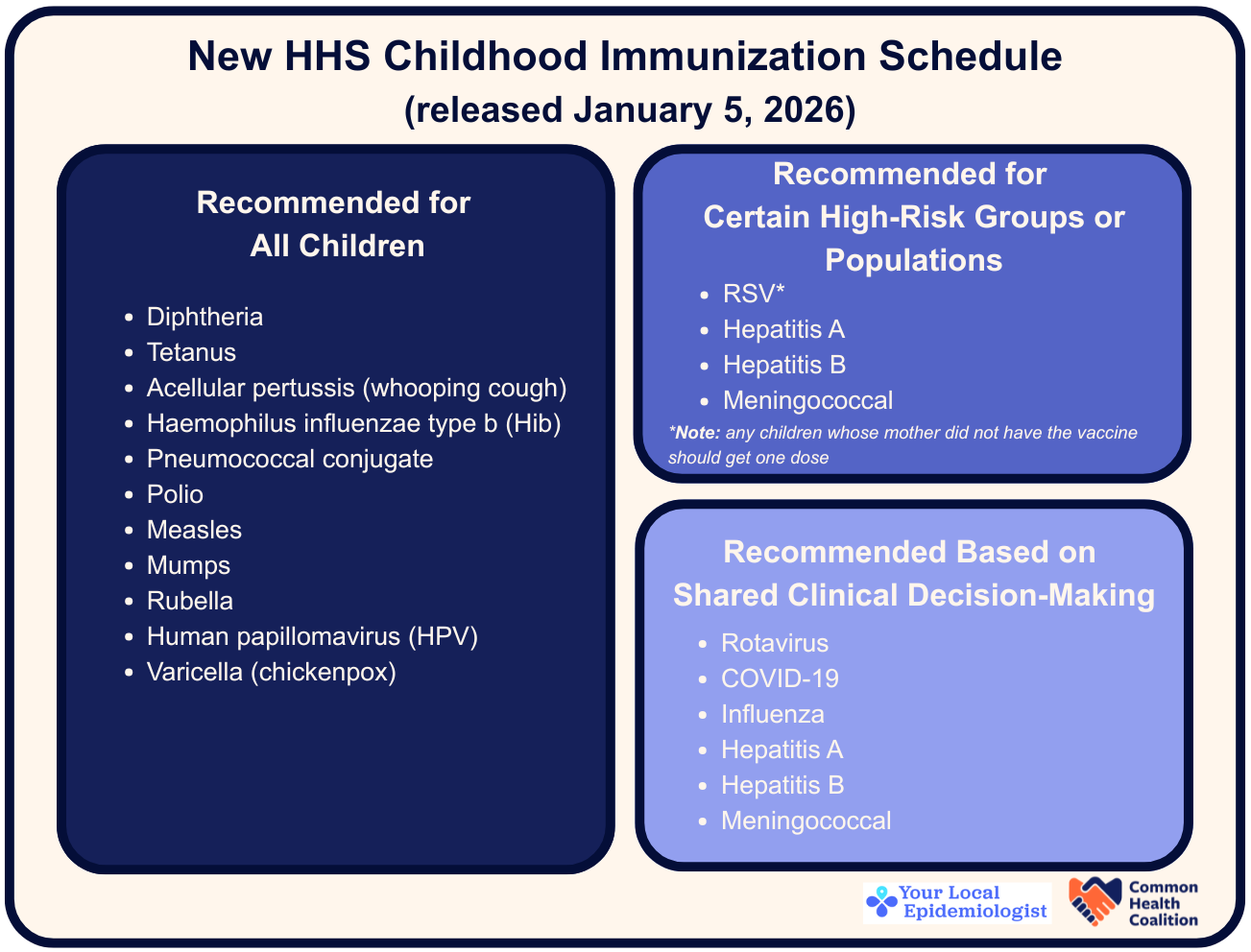
RFK Jr. is moving away from population-level prevention and toward individualized risk assessment. This is a fundamental shift in how the U.S. has protected vulnerable groups, how families are guided, and how parents will be asked to make decisions.
That shift matters. A lot.
Why is this a problem? It’s like going off-roading in a Porsche
The administration’s justification for this shift relies on comparisons to “peer countries” that recommend fewer vaccines. Denmark protects against 10 diseases, Germany 15, and Japan against 14. On the surface, this seems reasonable.
But here’s the problem: terrain matters.
Take Denmark. Denmark’s health and social system is well organized, well funded, and built for consistency, seamless integration for patients, and to provide a safety net for every family. Prenatal care is reliable. Nearly every child receives care on schedule. Follow-up is immaculate. And families have 46 paid weeks of maternity leave. It’s like a smooth, meticulously maintained highway where a sports car can thrive.
For example, in Denmark, only high-risk kids
This excerpt is provided for preview purposes. Full article content is available on the original publication.