How Quebec Farmers Took On Vermont’s Maple Syrup King—and Won
Deep Dives
Explore related topics with these Wikipedia articles, rewritten for enjoyable reading:
-
Maple syrup
18 min read
The article centers on the maple syrup industry's history and economics, but readers may not know the scientific process of sap collection, the specific conditions required for production, or why it can only be made in northeastern North America
-
Agricultural cooperative
14 min read
The article's central conflict involves farmers organizing cooperatives to combat Cary's monopoly power. Understanding how agricultural cooperatives function, their history, and why they succeed or fail provides essential context for the Quebec farmers' eventual victory
-
Desjardins Group
9 min read
Cyrille Vaillancourt, the 'Napoleonesque figure' who united Quebec maple farmers, later led Desjardins. Understanding this institution—North America's largest credit union—illuminates the broader cooperative movement in Quebec and Vaillancourt's significance
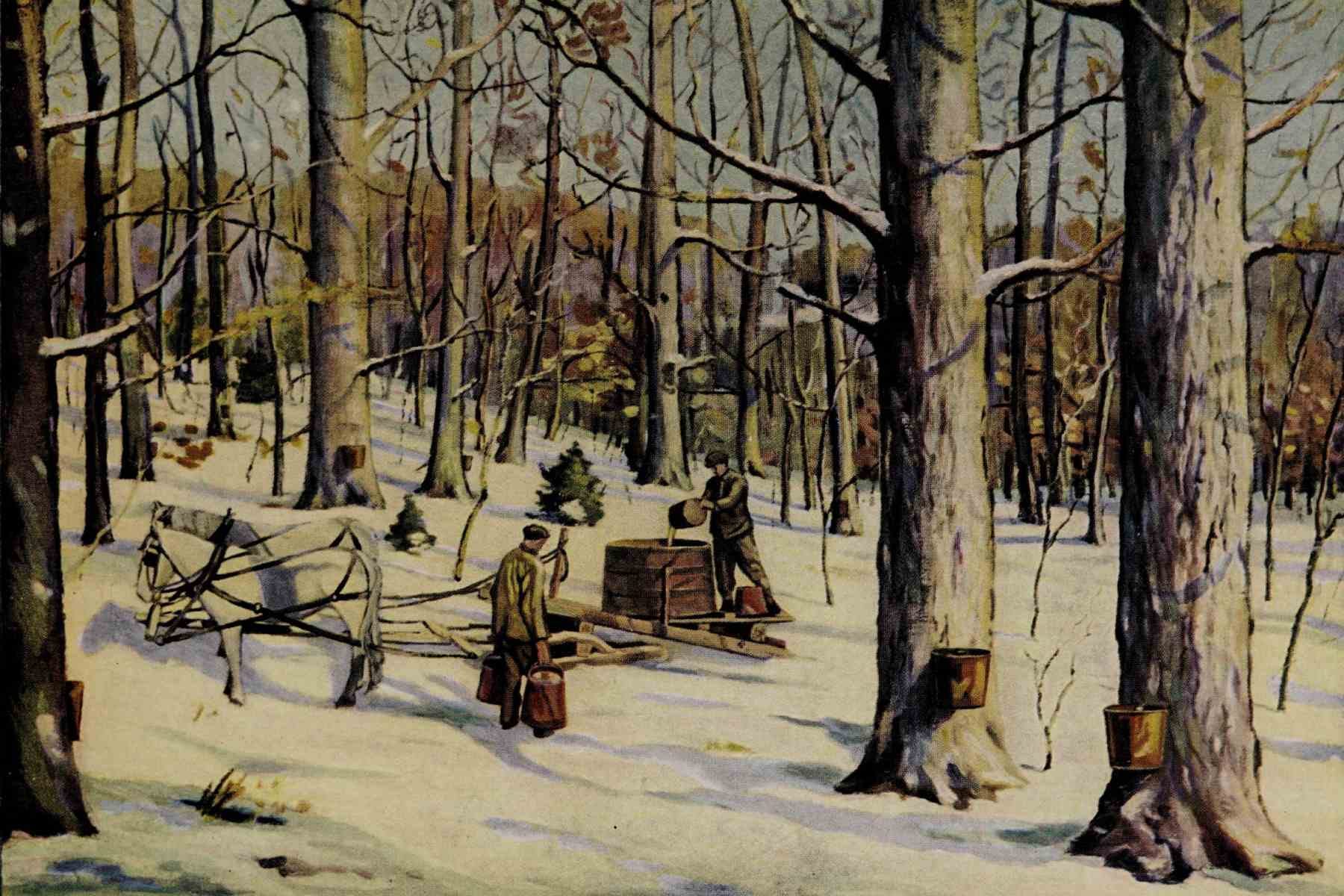
Collecting the Sap of the Sugar-Maple (Artemas Ward / Wikicommons)
This story was originally published on thewalrus.ca
The first person to get rich from the sweet products of maple trees was an American. George Clinton Cary was born in 1864 on a farm in Fort Fairfield, in eastern Maine, on the border of New Brunswick. As a boy of ten, Cary was already a budding farmer and had his own pair of steers. By age twenty-two, Cary was looking beyond the farming industry and became a travelling grocery salesman, moving goods by horse and buggy throughout Maine, Vermont, and New Hampshire.
The legend of Cary’s start in the maple business began in the spring of 1886. Cary’s wagon, pulled by a team of horses, got stuck in the mud on a road in Craftsbury, northern Vermont. The overnight low would refreeze the roads, so the young salesman had to stop for the night. This unscheduled lull gave Cary lots of time to try to convince a local storekeeper to buy his wares. The grocer had no money but offered to place an order if Cary would take payment in maple sugar at 4.5 cents per pound. Cary agreed, and found himself with 1,500 pounds of maple sugar. On a train later that spring, Cary met a tobacco salesman and learned that tobacco companies bought Barbados cane sugar to flavour plug chewing tobacco and paid five cents per pound. Cary smelled an opportunity and finessed a deal to ship the maple sugar to a Virginia tobacco company. Then he went looking for more maple sugar. This lucrative partnership for tobacco flavoured with maple sugar from both the United States and Canada would endure for decades, and it underpinned Cary’s rise to omnipotence in the world of maple products.
Cary packed the maple sugar in wooden crates and loaded it onto trains for shipment to tobacco companies. Cary was a fairly tall man, about six feet, and of solid build. A Boston newspaper compared him to the oxen that pulled the sap-gathering tanks on sleds through his sugar bush, and he demonstrated a similar determination. His business grew, and in 1898, he built a warehouse in Saint Johnsbury, Vermont, near the meeting of the Boston and Maine Railroad and the Saint Johnsbury and Lake Champlain Railroad. This turned into a chain of warehouses along Vermont railway lines. Cary hired
...This excerpt is provided for preview purposes. Full article content is available on the original publication.