America must embrace the Electric Age, or fall behind
Deep Dives
Explore related topics with these Wikipedia articles, rewritten for enjoyable reading:
-
Lithium-ion battery
15 min read
The article identifies lithium-ion batteries as one of three game-changing inventions enabling the electric revolution. Understanding the chemistry, history, and development of this technology provides essential context for why EVs became viable and why battery manufacturing is now a geopolitical battleground between the US and China.
-
Rare-earth element
14 min read
The article mentions rare-earth motors as critical to the Electric Tech Stack. These elements are essential for powerful electric motors and have significant geopolitical implications, as China controls most of the world's rare-earth mining and processing—directly relevant to the US-China competition discussed.
-
Network effect
13 min read
The article explicitly invokes network effects to explain why EV adoption will hit a tipping point where gas stations become unprofitable. Understanding this economic concept helps readers grasp why technological transitions can accelerate suddenly rather than gradually.

Elon Musk is America’s China.
That sounds like a silly thing to say, but what it means is that what the entire economy of China is set up to do — scale up high-tech manufacturing businesses — is something that only one man in America knows how to do. Only Elon has built China-like manufacturing businesses in America, and he has done it twice now — SpaceX and Tesla. When something like that happens twice, it wasn’t a coincidence.
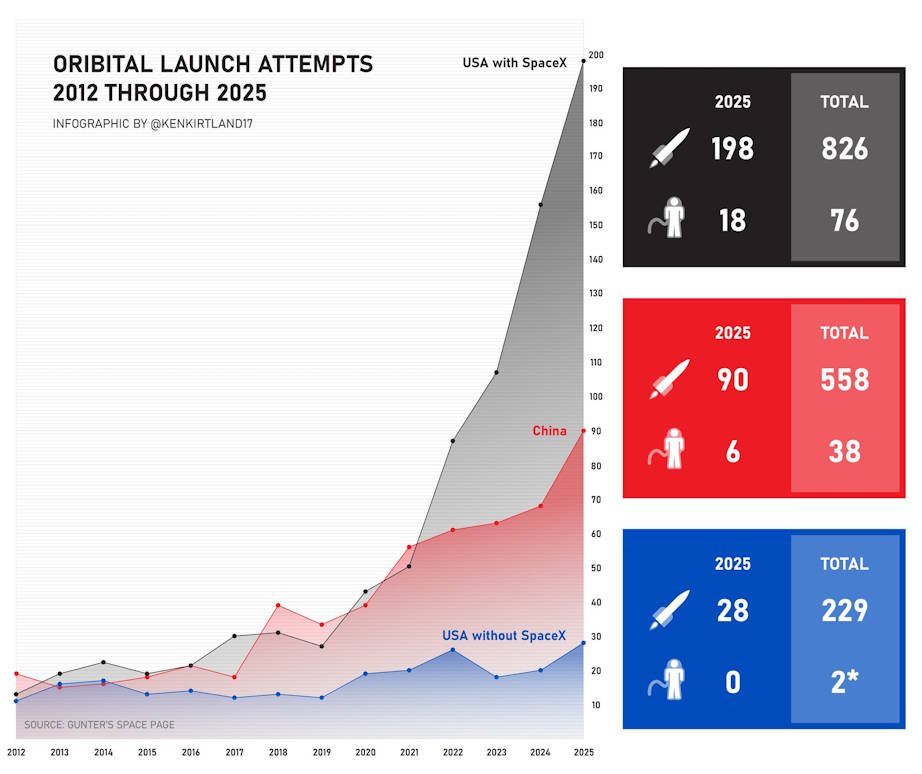
Just to give you an example of how important this is, note that without SpaceX, China would be leaving America in the dust when it comes to space launches. But with SpaceX, it’s America leaving China in the dust:
One implication of this is that America needs to make it a lot easier to set up and scale a manufacturing business, so that our entire high-tech manufacturing sector isn’t dependent on one slightly kooky right-wing billionaire. But that’s a topic for another post.
A second implication is that if we want to know about the future of physical technology, we should listen to Elon Musk. In fact, Elon has a great track record of seeing and entering manufacturing industries that China zeroes in on later:
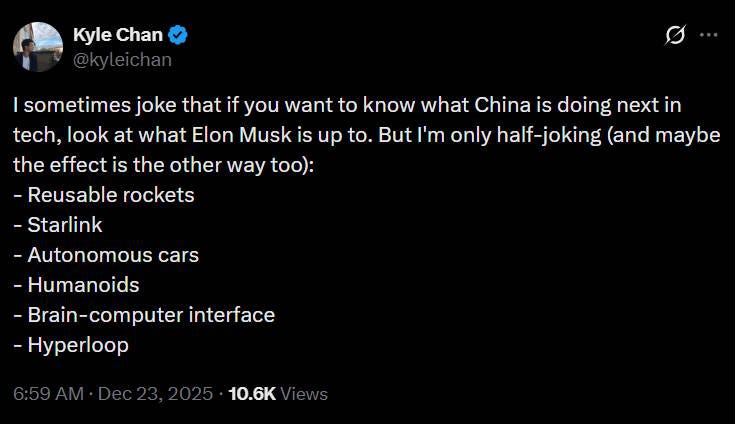
This is a good list, but it omits the most important items. The three industries that Elon zeroed in on very early, which made him much of his fortune — and which China has subsequently gone all-in on — are batteries, electric vehicles, and solar power. In fact, he still thinks these technologies are some of the most important in the world. In a recent interview, Elon said:
It seems like China listens to everything I say, and does it basically— or they’re just doing it independently. I don’t know, but they certainly have a massive battery pack output, they’re making a vast number of electric cars, and [a] vast amount of solar…
These are all the things I said we should do here [in America].
Elon didn’t go for batteries, EVs, and solar power because he was a climate-obsessed liberal; he correctly understood that there was a revolution underway in the technologies that humans use to produce, store, transport, and harness energy. He knew that whoever mastered that technological revolution would attain a dominant position in a bunch of different, seemingly unrelated industries.
...This excerpt is provided for preview purposes. Full article content is available on the original publication.