Abbott says megafloods are “just part of nature.” The fossil fuel industry disagrees.
This is a special joint edition of HEATED and ExxonKnews, a climate newsletter written by reporter Emily Sanders. ExxonKnews specializes in covering fossil fuel industry disinformation, dark money, and lobbying, as well as efforts to hold the industry accountable. ExxonKnews is a project of the Center for Climate Integrity. Sign up here.
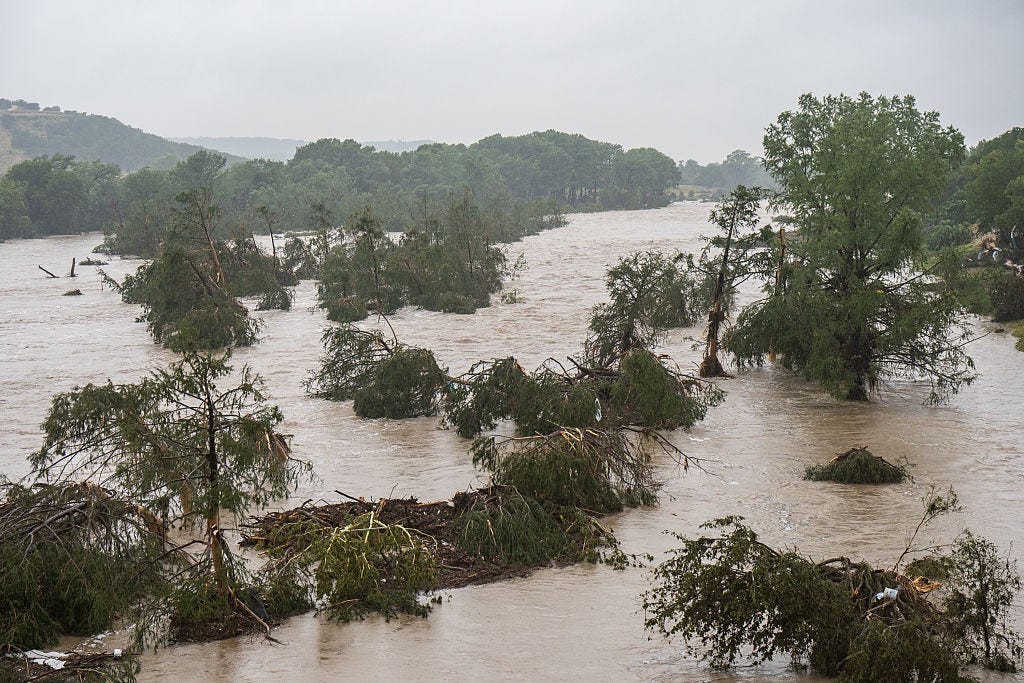
Less than a month before deadly flash floods devastated Kerr County, Texas, representatives of the oil and gas industry gathered about 100 miles away to discuss how to protect themselves from increasingly frequent and damaging extreme storms.
At the Omni hotel along the San Antonio River, the American Gas Association — a trade association and lobbying group for the U.S. gas industry — organized a group of industry and utility representatives, as well as members of the National Governors Association, the Department of Energy, and the Federal Energy Regulatory Commission, to talk about how to prepare pipeline infrastructure and the energy grid “for high demand seasons and severe weather events,” according to a leaked agenda and audio from the event.
They heard from Matt Lanza, a meteorologist from Houston-based CenterPoint Energy, who discussed how warmer Gulf waters earlier in the season have caused more frequent, damaging hurricanes and tropical storms across the Gulf Coast and Southeast.
"When I started off in energy, summer was not sit-back-and-relax time from a weather standpoint, but you could kind of ease up a little bit," he said. "But like now you're just constantly on edge... if you look at the last 10 summers, I think all 10 of them are in the top 15 hottest from a cooling degree day standpoint."
While he predicted a slightly above-normal hurricane season for the Gulf Coast this year, he reminded the room: “It doesn't necessarily take a hurricane to cause issues, which I think we're all very keenly aware of.”
"It sounds to me more like we may have less extreme mega storms, but a lot more storm tantrums,” reflected Kimberly Denbow, vice president of security and operations at the American Gas Association. “Like a little tantrum that causes a big ruckus, which requires preparedness on all of our parts, because clearly there's consequences that come with those as well.”
Less than a month after that meeting, one of those “storm tantrums”
...This excerpt is provided for preview purposes. Full article content is available on the original publication.