Are the Strongest Nor'easters Getting Stronger? A Closer Look
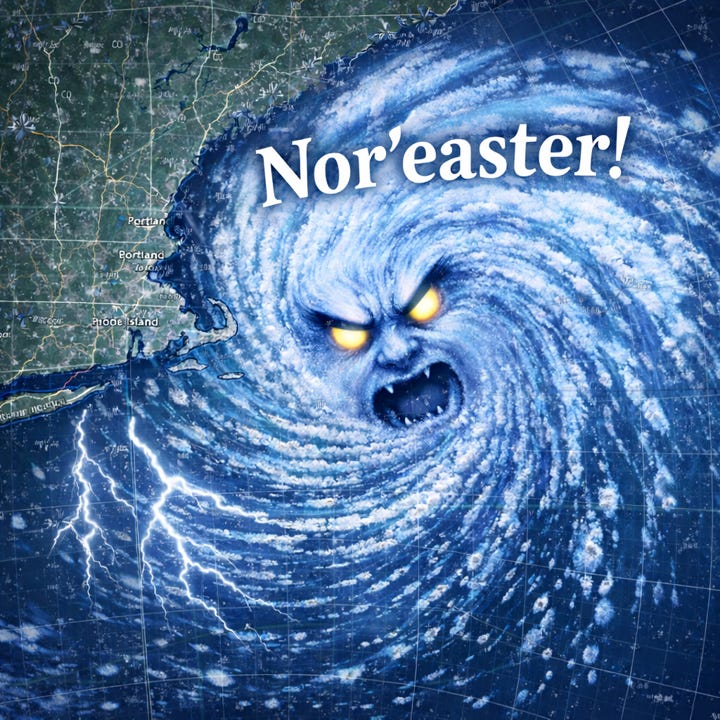
As New England digs out from a historic blizzard, today’s post takes a deep and technical dive into recent research — Chen et al. 20251 — claiming that Nor’easters have become detectably more intense over recent decades. That research asserts,
Our analysis of nor’easter characteristics reveals that the strongest nor’easters are becoming stronger . . .
Taking advantage of AI tools, I have replicated and extended the analysis. As is far too common in high profile climate research, the top-line claims of the paper do not survive scrutiny. Public commentary by the paper’s senior author and subsequent media reporting provide a case study in how uncertain and ambiguous findings are turned into strong claims expressed with absolute certainty.
Grab your coffee, settle in and let’s take a deep dive. Last July, a paper in PNAS by Chen and colleagues was accompanied by widespread media coverage claiming that the new paper was the first and last word on trends in the intensification of nor’easters. For example:
Live Science reported that nor’easters “have become 20% more destructive in the last 80 years.”
Inside Climate News declared that “the strongest ones are clearly getting stronger.”
The Weather Network, revisiting the study in December, announced that nor’easters are “growing more intense and producing more rain and snow than ever before.”
The University of Pennsylvania’s press release on the paper called its findings “unquestionable.”
Michael E. Mann, the paper’s senior author and a climate scientist at the University of Pennsylvania, in his accompanying blog post, stated that intensification “can now be seen in the observations.”
A closer reading of the paper shows that none of the above claims are a true reflection of what the paper actually says, supported by a simple extension of its methods and analysis.
Note: This post is a first experiment fully implementing my new use of AI for quantitative research – see How I use AI for more details. Today, I explore Chen et al., its supplementary materials, and the relevant ERA5 reanalysis literature. For readers interested in the quantitative details, please find more technical detail, data, and replication code for my analyses at the bottom of this post. Caveat lector!
Nor’easters are among the most consequential weather events affecting the densely populated U.S. East Coast, into New England and the Canadian maritime provinces. If the most intense storms have become detectibly more intense, and are expected
...This excerpt is provided for preview purposes. Full article content is available on the original publication.