Religion, Philosophy and the Duck-Rabbit. (Kyoto School)
Hello everyone. I’m Stephen West. This is Philosophize This!
So there’s a quote from one of the members of the Kyoto School that we’re going to be talking about today.
He said, “Religion without philosophy is blind, and philosophy without religion is vacuous.”
We’re going to be talking about the relationship between philosophy and religion, something many members of the Kyoto School were always rethinking and developing as they were doing their work.
I highly recommend reading the two posts we’ve done so far on Keiji Nishitani. Just a heads up, I’ll be using terms like Sunyata and referencing concepts from his work throughout this post.
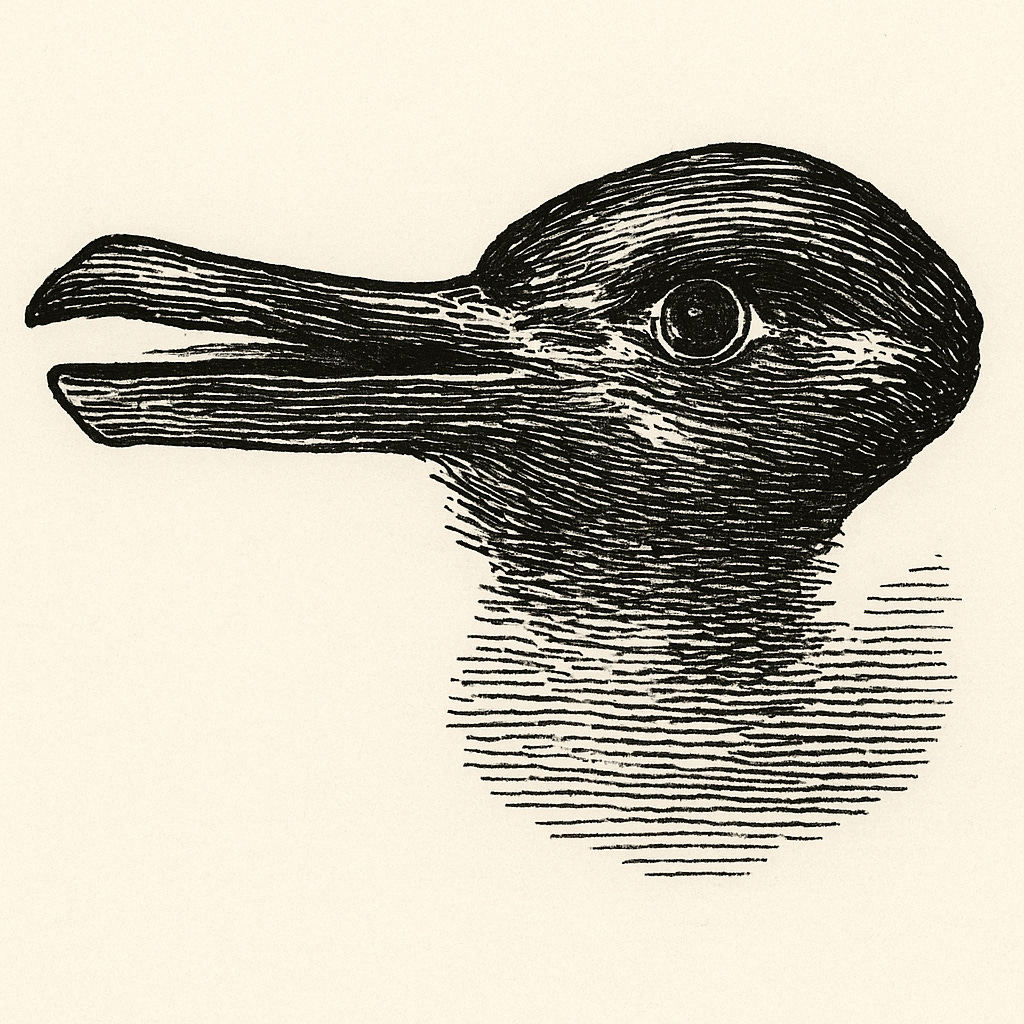
But all that said, I don’t even want to start with Nishitani or anyone from the Kyoto School for that matter. Today I want to start with something simple. I want to give some long-deserved attention to a very important cartoon character that’s come to be known as the duck-rabbit.
Who or what is a duck-rabbit, you may ask.
You ever seen one of those optical illusion things where half of the people that look at it see a duck and the other half see a rabbit?
There are tons of these things out there. It can be a sound. It can be a video. But the point is, aside from this just being some fun optical illusion on a kids’ menu at a restaurant, these are things that can show us something important about the way we see the world as human beings.
Ludwig Wittgenstein used the duck-rabbit in his work to talk about the meaning of words. But the duck-rabbit as a metaphor can actually be useful for all sorts of situations when we want to get out of seeing things in a classic, dualistic, abstract framing of the world, like we’ve been talking about in these posts lately.
And I’d like to take this moment to empathize with a certain kind of person out there reading this series so far.
This kind of person may say, “Look, I hear you. You keep talking about these different framings of our reality. One is a rational, utilitarian framing, where we create systems out of abstractions, I get that one.
But then you start talking about this phenomenological framing, sometimes you even say embodied or religious framing, where apparently in this type of awareness, we’re not breaking things down in this theoretical way anymore.
...This excerpt is provided for preview purposes. Full article content is available on the original publication.