No Kings, Just a Lot of Puppets
Deep Dives
Explore related topics with these Wikipedia articles, rewritten for enjoyable reading:
-
Gene Sharp
12 min read
The article directly references 'an academic supported by the CIA' who promoted Color Revolution methods globally - this is Gene Sharp, whose work 'From Dictatorship to Democracy' became the manual for nonviolent resistance movements worldwide. Understanding his background and influence is essential context for the author's critique.
-
Colour revolution
1 min read
The article explicitly critiques Color Revolutions as evidence for nonviolence effectiveness. Understanding the specific movements (Orange Revolution, Rose Revolution, etc.), their outcomes, and the debate over Western involvement provides crucial context for evaluating the author's claims.
-
Propaganda of the deed
13 min read
The article advocates for an 'ecosystem of revolt' that includes fighting, sabotage, and destruction. This 19th-century anarchist concept of political violence as communication directly relates to the author's argument about the strategic necessity of attack, providing historical depth to the debate.
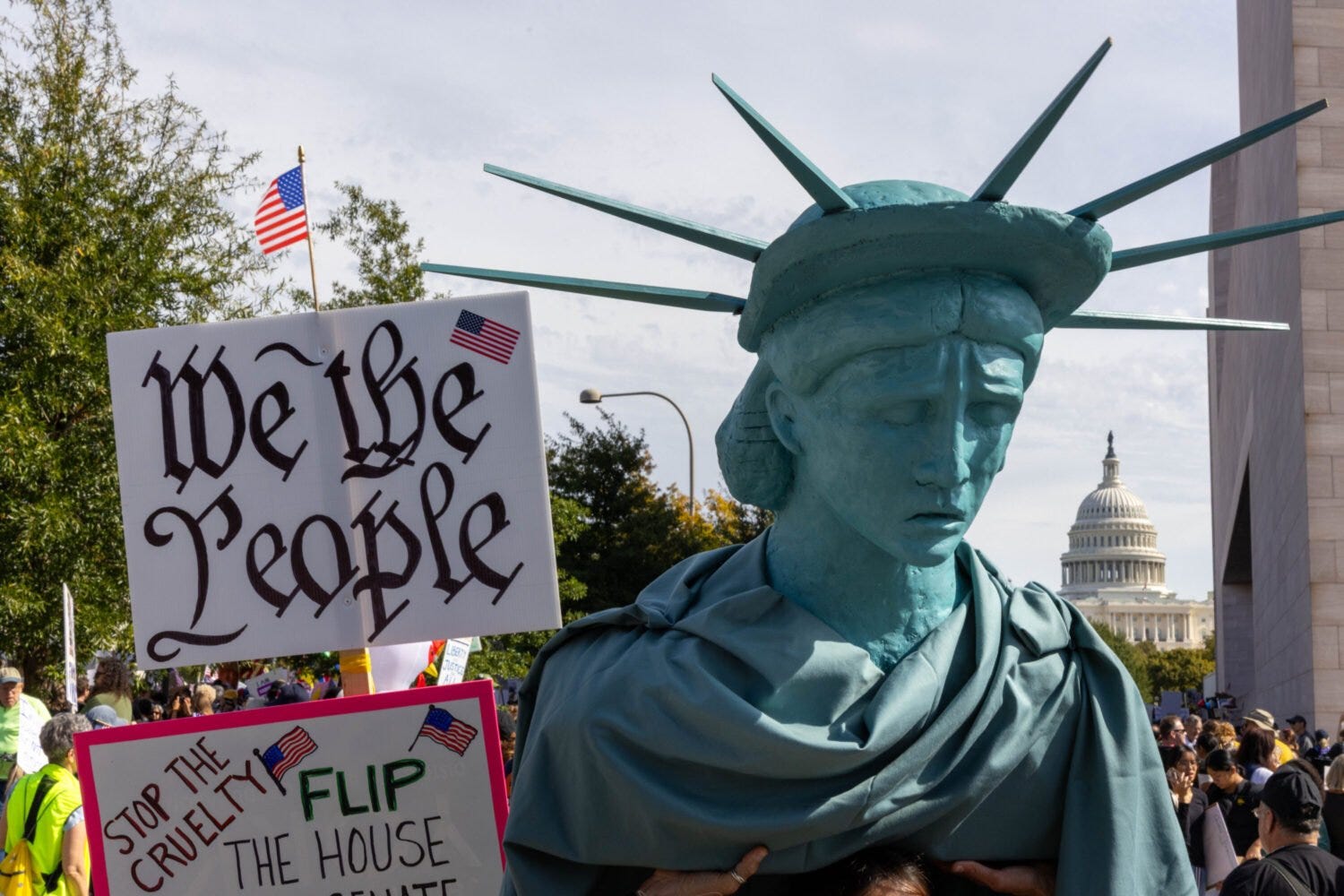
It’s been clear that one of the major effects of the No Kings movement, at least its dominant, center-Left tendencies, is to reenergize pacifism and historical erasure. Remember how in May 2020 no one was taking nonviolence seriously? Because it’s not something to take seriously. It is discredited, debunked, disproven. And yet it keeps popping up again and again, not from people with movement experience, but from naïve progressives, online trolls, politicians, and people from the non-profit industrial complex who get paid to pacify movements.
We already learned that nonviolence doesn’t work in 2020. The learning got erased. We already learned it in 2014. Erased again. We learned it in 2009. Then lost it. Learned it in 2003. Erased. Learned it in 1991. Gone. Learned it in 1968. Erased. Learned it in 1939. See the pattern?
When I reject nonviolence, I want to be crystal clear where the criticism is aimed:
For starters, “violence” is an incredibly vague category. It inevitably has an ethical or even moralistic connotation, and yet more than any other institution mass media defines what “violence” means. That’s not the case with, say, “solidarity” or “sabotage,” which for some odd reason the media don’t talk about as much. (Eventually I’ll have another article out on word slippage and in which cases it makes sense to resist.)
Before the 20th century, “violence” was a primarily poetic term, one that described mood or energy: it wasn’t systematically used to set ethical or strategic boundaries. And even if radical pacifists one day win their century-long crusade to define violence as something that must be directed against living beings (when the media above all want to speak of the violence of protesters who burn a Tesla or smash a bank window), the problem remains: a word that puts dropping a nuclear bomb, killing a Nazi, throwing a rock at a cop, beating up scabs, murdering a child, poisoning a river, gentrifying a neighborhood, or taking up arms against a colonial invasion all in the same box is categorically useless.
How about the person out there who says, “aha! but if works if you accept that self-defense isn’t violence!” I have heard this point made a hundred times. It is easy to take apart. In decades of debate I haven’t come across a single good response to the rebuttal, which is another illustration that
...This excerpt is provided for preview purposes. Full article content is available on the original publication.