The Moon Makes Us Human
Deep Dives
Explore related topics with these Wikipedia articles, rewritten for enjoyable reading:
-
Kerala school of astronomy and mathematics
13 min read
The article directly references the Kerala School's development of infinite series calculations centuries before Leibniz, claiming these innovations emerged from the need to calculate lunar calendars for religious festivals. This is a fascinating and little-known piece of mathematical history that challenges Eurocentric narratives of scientific development.
-
Giant-impact hypothesis
16 min read
The article mentions the major impact event that separated the moon from Earth 4.5 billion years ago as foundational to its argument about the moon's role in creating life. The scientific details of this hypothesis—the Theia collision theory—would provide rich context for readers.
-
Lunar effect
11 min read
The article discusses circalunar rhythms in organisms and the connection between menstrual cycles and lunar phases. This Wikipedia article covers the scientific study of the moon's influence on biological and behavioral phenomena, directly relevant to the article's central thesis about lunar influence on life.
1.
Both science and religion have this in common — that they emerge largely out of our attention to the cycles of the moon. Throughout history and across the world, the lunar calendar has been far more important, in shaping the cycles of ritual feasting and fasting that lie so much deeper than the creeds and the dogmata, than all the things the faithful make explicit in speech about the rituals to which they are already anyway attached. Religion, I am prepared to say, just is ritual, and ritual just is the reflection in culture of the same lunar periodicity that, in our particular corner of the cosmos, does much to shape the rhythms of life itself. Passover, Easter, Ramadan, Diwali — all are pegged to the lunar calendar. And in order to project that calendar into the near-future, in order that is to anticipate upcoming religious holidays, one must calculate. This, in essence, is the primary reason why, by the 14th century, the mathematicians of the Kerala School of southern India had innovated methods for calculating infinite decimal series — methods that three centuries later would come to be attached to the name of Leibniz, and to constitute one of the supposed innovations of the modern mathematical subfield of calculus. Had there been no defeat of the demon Narakasura by Lord Krishna, in short, there would be no suspension bridges, GPS satellites, or semiconductors either.
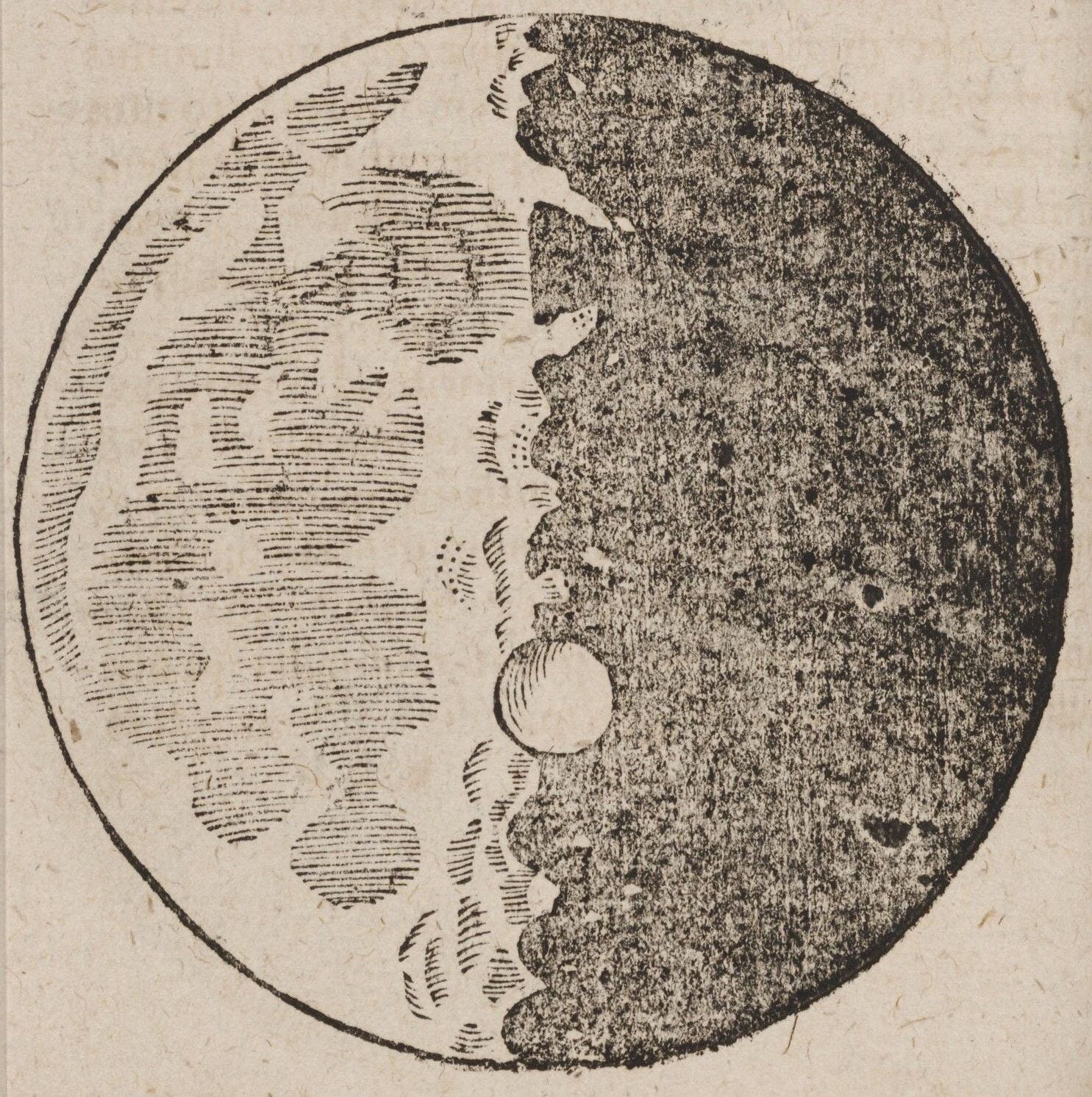
I mean this not in the spirit in which the Hindutva ideologues claim that the Vedas, properly interpreted, contain the blueprint for heavier-than-air aviation technology. I mean that ritual, founded on what we superficially call “myth”, requires the patterning of time, a task that relies on our innate mathematical aptitude. Over the course of history, diligent exercise of this aptitude cannot fail to lead to breakthroughs with significant practical applications. In this respect, for most of human history, religion and science were manifestly but different dimensions of a single overarching human endeavor. And if we wish to look for a single force or entity that set us down this path to begin with, we could not do much better than to point to the moon.
2.
It is likely that a major impact event separated the moon from the earth around 4.5 billion years ago,
...This excerpt is provided for preview purposes. Full article content is available on the original publication.