Eliezer Yudkowsky's View On Consciousness Doesn't Make Any Sense
Deep Dives
Explore related topics with these Wikipedia articles, rewritten for enjoyable reading:
-
B-theory of time
15 min read
Linked in the article (8 min read)
-
Mirror test
12 min read
The article specifically mentions the mirror test as Eliezer's criterion for animal consciousness. This Wikipedia article explains the test's methodology, which animals pass it, and its limitations as a measure of self-awareness - directly relevant context for evaluating the argument.
1 Introduction
Lots of people on Twitter are taking swings at Eliezer for his claim that chickens, newborn babies, and other animals we eat are probably not conscious. Many people’s takeaways have been that because Eliezer has nutty views on animal consciousness, you shouldn’t take seriously his views on other things.
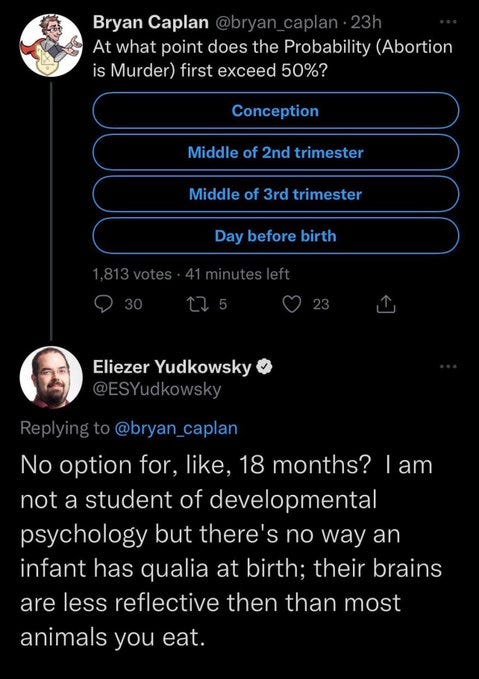
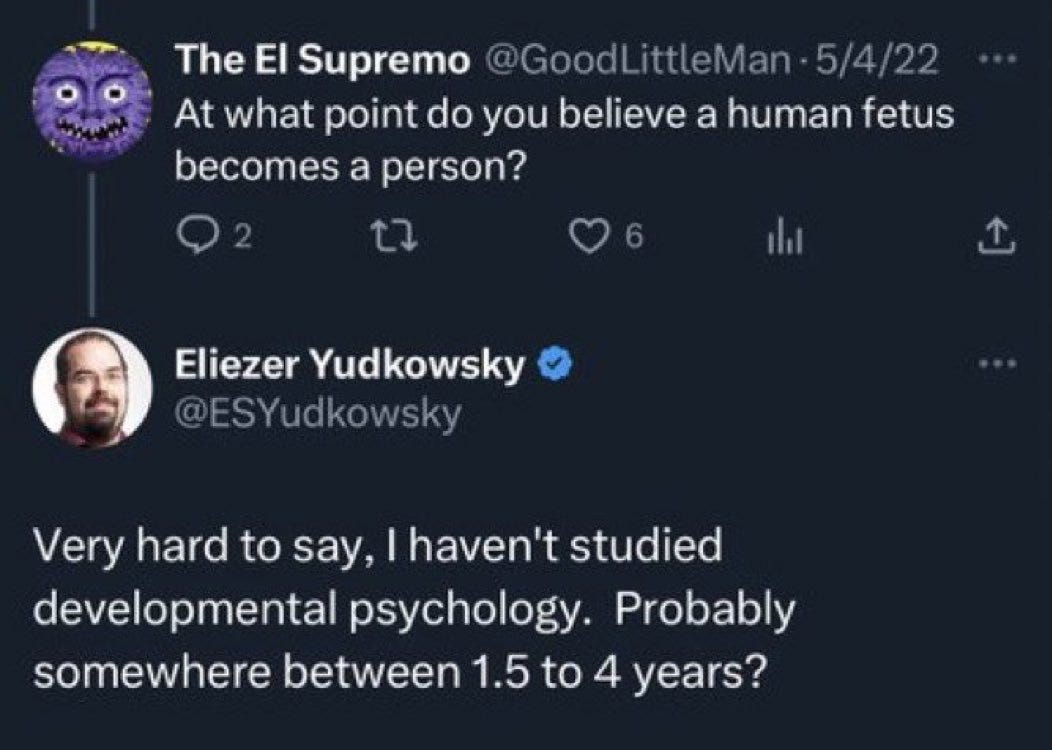
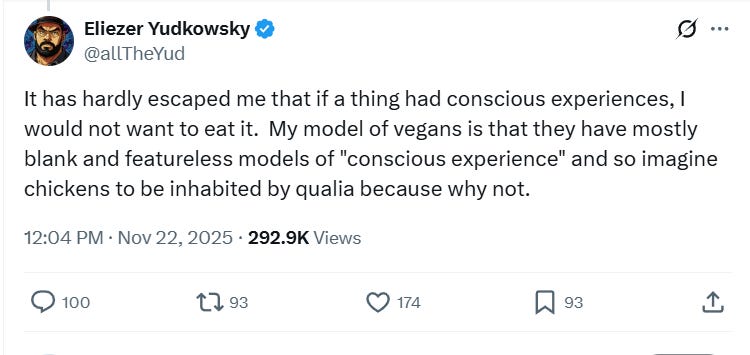
In this article, I want to make two points, one briefly, the other at length:
Whatever you think about Eliezer’s views about animal consciousness, this shouldn’t have much bearing on what you think about AI doom.
Eliezer’s views on animal consciousness are completely ridiculous, especially as justification for not being vegan.
The first point is much more straightforward: Eliezer is not the only person concerned about AI risk. Even if you think he’s a crank, Joe Carlsmith, Toby Ord, Max Tegmark, and Geoffrey Hinton certainly aren’t cranks, and they are also very worried about AI risk. So you shouldn’t ignore AI risk because you don’t take Eliezer seriously.
For what it’s worth, I don’t think Eliezer is a crank. My view of Eliezer—which I defended here a few years ago in some detail—is that while he often has interesting insights, he is very overconfident, fails to carefully understand a subject before discussing it, and thinks bad arguments are decisive. He’s worth reading, but not deferring to. Perhaps nowhere is that more evident than in his analysis of which animals are conscious.
Consciousness refers to having experience—to there being something it’s like to be you. Eliezer’s view, in a nutshell, is that to be conscious, one’s brain has to engage in higher-order self-modeling. For that, animals need a sense of self, and so animals that don’t have that, and that can’t pass a mirror test, are not conscious. Similarly, before humans have a sense of self, he doesn’t think they’re conscious.
This view suffers from several big problems:
It doesn’t fit well with the neuroscientific evidence at all.
It’s a highly specific theory of consciousness with no strong argument in its favor.
Even if a person was pretty sure of it, they shouldn’t be sure enough to think that animal welfare can be safely neglected.
Let’s explore these in more detail.
2 The neuroscientific evidence
Nearly every animal consciousness researcher in the world thinks that other mammals and birds are conscious. Likewise for infants. This is for a very straightforward reason: they behave as if they’re conscious,
...This excerpt is provided for preview purposes. Full article content is available on the original publication.