Shocking Betrayal: Why Progressives are Ditching Climate Laws and Dooming the Planet
Deep Dives
Explore related topics with these Wikipedia articles, rewritten for enjoyable reading:
-
Indian Point Energy Center
14 min read
The article mentions the 'premature closure of Indian Point nuclear plants in 2021' as a pivotal moment that removed carbon-free power from New York's grid. Understanding the history, controversy, and technical details of this specific nuclear facility provides essential context for the energy policy debate.
-
Capacity factor
10 min read
The article discusses 'firm capacity' versus 'intermittent capacity' from wind and solar, but doesn't explain the technical concept. Understanding capacity factor is crucial for evaluating claims about grid reliability and why nameplate capacity doesn't equal actual power delivery.
-
Marcellus Formation
14 min read
The article references 'banning hydraulic fracturing in the Marcellus shale' in Upstate New York. This massive shale gas deposit spanning multiple states is central to the regional energy debate, and its geological and economic significance provides important context for understanding New York's energy supply constraints.
This week, we released a bombshell new report detailing the massive costs and reliability challenges posed by New York State’s climate and energy policies.
Just kidding, the report, entitled New York’s Climate Crossroads: Assuring Affordable Energy, was actually a scathing piece from the Progressive Policy Institute (PPI)—but based on the findings, you would be forgiven for thinking we had written it.
PPI identified “a clear and undeniable pattern of failure” when assessing New York’s progress in meeting the mandates in its signature climate law, the 2019 Climate Leadership and Community Protection Act (CLCA).
According to the New York Post, Neel Brown, the author of the PPI study, said:
“New York set bold climate targets, but ignored the economic and technical realities required to achieve them.”
We couldn’t have said it any better ourselves.
Failure to Launch
PPI reports that the key mandates in the CLCA are:
Greenhouse Gas Reductions: 40 percent reduction from 1990 levels by 2030 and 85 percent by 2050.
Zero-Emission Electricity: 100 percent zero-emission electricity by 2040.
Renewable Energy Grid: 70 percent of electricity from renewable sources by 2030.
Offshore Wind: Install 9,000 megawatts (MW) by 2035.
Distributed Solar: Install 10,000 MW by 2030.
Energy Storage: Install 6,000 MW by 2030.
Hilariously, and unsurprisingly, the PPI study found New York is nowhere near meeting any of these goals, except rooftop solar. But as we noted in our piece Stealing with Solar, net metering raises prices for everyone by shifting the costs of maintaining the grid to the people who can’t afford rooftop solar installations.
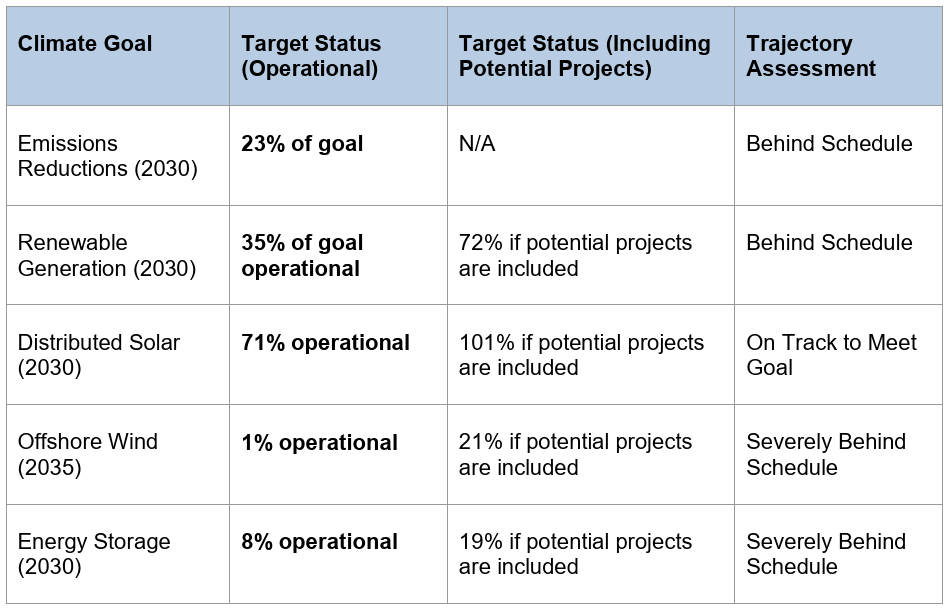
And these findings aren’t surprising, because the fact is that these weren’t realistic goals to begin with.
While 10 to 30 years may seem like a long time for us, this is a relatively short period in terms of the electricity grid, where traditional power plants like coal, natural gas, oil, and nuclear can keep churning out affordable and reliable power for 60+ years. This is especially true when you’re discussing radically altering the resource mix of the grid, which is what New York and other state policies are seeking to accomplish.
Achieving these policy goals was doomed to fail from the beginning.
THE LOOMING CRISIS: A COLLISION OF SUPPLY, DEMAND, AND COST
Amazingly, that was the actual headline in the PPI report, as they note:
...New York’s energy system is entering an environment where policy-driven pressures are converging to
This excerpt is provided for preview purposes. Full article content is available on the original publication.