Making Sense of the EPA Endangerment Finding Rule

A few days ago the U.S. Environmental Protection Agency (EPA) issued a new rule that rescinded the 2009 Endangerment Finding that found that six greenhouse gases emitted from autos posed risks to health and welfare. Also eliminated by the EPA decision are a set of regulations governing emissions from light vehicles and trucks that followed directly from the Endangerment Finding.
You can read background leading up to the ruling — here, here, and here. I’ve spent the past few days reading the rule and associated documents, and have prepared an initial set of questions and answers on arguments in the rule that stood out to me as important.
Online discussion of the rule that I’ve seen suggests hyperbolically that it is either the end of all U.S. climate policy or alternatively the greatest regulatory rollback in U.S. history. I don’t align with either view. While the final rule is much stronger than I anticipated, based on EPA’s early arguments, I still think that it has a good chance of being struck down, but it might be close.
What the rule does offer is an opportunity for Congress — to at least clarify the language of Clean Air Act, but perhaps more significantly to open up a debate over what a common-sense, bipartisan approach to greenhouse gas policy might look like in legislation.
With that, let’s go to the FAQs . . .
What is the “endangerment finding” debate about anyway?
The entire debate over the Endangerment Finding is based on interpretations of the meaning of a 112-word paragraph in the Clean Air Act., shown in full below.
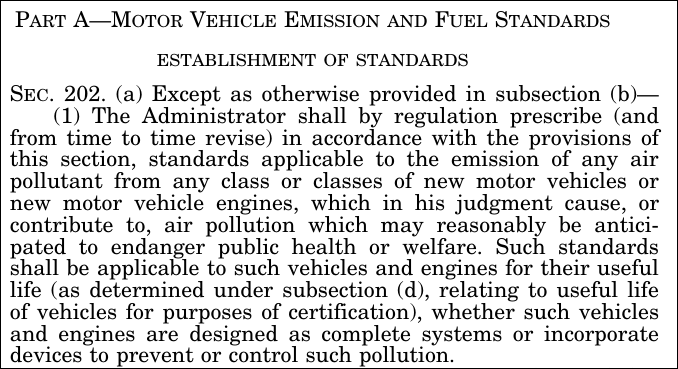
In its rule, the EPA explained that it was reinterpreting 9 of these 112 words, highlighted below:
“The EPA determines that CAA section 202(a)(1) does not authorize the Agency to prescribe emission standards in response to global climate change concerns for multiple reasons, including the best reading of the statutory terms “air pollution,” “cause,” “contribute,” and “reasonably be anticipated to endanger.” This statutory interpretation is corroborated by application of the major questions doctrine. The EPA further determines that GHG emission standards for new motor vehicles and engines do not impact in any material way the public health and welfare concerns identified in the Administrator’s prior findings in 2009.”
EPA argues that legal judgments since the issuance of the 2009 endangerment
...This excerpt is provided for preview purposes. Full article content is available on the original publication.