How “95%” escaped into the world – and why so many believed it
Hi all, today’s post is open to all in the service of public discourse and anti‑slop thinking.
One number still keeps turning up in speeches, board meetings, my conversations and inbox:
“95 percent”
Do I need to say more than that? OK, here’s another clue: this number traveled on borrowed authority in 2025, rarely with a footnote and it started to shape decisions.
The claim is this: “95 percent” of organizations see no measurable profit-and-loss impact from generative AI. Of course, you know what I’m talking about. It has ricocheted through Fortune, the FT, The Economist, amongst others.
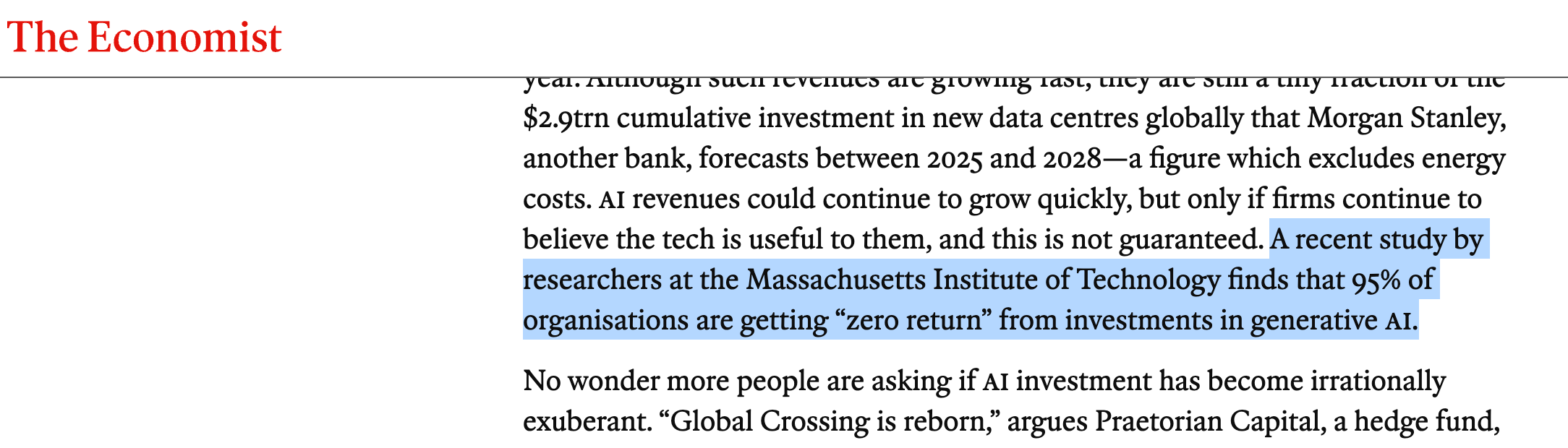
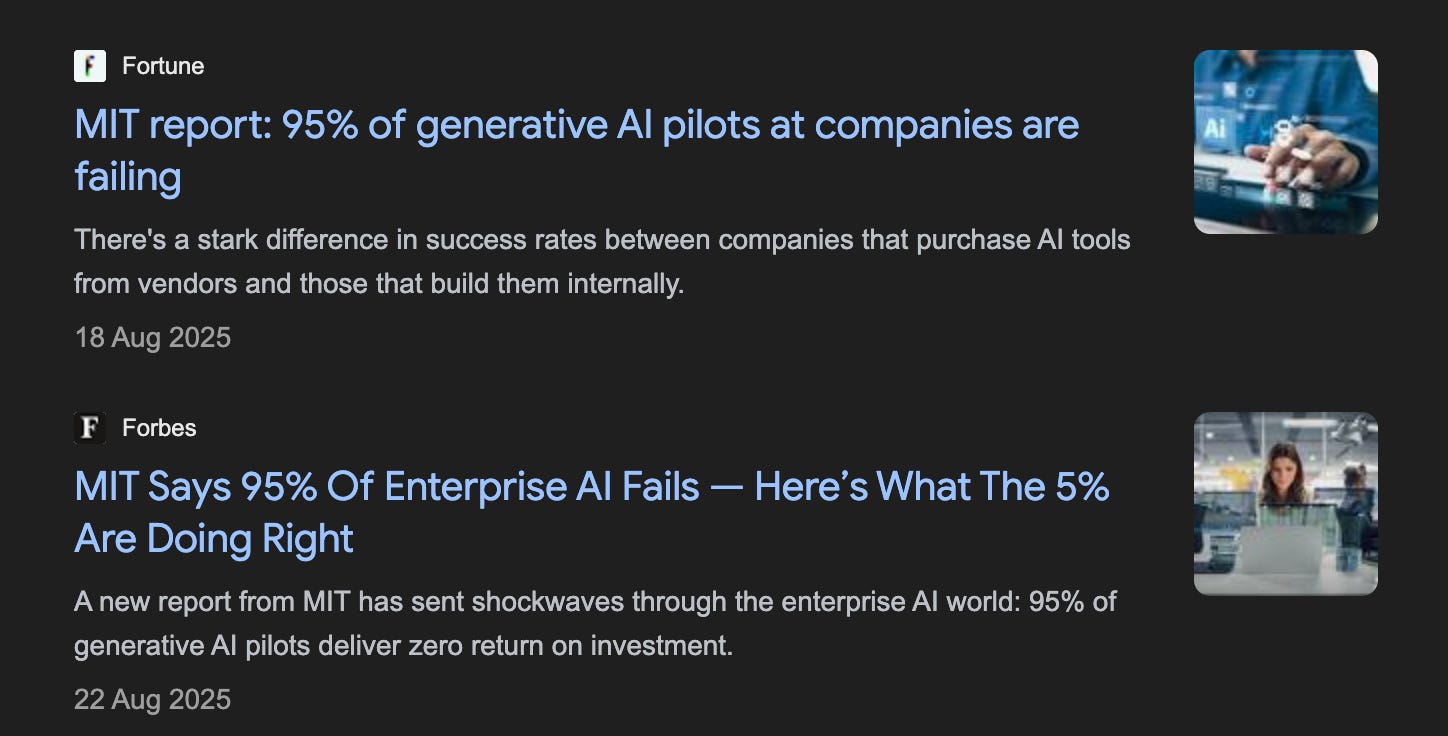

Often presented as “MIT / MIT Media Lab research,” the “95 percent” is treated as a settled measurement of the AI economy. It’s invading my conversations and moving the world. I’ve heard it cited by executives as they decide how to approach AI deployments and investors who use it to calibrate risk.
This number basks in the glow of MIT, the world’s best technology university. And I started to wonder if this evidence had truly earned that halo. Turns out, I’m not the only one – Toby Stuart at the Haas School of Business wrote about it as an example of how prestige and authority can turn a weak claim into an accepted truth.
Late last year, I tried to trace the claim back to its foundations. Who studied whom, when and what counted as “impact”? What makes the “95 percent” a number you can rely on, rather than a sop for clickbait? I also reached out to the authors and MIT for comment. I’ll share today what I found.
The paper trail
The original report was produced in collaboration with the MIT NANDA Project. The NANDA project was, at the time the report was published, connected to the Camera Culture research group of the MIT Media Lab. MIT’s logo is the only logo that appears in the document. The phrase “MIT Media Lab” doesn’t appear in the document.
The paper’s two academic authors, Associate Professor Ramesh Raskar and Postdoctoral Associate Pradyumna Chari, both affiliated with the same Camera Culture research group at MIT Media Lab. There were two
...This excerpt is provided for preview purposes. Full article content is available on the original publication.