A Flash is Not a Cupcake...
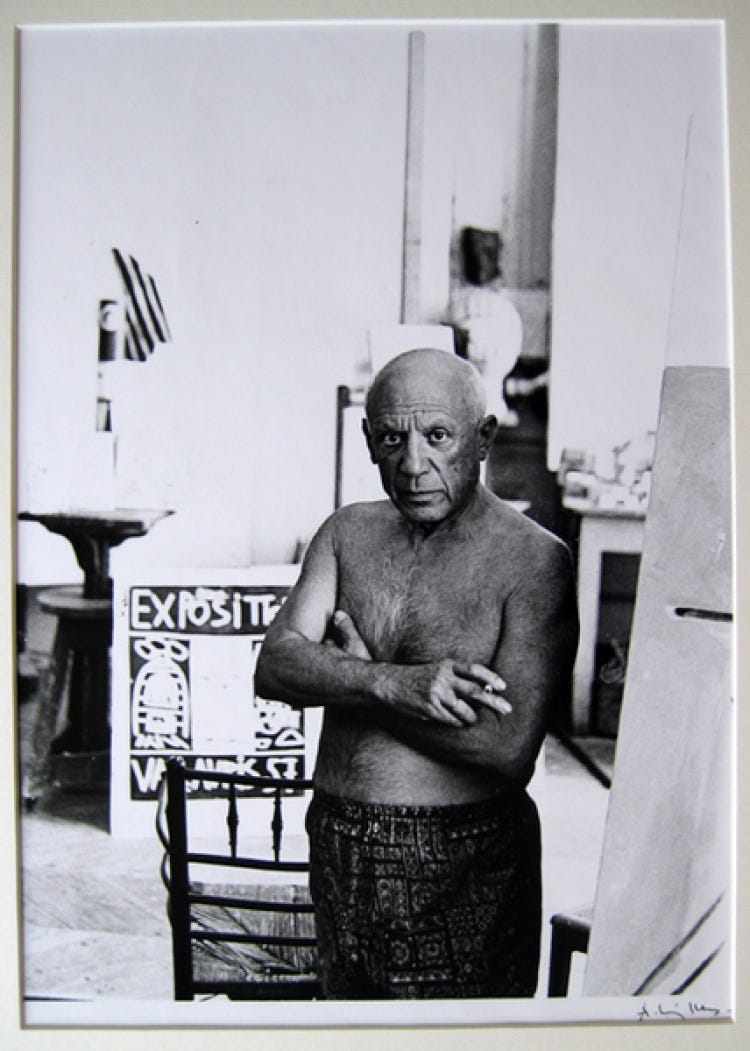
A little artist.
(What follows is adapted from a 2021 newsletter, the topic of which I think bears repeating. Hope you enjoy. ~KF)
I’m often asked to define flash fiction, and almost out of a sense of duty, I provide the standard answer (flash fiction is a story of 1,000 words or fewer), but it feels so dissatisfying to say this. Yes, that’s flash at its most basic but to those of us who read, write, and teach it, it’s so much more than that.
To say flash is a short story, only smaller, feels reductive. If a short story is a cake, a flash is a cupcake. If a novel is a house, the short story is a room, then flash is, what? A corner of the room? A closet? If a story is a meal, a flash is a morsel? A snack? These metaphors distinguish flash by its smallness alone. It would be like defining Pablo Picasso, who stood 5 feet 4 inches, as a “little artist,” instead of the revolutionary 20th century artist and co-founder of Cubism he was.
Flash fiction is its own unique literary form, not merely a short story in miniature, and I believe we should teach it as such.
I love what W. Todd Kaneko says in his essay, “Planets in Miniature: On Kandor and Compression in Flash Fiction,” from the wonderful flash anthology edited by Megan Giddings, Forward: 21st Century Flash Fiction (Aforementioned Productions, 2019):
“A flash fiction could be called a little story, but not in the way that a dollhouse is a miniature of those mansions on the affluent side of town. While a flash fiction takes up less real estate on the page than a longer work, it can deliver an equal amount of story, just compressed. In great part, compression in flash fiction is not about shrinking, but about hyper-efficient narrative.”
How then to teach / demonstrate the skill of “hyper-efficient narrative”?
We can of course have students write a longer, traditional short story, then instruct them how to cut it down to size:
Trim the fat by eliminating redundancies, asides, excess description, needless backstory and exposition.
Sharpen dialogue by distilling it to its essence, to only what serves characterization and plot.
Edits like the above, as well as “arriving late and leaving early” are just fundamental ways to make any writing stronger. But we’re still teaching and
...This excerpt is provided for preview purposes. Full article content is available on the original publication.