Nietzsche and the Zionists
The Gaza Strip was an embarrassing subject; under Egyptian rule, it was dangerously close to Israeli centers, but ruling hundreds of thousands of refugees was also a bad option. “If I believed in miracles I would want it to be swallowed up by the sea”
— Ben-Gurion, 1956, in ‘Ben-Gurion, Father of Modern Israel’ by Anita Shapira
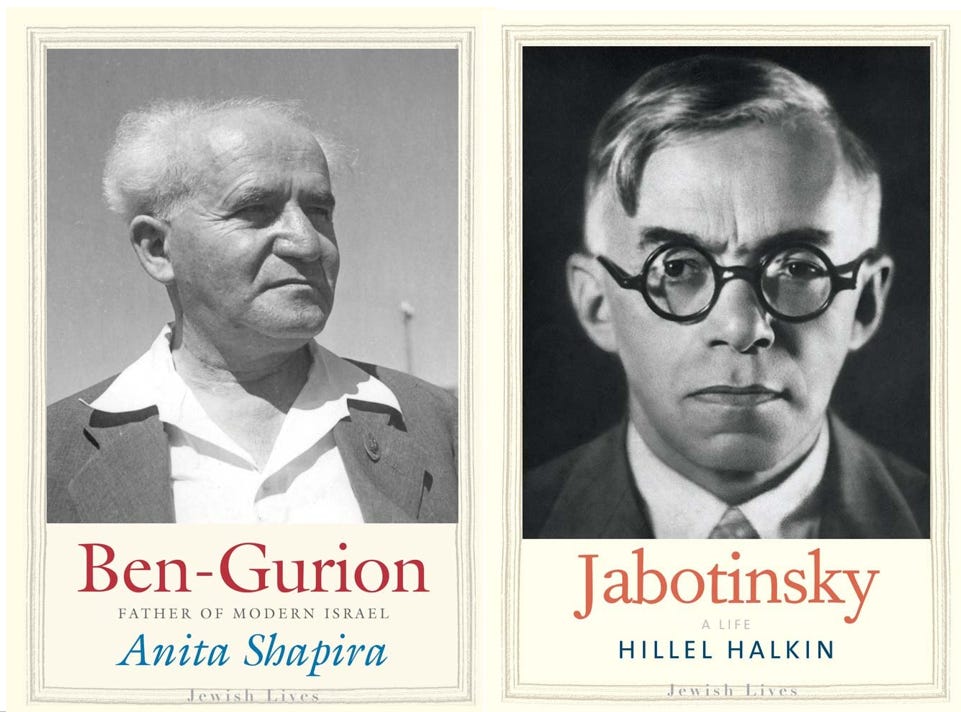
Related: Herzl’s Dream, The Hundred Years' War on Palestine, On Gaza
There’s a lot that’s surprising about the lives of the early Zionist fathers. Ben-Gurion, a Plonsk shtetl Jew who in his early-teens first adopted spoken Hebrew with his Zionist compadres, singularly propelled spoken Hebrew (a rarity) to a hallmark of Plonsk’s Zionist youth. He later learned Turkish in three weeks.1 Jabotinsky was an Odessan cosmopolitan,2 an author and playwright, a cad who could flirt seamlessly in Italian and almost a dozen other languages.3 At one point he proposed to Latinize Hebrew script, following Ataturk’s example in Turkey. For pioneers of a nascent nation to be forged in war, they were surprisingly intellectual. Ben-Gurion was book obsessed, building a huge library into his first home, and startling Isaiah Berlin with his inner life.4 Jabotinsky translated Dante, Poe, and Byron into Hebrew. He wrote five novels, one of which (Samson the Nazirite) was made into a Paramount picture where he was credited (!). For an agrarian socialist, Ben-Gurion hated the farming life. For his reputation as a nationalist firebrand, Jabotinsky was not much of a warrior. His only (probable) kill was shooting a wounded Turkish prisoner his troops were unable to take with them, which haunted him for life.
Ben-Gurion’s agrarian socialism seems arcane and bizarre today, and it’s easy to forget how dominant and very literal it was in early Israel. Ponder this paragraph, for example:
Neither the Weizmann-dominated Executive nor the Labor Zionist–controlled Council wished to see a large influx of European Jews who were not interested in agricultural pioneering. Their first priority was not maximally increasing the Jewish population of Palestine... Rather, as Weizmann stated, it was ‘converting into peasant farmers an urbanized people’ as part of the transformation of values in Jewish life that Zionism stood for. (Hillel Halkin, Jabotinsky)
Jabotinsky’s nationalism and emphasis on a Jewish majority seem clearly correct. And when you look upon Israel today, it’s proven prescient. Labor is no more. Agrarian socialism is no more. Jabotinsky’s
...This excerpt is provided for preview purposes. Full article content is available on the original publication.