VERSIONS OF ABJECT: UGLY, CREEPY, DISGUSTING (PART ONE)
Deep Dives
Explore related topics with these Wikipedia articles, rewritten for enjoyable reading:
-
Julia Kristeva
13 min read
Kristeva's theory of abjection is the central framework of this article. Understanding her background as a Bulgarian-French philosopher, psychoanalyst, and literary critic—and how she synthesized Lacanian psychoanalysis with semiotics—provides essential context for her concept of the abject discussed throughout.
-
Objet petit a
12 min read
The article extensively contrasts Kristeva's abject with Lacan's objet petit a, examining how each functions differently within symbolic order. This Lacanian concept of the unattainable object of desire is crucial for understanding the theoretical distinctions Žižek draws.
-
Quentin Matsys
12 min read
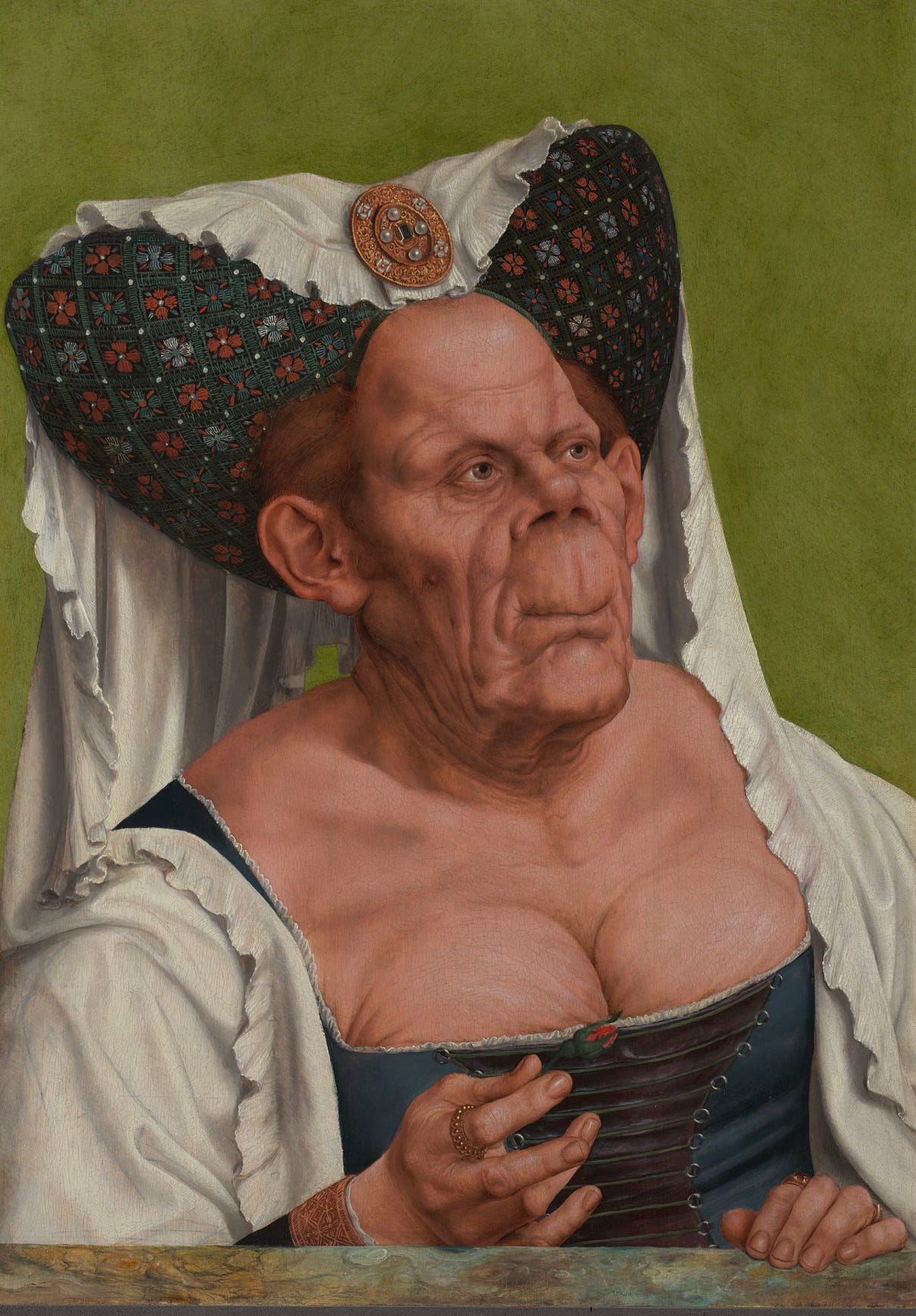
The article opens with Massys' 'The Ugly Duchess' (1513) as its visual anchor. Understanding this Flemish Renaissance painter and this particular grotesque portrait—possibly depicting a woman with Paget's disease—illuminates why this image exemplifies the concept of aesthetic abjection.
Welcome to the desert of the real!
If you desire the comfort of neat conclusions, you are lost in this space. Here, we indulge in the unsettling, the excessive, the paradoxes that define our existence.
Below, an older text. To be published in parts.
(Painting: Quinten Massys’ An Old Woman (known as The Ugly Duchess, 1513)
What happens when we stumble upon a decaying human corpse or, in a more ordinary case, upon an open wound, shit, vomit, brutally torn-out nails or eyes, or even the skin that forms on the surface of warm milk? What we experience in such situations is not just a disgusting object but something much more radical: the disintegration of the very ontological coordinates that enable us to locate an object in external reality “out there.” The phenomenological description of such experiences is Julia Kristeva’s starting point in her elaboration of the notion of the abject: the reaction of horror, disgust, withdrawal, ambiguous fascination, and so on, triggered by objects or occurrences that undermine the clear distinction between subject and object, between “myself” and reality “out there.” The abject is definitely external to the subject, but it is also more radically external to the very space within which the subject can distinguish itself from reality “out there.” Maybe Lacan’s neologism “extimate” can be applied here: the abject is so thoroughly internal to the subject that this very over-intimacy makes it external, uncanny, inadmissible. For this reason, the status of the abject with regard to the pleasure principle is profoundly ambiguous: it is repulsive, provoking horror and disgust, but at the same time exerting an irresistible fascination and attracting our gaze to its very horror: “One thus understands why so many victims of the abject are its fascinated victims—if not its submissive and willing ones.”1 Such a mixture of horror and pleasure points towards a domain beyond the pleasure principle, the domain of jouissance: “One does not know it, one does not desire it, one enjoys it [on en jouit], violently and painfully. A passion” .
Is the abject, then, close to what Lacan calls objet petit a, the “indivisible remainder” of the process of symbolic representation that functions as the always-already lost object-cause of desire? Objet petit a as the object-cause of desire is, in its very excessive nature, an immanent part of the symbolic process, the spectral/eluding embodiment of lack that motivates desire
...This excerpt is provided for preview purposes. Full article content is available on the original publication.