Wind and Solar Get the Stick
“So if somebody wants to build a coal-powered plant, they can. It’s just that it will bankrupt them because they’re going to be charged a huge sum for all that greenhouse gas that’s being emitted.” - Barack Obama
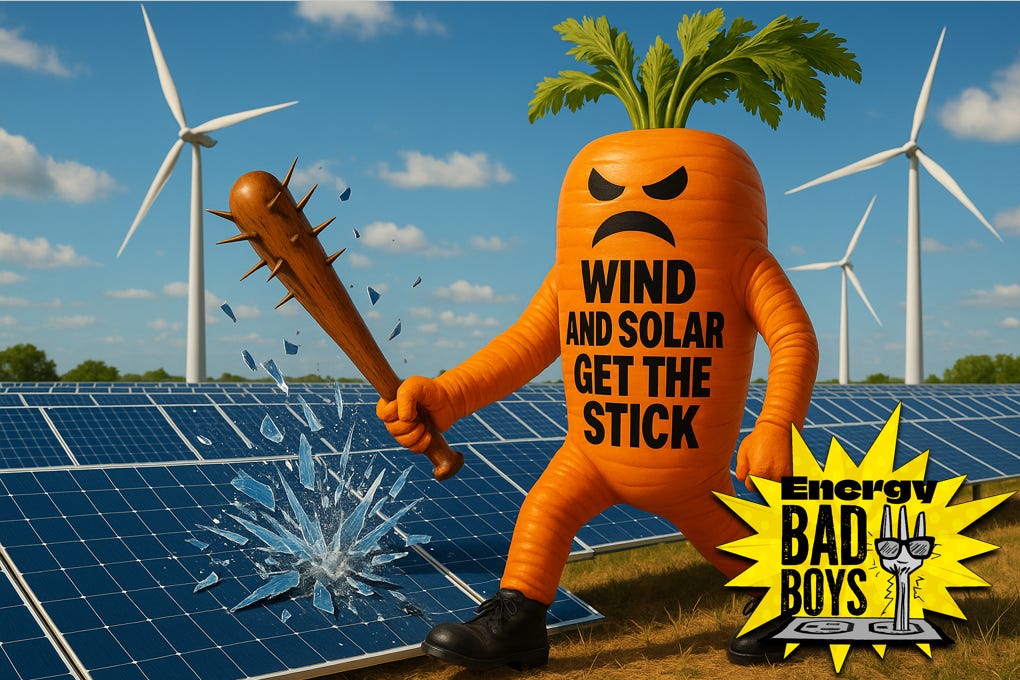
There are two primary means of motivating people to do things: incentives (carrots) or negative consequences (sticks).
Wind and solar advocates often complain about uncertainty in their business models, but the main uncertainty these industries have faced over the last four decades has been regarding the size of their carrots provided by the government, rather than the swings of normal market conditions.
Will the generous production tax credits (PTC) and investment tax credits (ITC) be extended (again)? Will states continue to create an ever-larger guaranteed market for their preferred product through energy-affirmative-action renewable portfolio standards?
At the same time, wind and solar benefited from the policies of liberal politicians at both the state and federal levels, who began brandishing larger and larger sticks against the competition. These sticks took the form of legislation and regulation, constituting a “whole of government approach” against conventional energy sources.
Coal mining and oil and gas drilling leases were canceled, pipelines were protested, and permits were pulled; 100 percent carbon-free electricity standards created dead-end markets for coal and natural gas in some states, federal greenhouse gas and criteria pollutant regulations on power plants sought to limit their use nationwide, and financial regulations to chill continued investment in these industries.
There was also plenty of rhetoric that chilled investment coming from top political leaders. In the lead-up to his eventual presidential win, then presidential nominee Joe Biden signaled his opposition to fossil fuels by proclaiming at a town hall event in New York City, “I guarantee you, I guarantee you, we are going to end fossil fuel, and I am not going to cooperate with them.” He clarified that this meant no more subsidies, no more drilling on federal lands, and “no ability for the oil industry to drill, period. It ends."
The Biden presidency put these words into action, pausing new oil and gas leases on public lands in January 2021 and taking over 80 other actions by early 2022 to negatively impact the fossil fuel industry—in addition to passing the Inflation Reduction Act (IRA), which Biden described as an attempt to move “away from fossil fuels to cleaner technologies like wind…”
For
...This excerpt is provided for preview purposes. Full article content is available on the original publication.