The Legal Megalomania of Intersectionality
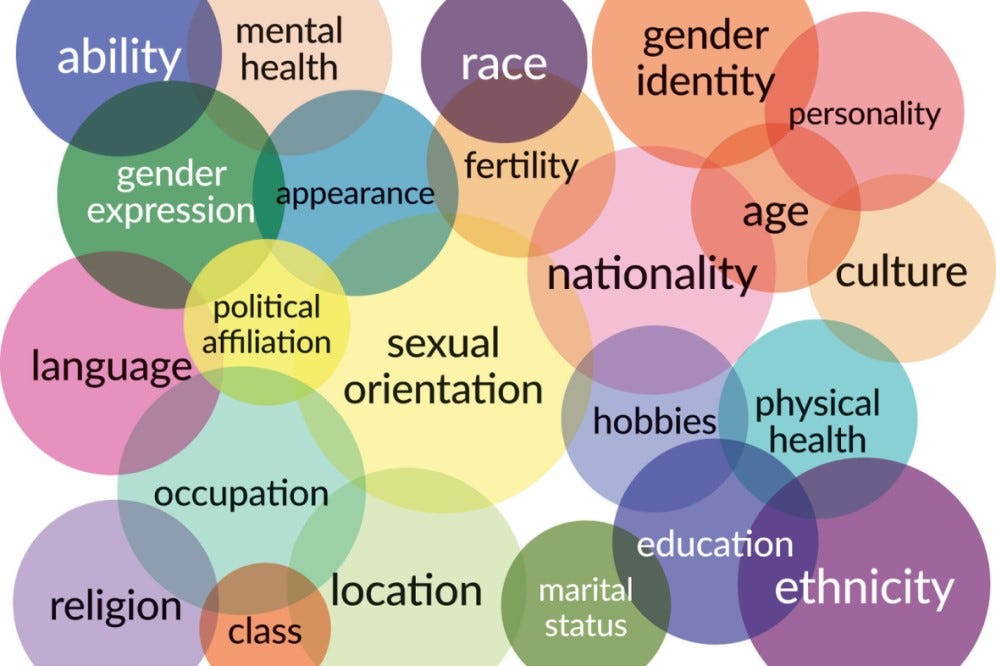
This article is long, dense, and technical but also clear, rigorous, and unanswerable. It demonstrates that one of the key activist concepts of our time, a buzzword that has been elaborated into a worldview, rests on an intellectual foundation built atop quicksand.
Much of the authority of “intersectionality”, and by extension the cascade of tedious copypasta which now infests our governing bureaucracies, public schools, and the Instagram feeds and inner monologues of neurotic youth throughout the Western world, rests upon the unexamined assumption that the original theory is grounded in rigorous legal scholarship that offers a revelatory lens through which to identify the hidden inequities stitched into the fabric of our societies. The author of this post dismantles this pretense by thoroughly fisking the actual legal analysis at the heart of the article that inaugurated the discourse. She reveals how little its own analysis supports its overarching claims and how much of it in fact subverts it.
It is of course somewhat quixotic to try to hold to account a buzzword that was never intended to meet the standards of an intellectual discipline to the standards of an intellectual discipline. Intersectionality, like most of the corpus of maudlin and histrionic textual performances that were laundered through law journals as “Critical Race Theory,” was forthrightly aimed at incubating a memeplex that activists and other moral entrepreneurs could milk for clout and not to withstand the scrutiny of legal scholars. In this it has succeeded hugely.
At one level, it doesn’t really matter that the original statement of intersectionality’s theoretical claims are self-undermining or that its major premises can be empirically refuted by three minutes of Googling (revealing, for instance, that white men are the group by far the most likely commit suicide, or that any empirical analysis finds that the group for whom disadvantage most compounds are those who are black and male, who lag far behind their black female counterparts along every measurable index of well-being despite operating in an alleged patriarchy.) No one subjected the article to any real scrutiny at the time of publication because the concept was never about creating analytically useful tools for understanding the world. Consolidating power within left activist spaces and generating a paint by numbers academic discourse that can provide leverage for those seeking tenure in schools of education, psychology, and social work, whose graduates have gone on to bend one profession
...This excerpt is provided for preview purposes. Full article content is available on the original publication.