Trumpist Geopolitics in Western Balkans
Deep Dives
Explore related topics with these Wikipedia articles, rewritten for enjoyable reading:
-
Dayton Agreement
13 min read
The article centers on the 1995 Dayton Agreement as the foundational framework for Bosnia and Herzegovina's current political structure. Understanding the specific provisions, negotiations, and compromises of this agreement is essential context for the article's critique of how it 'froze the country into a constitutional maze' and why proposals for a 'third entity' are now being debated.
-
Milorad Dodik
1 min read
Dodik is a central figure in the article, described as having 'built his power on the nonstop manufacture of an existential threat' while presenting himself as having Moscow's backing. His political career and evolution from moderate to nationalist leader provides crucial context for understanding the current political dynamics in Republika Srpska.
-
Željko Komšić
12 min read
The article discusses the 'Željko Komšić case' as a symbolic controversy where the Croat member of Bosnia's Presidency was elected primarily by Bosniak votes. This specific electoral dispute is key to understanding the legitimacy debates around ethnic representation and the push for electoral reform and a potential third entity.
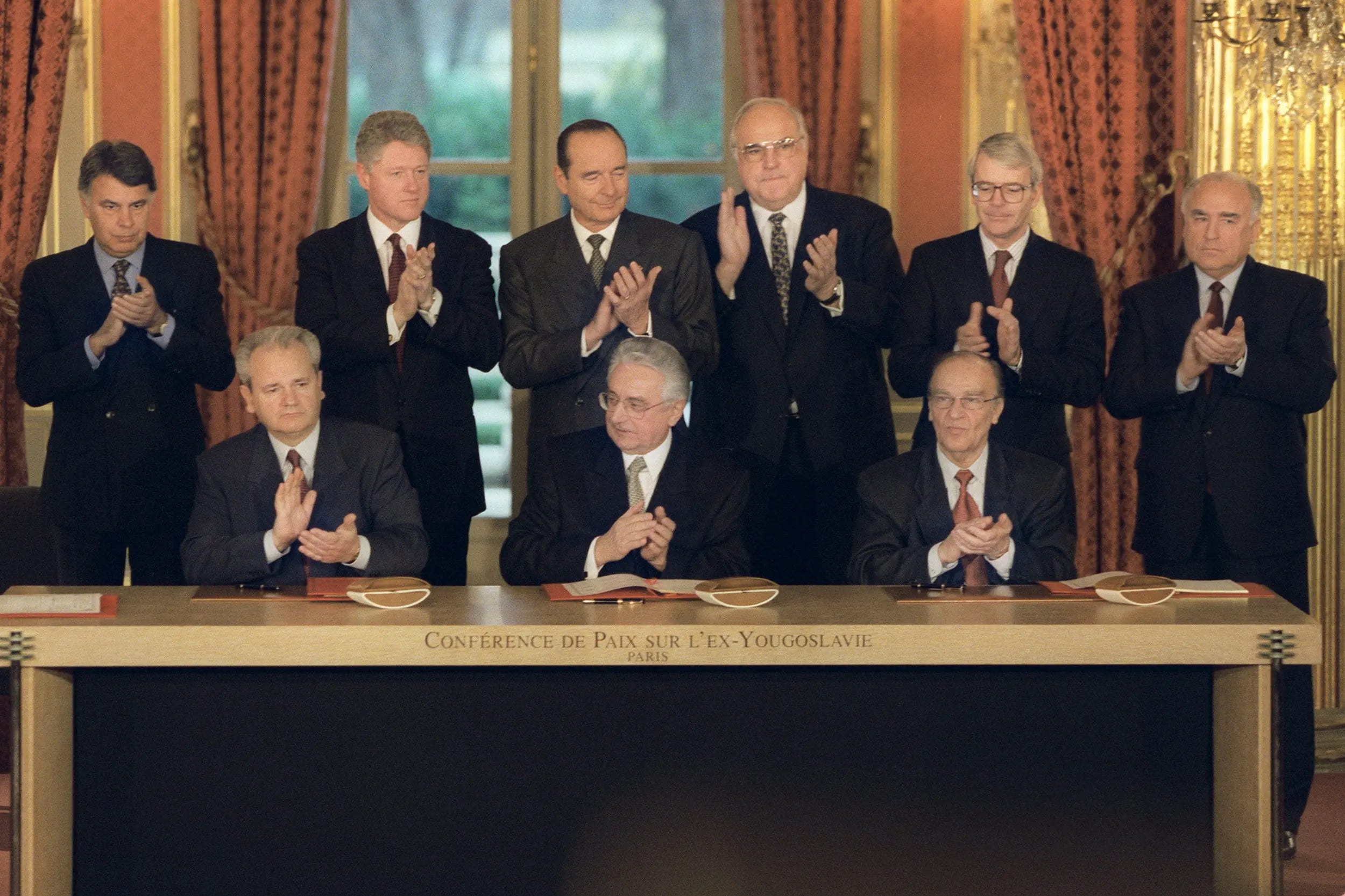
Bosnia and Herzegovina is usually introduced to foreign readers as a “post-war success story” held together by the 1995 Dayton Peace Agreement—a fragile compromise that ended the bloodshed by freezing the country into a constitutional maze. Two entities, three “constituent peoples,” a rotating tripartite Presidency, layers of vetoes and international supervision: Dayton didn’t build a shared political community so much as it administered a ceasefire in legal form, turning everyday life (jobs, schools, hospitals, housing) into collateral damage of permanent ethnic bargaining.
But in recent years, a different vocabulary has been gaining ground—one that reframes BiH not as a society in need of reconstruction, equality, and economic renewal, but as a border problem. In this language, the country is no longer a place where people live; it is a sanitary cordon. Its institutions become a guardhouse for the EU and NATO, and its internal arrangement is treated as something to be “adjusted” to the needs of frontier management. That is how calls for constitutional and territorial “reform” are increasingly sold: not as democratic repair, but as security engineering.
This is where Trumpist ideology enters the picture.
A policy analyst at the conservative US think tank The Heritage Foundation, Max Primorac—the son of Croatian right wing immigrants from Herzegovina and a man well placed within Trumpist circles—has articulated a view that has largely slipped under the radar in Serbia, Montenegro, and Bosnia and Herzegovina, even though it neatly distills the dynamics now unfolding on the ground.
Starting from the familiar narrative of the “sad fate” of Croats in BiH and the demographic decline afflicting both Bosnia and Croatia—a downturn driven, to a significant extent, by prolonged post-Yugoslav social unraveling and economic out-migration—Primorac immediately translates the issue into the language of geopolitics and security borders. In that context, he said the following:
“The last thing Croatia needs right now—or NATO, or the EU, because it’s the same border—is for (the Croatian people in BiH, author’s note) to be left with yet another pro-Kremlin-oriented Serb entity and a radicalized Muslim entity. At this moment, I think the only way to prevent that, and to secure the Croatian and European border, is for there to be a third entity. Otherwise, the Croatian community will disappear.”
What matters most in this statement is neither any real concern for the “Croatian people,” nor the performative
...This excerpt is provided for preview purposes. Full article content is available on the original publication.