American Will: The Panama Canal
The Panama Canal was, at the moment of its completion, the largest structure ever built by man. Its locks — each chamber a thousand feet long, a hundred and ten feet wide, their gates rising eighty feet from the floor, taller than a seven-story building — were formed of more concrete than any construction in human history. To dig the canal, seventy-five thousand men excavated enough earth to build seventy Great Pyramids, enough to bury Manhattan to the depth of a man’s chest.
This the Americans built over ten years and three presidencies.
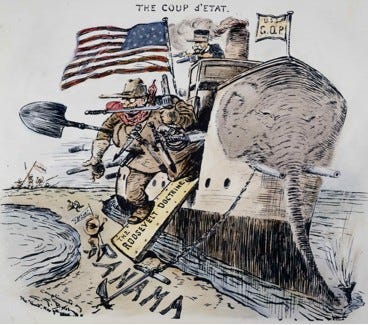
But before the Americans could build the canal, they had to build the largest artificial lake on earth, flooding an entire river valley to lift ships over mountains. Before they could build the lake, they had to rid the isthmus of pestilence, eradicating yellow fever from a region where it had reigned for three centuries. Before they could eradicate the fever, they had to control the land — which meant staging a revolution, peeling Panama away from Colombia in a single bloodless day.
And before any of it — before the lake, before the eradication of fever, before the coup — they had to succeed where the greatest builder of the age had failed. Ferdinand de Lesseps, the hero of Suez, had tried to cut this canal. By 1889 he had spent a decade and $287 million of French savings. He had buried twenty-two thousand men in the jungle earth. And he had accomplished nothing but ruin.
The man who had made the world smaller had sought to cut it in half. Within two years of his triumph at Suez, while Europe still rang with his name, Ferdinand de Lesseps turned his gaze westward — to the dark, fever-haunted jungles of Central America. If he could slice through the sands of Egypt, why not the spine of the New World? In 1879, at the age of seventy-four, he convened an international congress in Paris and, through the sheer gravitational force of his reputation, secured approval for a sea-level canal through the Isthmus of Panama.
The American engineers in attendance — men who had actually surveyed the terrain — knew it was madness. They had spent years tramping through the mosquito clouds and the sucking mud, taking measurements, losing colleagues to fever. They knew the Chagres River, that treacherous serpent that could rise forty feet in a
...This excerpt is provided for preview purposes. Full article content is available on the original publication.