New Book, Founding Member Perks, and Hegelian Dialectics with Myself
Deep Dives
Explore related topics with these Wikipedia articles, rewritten for enjoyable reading:
-
Populism
14 min read
The article announces a book entirely dedicated to explaining populism as a political phenomenon. Understanding the academic definition, historical examples, and scholarly debates around populism would provide essential context for evaluating the author's arguments.
-
Dialectic
15 min read
The article title explicitly references 'Hegelian Dialectics with Myself' and the author's intellectual journey from endorsing Trump to rejecting MAGA represents a thesis-antithesis-synthesis pattern. Understanding this philosophical framework illuminates the author's self-described ideological evolution.
-
Elite theory
12 min read
The article extensively discusses elites, 'organic elites,' and the relationship between elite networks and populism. The author references his previous work on 'Elite Human Capital' and presents a theory of democratic institutions centered on elite function. Elite theory provides the academic foundation for these arguments.
I’m ready to announce that I have a book coming out this summer. It is called Kakistocracy: Why Populism Ends in Disaster. Here is the cover:
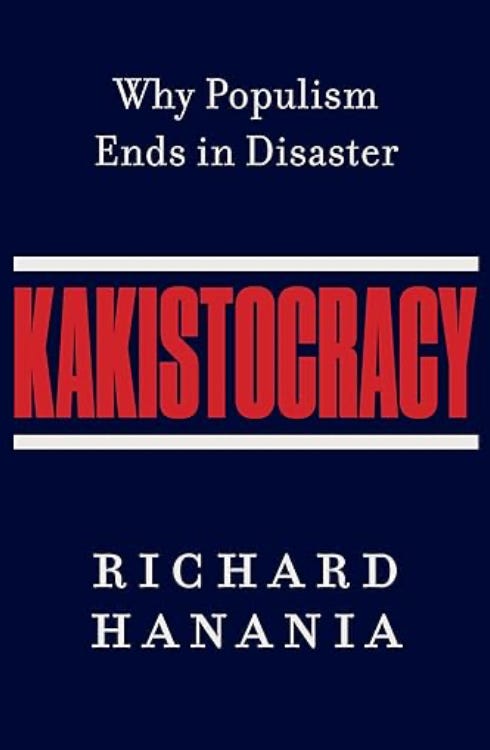
You can buy it here on Amazon in hardback, or on Audible or Kindle. For the audiobook, I think I’m going to read it myself this time, as I regretted not doing this for the last one. If you want to hear my sonorous voice for 12 hours or so, then the audiobook is for you.
I am encouraging everyone to preorder now and then forget about the book until July. I’m in an interesting place in the political discourse. There are a lot of people of all opinions and outlooks who do not like me. Rather than holding back on what I think, my goal has been to become so relevant – to insert my views into public conversations in ways that smart people find compelling – that I am difficult to ignore. Having a book that sells extremely well is one of the most straightforward ways I can continue doing this. So buying Kakistocracy is voting with your wallet that you want me to be an important figure who others listen to. I don’t think you’ll find anyone else who has been more honest with you about what they believe and why, and who has shown less regard for the reactions of any political faction, other than the one that cares about ideas and what is true.
Aside from providing support to me personally, Kakistocracy can be seen as a book that explains what has been perhaps the main global political development of the twenty-first century. It sets out to explain populism in a way that will be satisfying to both the political scientist and the interested news consumer. Until about a decade ago, we were all used to thinking about politics primarily in terms of right versus left. While it would be ridiculous to claim that ideology as traditionally understood doesn’t remain extremely important, one country after another has been shaken up by the increasing salience of the populist–non-populist axis. This often centers around the topic of immigration, but populism has also risen in countries where this isn’t a major issue, and it more broadly reflects a shift in how citizens interact with the institutions that rule over them and claim to provide structure, guidance, and information.
Kakistocracy argues that
...This excerpt is provided for preview purposes. Full article content is available on the original publication.