Penn Students' Lawsuit Shows Campus Antisemitism Uproar Is A Manufactured Crisis
Deep Dives
Explore related topics with these Wikipedia articles, rewritten for enjoyable reading:
-
First Intifada
14 min read
The article extensively discusses the term 'intifada' and its political implications. Understanding the historical First Intifada (1987-1993) provides essential context for why this term remains so contested and what forms of resistance it historically encompassed.
-
Boycott, Divestment and Sanctions
17 min read
The article mentions BDS as one of the contested political concepts being labeled antisemitic. The Wikipedia article provides detailed history of the movement, its goals, methods, and the legal/political debates surrounding it.
-
Palestinian right of return
18 min read
Explicitly mentioned in the article as a concept wrongly labeled antisemitic. The Wikipedia article covers the 1948 displacement, UN Resolution 194, and the complex legal and demographic arguments that make this one of the most contentious issues in Israeli-Palestinian negotiations.
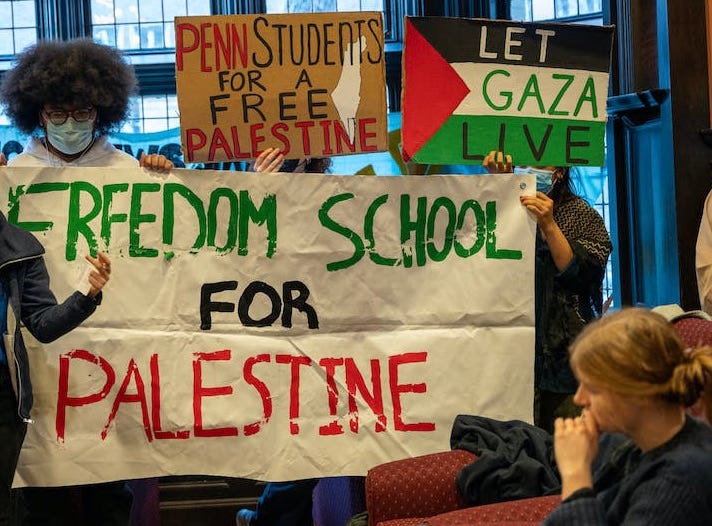
Saturday’s resignation of University of Pennsylvania President Liz Magill came after months of controversy — and a viral-video grilling of Magill in a congressional hearing — over allegations the school has become a hotbed of antisemitism.
While those allegations have been given widespread credence, a Stark Realities analysis of dozens of claimed antisemitic incidents at Penn finds that, apart from a small handful of cases, the great majority are merely instances in which Penn students, professors and guest speakers engage in political expression that proponents of the State of Israel strongly disagree with.
Conveniently, a catalogue of supposed examples of anti-Jew bigotry at Penn is laid out in a federal lawsuit filed last week against the school by two Jewish students who allege it “has transformed itself into an incubation lab for virulent anti-Jewish hatred, harassment, and discrimination.” In the suit, dual American-Israeli citizen Eyal Yakoby and American Jordan Davis seek “substantial damages in an amount to be determined at trial.”
For those wanting to look beyond what’s been said about Penn by grandstanding politicians, click-seeking news outlets and sensationalist social media posters, the 84-page complaint is a valuable resource. Unlike the sloppy court of public opinion, real courts demand a detailed presentation of specific allegations.
However, scrutiny of the Penn complaint — prepared by Philadelphia lawyer and Penn law grad Eric Shore and New York City law firm Kasowitz Benson Torres — confirms the campaign against the Philadelphia school is just the latest component a broader, long-running drive to censor political expression that’s critical of the State of Israel and sympathetic to Palestinians.
In support of that drive, conservatives who’d previously and rightfully bashed campus viewpoint censorship and crackdowns on flexibly-defined “hate speech” are among the most vocal advocates of installing a new censorship regime to keep students “safe” from anti-Israel rhetoric.
Political Views Wrongly Labelled as Antisemitic
Objective readers of the complaint will quickly note a number of red flags, starting with strident, vitriolic language referring to “rabidly antisemitic professors” and “Jew-hating” speakers who “spew antisemitic venom” by “bellowing into bullhorns to express their hatred for Israel.”
However, the complaint’s foremost flaw is its repeated assumption that various political concepts, views and slogans promoted by critics of Israel are inherently antisemitic or genocidal. This kind of attack isn’t unique to the Penn complaint; it’s constantly used
...This excerpt is provided for preview purposes. Full article content is available on the original publication.