Inside China’s Tech Turnaround
Deep Dives
Explore related topics with these Wikipedia articles, rewritten for enjoyable reading:
-
Made in China 2025
10 min read
The article directly references this industrial policy and its partial success. Understanding the full scope of this strategic plan—its ten priority sectors, specific targets, and international controversy—provides essential context for why China is investing so heavily in semiconductors and AI infrastructure.
-
Semiconductor industry in China
13 min read
The article repeatedly discusses China's push for domestic chip production, the Big Fund, and data centers running on locally made chips. This Wikipedia article covers the history of China's semiconductor ambitions, key companies like SMIC, and the technical gaps that explain why export controls matter.
-
Wassenaar Arrangement
11 min read
The article mentions U.S. and allied export controls on advanced chipmaking tools but doesn't explain the international framework behind them. The Wassenaar Arrangement is the multilateral export control regime that coordinates these restrictions on dual-use technologies, providing crucial context for understanding how semiconductor sanctions actually work.
After years of being called “uninvestable,” China’s $19 trillion stock market is back in global portfolios. The reason isn’t real estate or manufacturing. It’s tech.
AI, biotech, and semiconductors are pulling foreign investors back into the country, despite export bans and trade tension.
Market sentiment shift
Foreign inflows into Shanghai, Shenzhen, and Hong Kong exchanges are climbing again. Indices are hitting multi-year highs after Beijing’s monetary easing and a fragile tariff truce with Washington. Institutional investors see Chinese tech as undervalued compared to global peers, especially as companies double down on AI and automation.
Reuters reports that global funds are selectively returning to Chinese equities, focusing on sectors where domestic policy support meets long-term demand.
Domestic tech push
China is spending heavily to rebuild its tech base from within.
A new data-center complex in Qinghai runs on locally made chips, part of a state plan to expand computing capacity and reduce reliance on U.S. hardware.
Reuters shows how the project became a showcase for “Made in China” semiconductors.
Smartphone maker Honor announced a $10 billion plan to develop AI-driven devices, from PCs to wearables.
Meanwhile, the government launched the National AI Industry Investment Fund, worth about $8.2 billion, to finance chip design, computing infrastructure, and AI applications.
The third phase of the China Integrated Circuit Industry Investment Fund—the “Big Fund”—is channeling billions into domestic semiconductor production and materials.
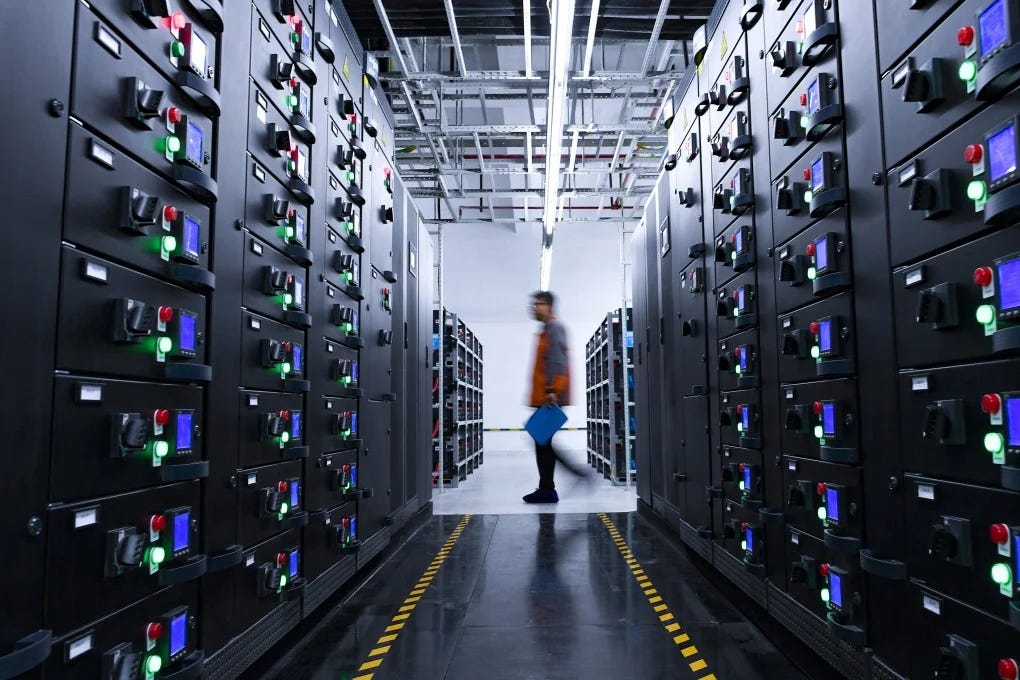
China’s data-center buildout
China is pouring money into new data centers across inland provinces. Local governments offer cheap land and energy, and Beijing wants more computing power outside the crowded coastal regions.
Bloomberg showed how projects in places like Gansu and Qinghai are turning into large AI hubs, powered by domestic chips and linked to major cities through high-speed fiber.
Reuters reported that the Qinghai complex is now a showcase for locally produced semiconductors. The site handles training workloads for state agencies and private tech firms.
This expansion matters for two reasons:
First, it reduces dependence on foreign hardware by scaling local chip demand.
Second, it supports the national strategy to spread AI infrastructure beyond Beijing and Shenzhen.
More capacity means lower costs for developers and a stronger ecosystem for AI startups.
Biotech partnerships
While the West debates decoupling, foreign pharma is doubling down on Chinese biotech.
AstraZeneca and Pfizer are signing licensing
...This excerpt is provided for preview purposes. Full article content is available on the original publication.