Scoop: The leaked protocol of the CDC-funded Hepatitis B vaccine trial in Guinea-Bissau. “This is another Tuskegee.”
We have an exclusive that I believe we are first to report, thanks to the HHS employees, past and present, who continue to bravely speak out. Help me amplify them by reading, sharing, and supporting this work. Thanks!
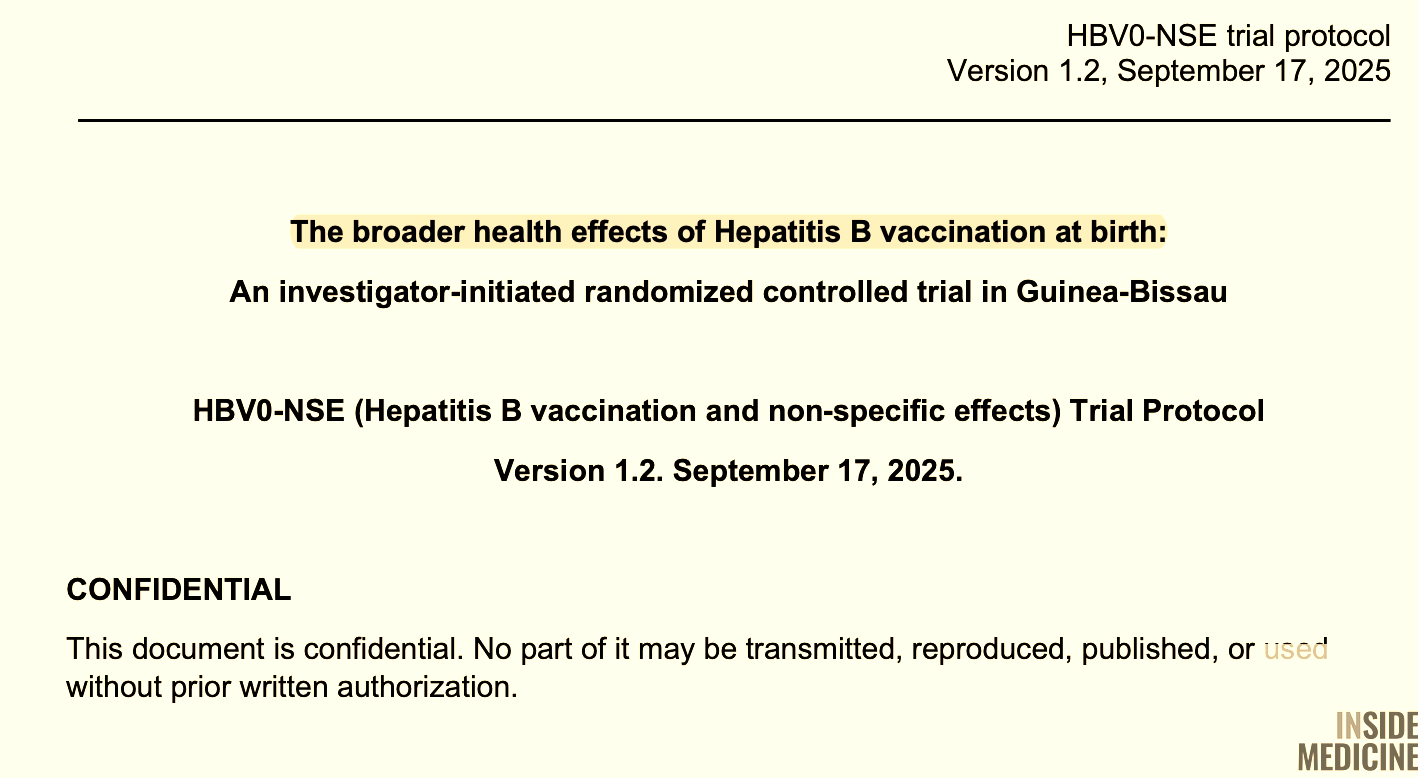
On December 18, the CDC announced a $1.6 million award, without competition, to Danish researchers that would fund an experiment on babies in Guinea-Bissau. The grant, the agency said in a Federal Register notice, would fund a “randomized controlled trial to assess the effects of neonatal Hepatitis B vaccination on early-life mortality, morbidity, and long-term developmental outcomes.” While the details were not public, what was known raised major ethical concerns among experts, especially since the WHO has recommended universal birth doses of the Hepatitis B vaccine since 2009, and GAVI (the vaccine alliance), has committed to funding that policy in Guinea-Bissau starting in 2027.
“This announcement has set alarm bells ringing in the global health community,” Professor Martin McKee, of the London School of Hygiene and Tropical Medicine, told The Guardian.
“Everything is wrong with awarding this unsolicited single-source grant, including the approval process, concerns about conflict of interest, and the dubious ethics of the research,” Dr. Robert Steinbrook, Health Research Group Director at Public Citizen said.
“I’m deeply skeptical that this is a good use of taxpayer money,” UC Berkeley epidemiologist Dr. Arthur Reingold told Science.
And that was before anyone had seen the full protocol.
Here, for the first time in public, obtained by Inside Medicine from a current CDC official granted anonymity to protect his job, is that protocol in its entirety.

What was known, what we’re learning. No placebo? No problem.
Very few people have seen this protocol before. Politico’s Sophie Gardner obtained it in December, but the document was not published at that time. Dr. Arthur Caplan told Gardner that the study was exploitative, later calling it “immoral.” HHS defended the study in multiple outlets, saying that the “highest scientific and ethical standards” would be ensured.
But the trial’s details—closely reviewed by Inside Medicine and Dr. David Boulware, Professor of Medicine at the University of Minnesota, and a veteran designer of high-quality randomized clinical trials—reveal a study that is likely even more flawed than experts had feared.
The “idea” behind this trial
...This excerpt is provided for preview purposes. Full article content is available on the original publication.