Academia's Putinverstehers
By Andrew Chakhoyan
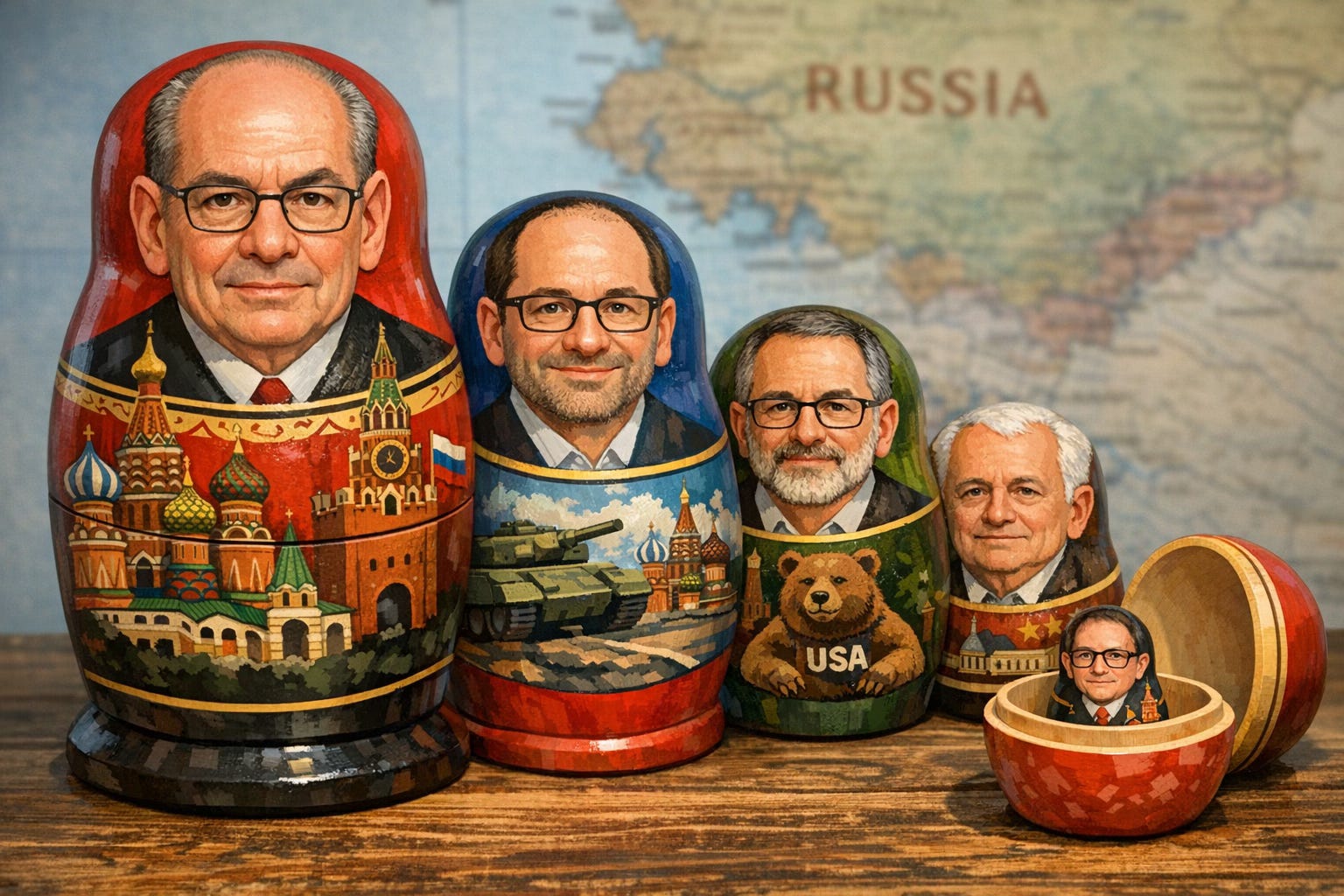
Three scholars walk into a bar and watch a country being invaded, live on TV. The constructivist says: “We must help.” The pragmatist says: “We should calculate costs and benefits.” The realist says: “Actually, this is NATO’s fault.”
It’s a joke, except that it isn’t. Every time Russia wages war, a familiar chorus rushes in to explain why the aggressor is not truly to blame, and why even mass atrocities must be “understood” rather than condemned. Responsibility is diluted, tired tropes and equivocation recited, and restraint is demanded not of the attacker, but of the victim. Don’t they know that appeasement is a path to a larger war, not a way to prevent it?
Armed with historical amnesia, Putinverstehers alike are keen to teach the masses that the safest path is to pressure the invaded country to accept occupation “for peace” and why, for the sake of “global stability,” it’s okay for Ichkerians, Georgians, and Ukrainians to have less freedom, less territory, and less dignity.
In Ukraine’s case, this advocacy implies that the world has no choice but to accept that Russia will, or even has the right to, murder Ukrainian children in the middle of the night and steal them. It’s Russia’s “sphere of influence.” Don’t you get it?
As an academic framing, Realpolitik in foreign policy is not the problem. It envisions states as self-interested actors competing for power and security in an international system. There is no global policeman, and even if America played one for a few decades, it was never a good idea.
Traditional realism emphasizes national interest, balances of power, and hard constraints over wishful thinking.1 It’s a helpful counterweight to the naive idealism of those who believe strongly-worded declarations can substitute for deterrence (see the Budapest Memorandum), and to neoconservative hubris (see: the Iraq war). Realism, properly applied, demands we perceive the world as it is, rather than as we’d like it to be.
But a perverted version of this canon applied exclusively to Russia—let’s call it Russialism—has emerged, proselytized by a particular set of Kremlin’s useful idiots. Their motivations and the tuning of their moral compasses remain a cosmic mystery. John Mearsheimer.2 Samuel Charap. Stephen Walt. Thomas Graham. Richard Sakwa. I’m sure you can add to this list. Different styles, same insufferable arrogance, intellectual malpractice, and immunity to evidence.
Their
...This excerpt is provided for preview purposes. Full article content is available on the original publication.