Understanding and Modeling NIH Research Grant Success Rates and the Impact of “Multiyear Funding”
This is a guest post from Jeremy M. Berg, who is currently Professor of Computational and Systems Biology at the University of Pittsburgh. Berg received his B.S., M.S., and Ph.D. degrees in chemistry. He started as an Assistant Professor of Chemistry at Johns Hopkins University in 1986. He moved to the Johns Hopkins School of Medicine as Director of the Department of Biophysics and Biophysical Chemistry in 1990. In 2003, he became Director of the National Institute of General Medical Sciences (NIGMS) at NIH. He served at NIGMS until July 2011 when he moved with his wife Wendie Berg, M.D., Ph.D., a leading breast imaging researcher, to the University of Pittsburgh. Berg served as Editor-in-Chief of the Science family of journals from 2016-2019.
He has some thoughts about how often proposals succeed, and what will happen with the current move towards funding multi-year grants upfront rather than year-by-year.
Understanding and Modeling NIH Research Grant Success Rates and the Impact of “Multiyear” Funding
The National Institutes of Health funds the majority of the biomedical research in the United States. Perhaps the two most important parameters regarding NIH funding for researchers are the size of the NIH appropriation and the grant success rate (the probability of having a grant proposal funded). How are these two parameters related?
The NIH appropriation (in nominal dollars) over time is shown here.
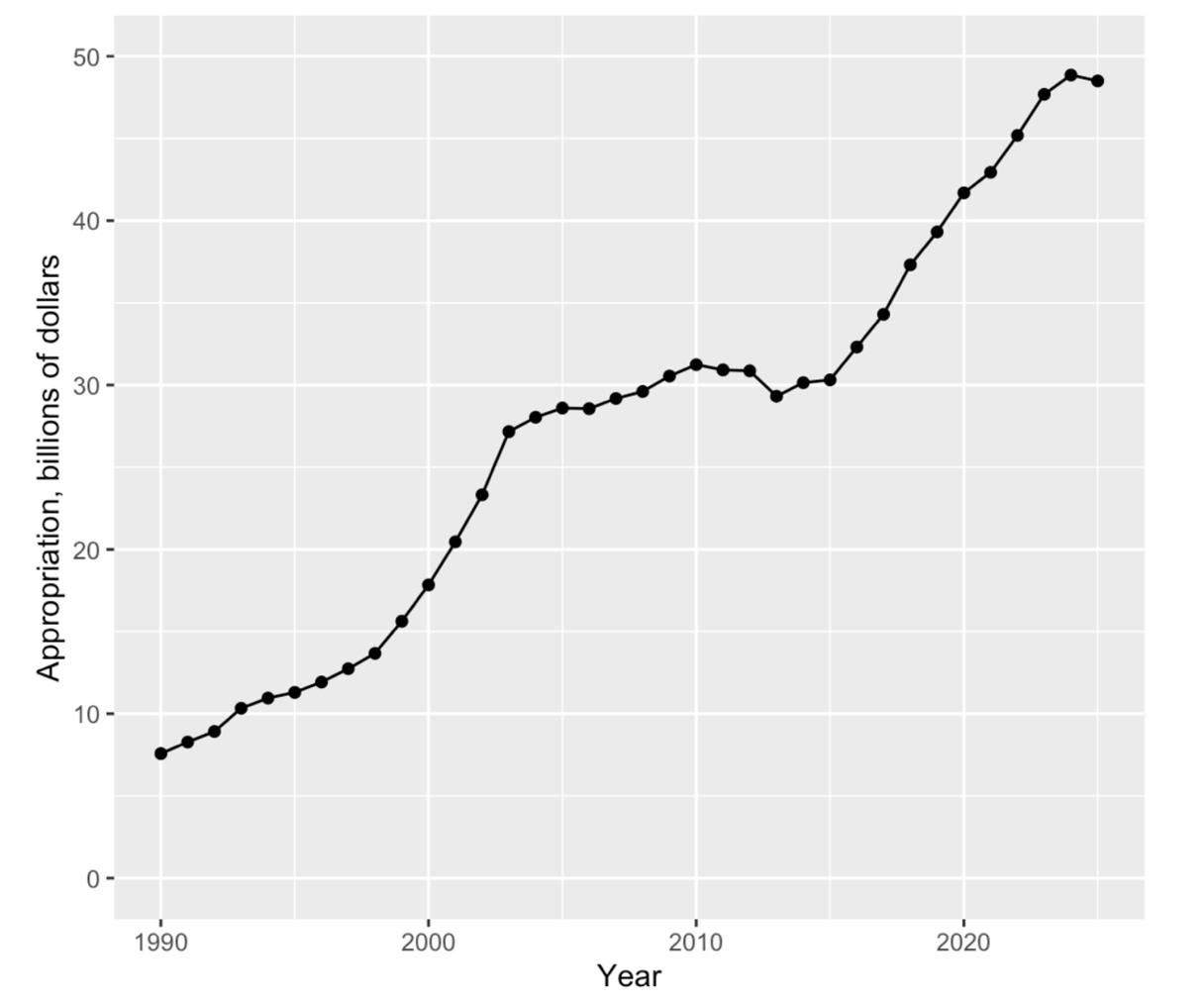
This graph reveals the NIH budget “doubling” from 1998 to 2003, followed by a period of relatively flat funding, followed by steady, but more modest, increases starting in 2016.
For comparison, the success rates for Research Project Grants are shown here:
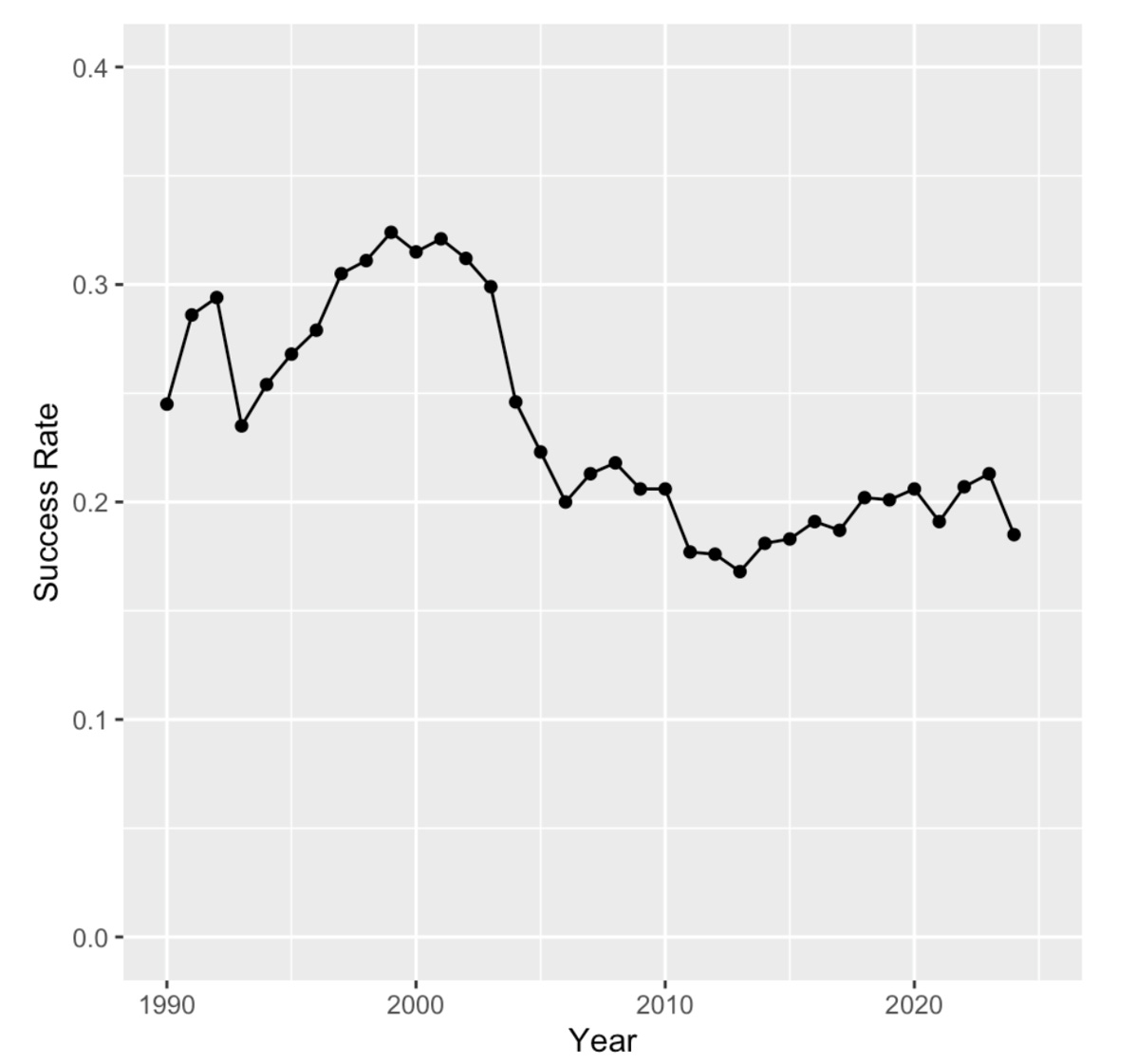
The success rate is defined as the number of competing grant applications funded divided by the number of applications reviewed in the same fiscal year.
The success rate did increase somewhat during the “doubling” but then it plummeted from > 0.30 (30%) to at or below 0.2 (20%) within a couple of years after the doubling ended. It has remained close to this level ever since, even with the increases in appropriation over the past decade.
Overall, these two parameters are negatively correlated with a Pearson correlation coefficient of -0.69.
Because NIH has increased grant sizes to correct for inflation (at
...This excerpt is provided for preview purposes. Full article content is available on the original publication.